Special Statement:
This article is solely focused on conducting research on related industries and foreign markets. It does not make recommendations for any specific product nor does it comment on any domestic policies.
The legality of the product mentioned in the article is only applicable in the local overseas area. Domestic readers should take note and strictly abide by Chinese laws and regulations.
3. This article is not intended as an investment or consumption advice.
This article is prohibited for minors to read.
On January 10th, 2023, recreational marijuana sales opened for adults 21 years and older in Connecticut. The sales began at the state's seven existing medical marijuana dispensaries. This came less than two years after Governor Ned Lamont signed legislation making Connecticut a legal marijuana state.
It is expected that up to 40 pharmacies and dozens of other cannabis-related businesses will ultimately open in Connecticut by the end of this year.
Today is historic, but the real story is about the benefits of changing lives and communities," said Adam Wood, president of the Connecticut Cannabis Industry Association in a statement. He estimates that this new industry will create over 10,000 job opportunities in the coming years and generate billions of dollars in new revenue, which will help to benefit communities most affected by the war on drugs.
On Tuesday, Democratic lawmaker Ramonte stated that one of the goals of legislation legalizing recreational marijuana is to create a regulated and safer product for consumers. Another aspect of the law allows for the expungement of convictions for low-level marijuana crimes, many of which are automatically cleared. Officials report that since the start of the new year, nearly 44,000 such convictions have been expunged.
Today marks a turning point in the unjust consequences of the war on drugs, as the most noteworthy development is the emergence of an unregulated underground market for legal substitutes to marijuana," said Lamont in a statement.
On January 10th at 10am, the sale of recreational marijuana was allowed to begin. State-approved shops in Branford, Meriden, Montville, New Haven, Newington, Stamford, and Willimantic are expected to open to the public on the first day. Two additional approved pharmacies in Danbury and Torrington will open later.
On Tuesday, January 10, 2023, customers lined up outside The Botanist in Montville, Connecticut to purchase cannabis products, marking the first day of recreational cannabis sales in the state. Seven existing medical cannabis locations have been granted mixed licenses to sell recreational cannabis to adults aged 21 and over, and are open to the public. It is expected that up to 40 dispensaries will open statewide by the end of the year.
In Monteville, local state legislators and the mayor attended the ribbon-cutting ceremony of The Botanist. Prior to the start of recreational sales, a steady stream of medical marijuana patients stopped by to pick up their orders. Staff folded free t-shirts inside heated tents, ready to assist customers with placing orders at the sales kiosks.
Lynn Goldstein, a 60-year-old from Norwich, was the first customer in line at the Montreal dispensary. She stated that she has been using medical marijuana for chronic pain since 2011 and is pleased that recreational sales are now legal, but also has some concerns.
I am genuinely concerned about young people because they do not know how to handle themselves and are more likely to drink and drive, which makes it difficult for police to establish the facts," she said.
Goldstein added that she didn't intend to be the first person in line, but she was glad she was. She received a goodie bag that included a $250 vaporizer.
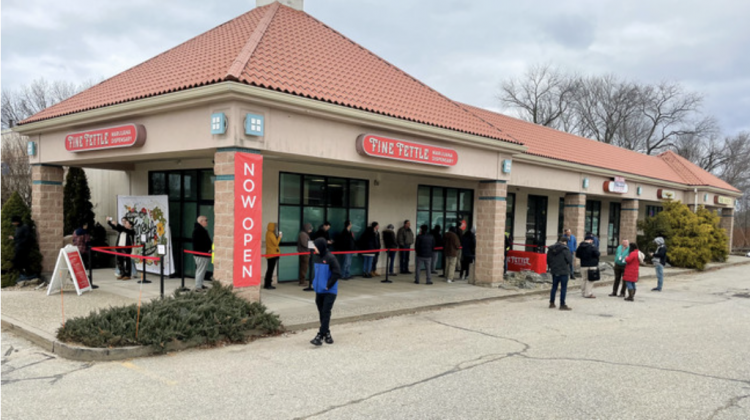
Around 20 people were seen lining up before the opening of Fine Fettle pharmacy in Willimantic. The pharmacy has implemented a policy requiring customers to order online and arrive at the store at a designated time to avoid long queues.
On January 10, 2023, customers were seen lining up outside Fine Fettle marijuana dispensary in Willimantic, Connecticut, waiting for the legal sale of recreational marijuana in the state. It is estimated that by the end of this year, up to 40 dispensaries and dozens of other marijuana-related businesses will ultimately open in Connecticut.
Samuel Gabbey, a 32-year-old parcel delivery operations manager from Mansfield, has been waiting for this day for many years. He recommends that people should instead buy from legal stores to avoid purchasing from strangers and alleviate concerns over unknown substances added to marijuana.
Finally, there will come a day when we can all come here, get what we want, and go home without worrying about the police or anything," he said. "So today is a good day for the people of Connecticut.
It is unclear if the novelty of marijuana legalization will have an impact on consumers in Connecticut, given that it began retail sales last year in the neighboring state of Massachusetts and more recently in Rhode Island and New York.
In the past decade, 21 states have legalized adult recreational marijuana use, despite it remaining illegal under federal law. Since last November when Maryland and Missouri voters approved legalization, marijuana advocates have been pushing similar efforts in other parts of the United States, including Ohio and Oklahoma.
According to data from the National Conference of State Legislatures, as of February 3, 2022, 37 states, three territories, and the District of Columbia allow the use of marijuana products for medical purposes.
On Tuesday, a "hybrid" medical and recreational marijuana retail store in Connecticut prepared for a large crowd.
Kate Nelson, Senior Vice President of Acreage Holdings in the Midwest and Northwest regions, which owns the Botanist brand, stated that the Montville factory receives around 200 to 300 medical marijuana clients per day. She predicted that sales would increase by 150% in the first week of recreational sales; however, she acknowledges that this growth may level off over time.
The company's second location in Connecticut will be located in Danbury and is expected to open in the coming weeks after final approval from local authorities.
I believe that even before the launch of the 40 operators, we will begin to see less excitement about new developments and more focus on how the current state will evolve," said Nielsen. "There are other adult-use states near our region, so this will really be a priority for us, especially in Connecticut, to ensure that the adult-use program has the products it needs and that we can support the industry... to ensure Connecticut is prepared for competition in the market.
The initial sales limit for marijuana in Connecticut will be set at a quarter of an ounce (7 grams) of marijuana flower or an equivalent amount, in order to ensure adequate supply for medical marijuana patients. Customers may purchase different items together to make up for the quarter of an ounce limit. The state's Department of Consumer Protection plans to closely monitor retail sales and manufacturing supply in order to determine when this amount can be increased in the future.
Disclaimer
This article is provided solely for professional research, industry discussion, and informational purposes. Any references to brands, companies, products, technologies, or policies are made for factual reporting and analytical purposes only, and do not constitute endorsement, recommendation, promotion, or advertising by 2Firsts.
Nicotine-containing products, including but not limited to cigarettes, e-cigarettes, heated tobacco products, and nicotine pouches, carry significant health risks. Readers are responsible for complying with all applicable laws and regulations in their respective jurisdictions, including age restrictions and access limitations.
The information contained in this article should not be regarded as investment, legal, medical, regulatory, or commercial advice. While 2Firsts strives to ensure the accuracy and reliability of its content, it does not assume liability for any direct or indirect loss arising from errors, omissions, inaccuracies, or reliance on the information contained herein.
This article is not intended for individuals below the legal age for accessing tobacco or nicotine-related information in their jurisdiction.
Copyright Notice
This article is either original content produced by 2Firsts or content reproduced, translated, summarized, or adapted from third-party sources with attribution where applicable. The intellectual property rights of the original content remain with 2Firsts or the respective original rights holders.
No individual or organization may copy, reproduce, distribute, republish, modify, translate, or otherwise use this content without prior authorization. Any unauthorized use may result in legal action.
For copyright-related inquiries, corrections, or removal requests, please contact: info@2firsts.com.
AI-Assisted Translation and Editing Notice
Portions of this article may have been translated, edited, or reviewed with the assistance of artificial intelligence tools to improve efficiency and readability. Due to the limitations of AI-assisted translation and editing, discrepancies, omissions, or inaccuracies may exist when compared with the original source.
Where applicable, readers are advised to refer to the original source for the most complete and accurate information. If you identify any errors or believe that any content infringes upon your rights, please contact us at info@2firsts.com, and we will review and address the matter promptly.