Key Points
- Alabama and Oklahoma showed no significant association between directory publication and overall e-cigarette nicotine sales or product availability; Louisiana sales fell an average 38.29%, but the decline was not sustained.
- Louisiana product availability fell an average 53.55%; sales of nontobacco-flavored disposables declined 71.55%, while menthol-prefilled cartridge sales increased 50.24%.
- The study said the increase in Louisiana menthol-prefilled cartridge sales was driven largely by R.J. Reynolds Vapor Co.'s Vuse Alto.
- By April 2025, unlisted products accounted for 92.1% of e-cigarette nicotine sales in Alabama, 53.6% in Oklahoma and 52.3% in Louisiana.
2Firsts
September 17, 2026
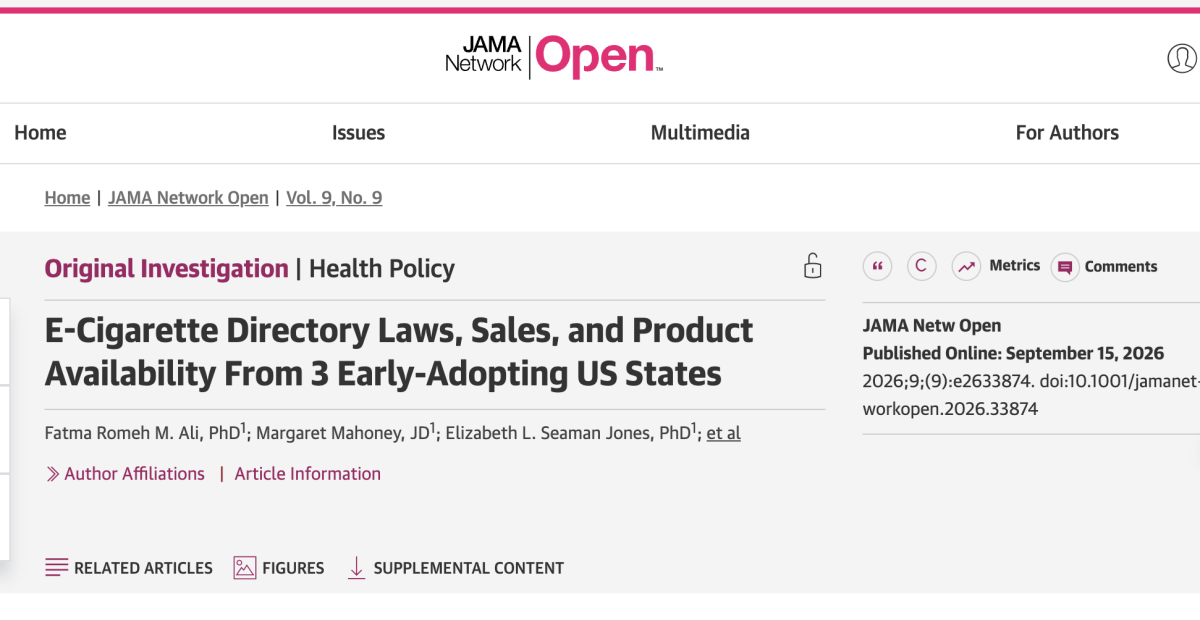
According to a study published in JAMA Network Open on September 15, 2026, Alabama, Oklahoma and Louisiana — the first three U.S. states to implement e-cigarette directory laws — saw no sustained decline in e-cigarette sales following directory implementation. Researchers detected no significant association between directory publication and overall e-cigarette nicotine sales or product availability in Alabama or Oklahoma, while Louisiana experienced a significant initial sales decline followed by a rebound.
No Sustained Sales Decline Across Three Early-Adopting States
The study was conducted by CDC Foundation researchers Fatma Romeh M. Ali, Margaret Mahoney, Elizabeth L. Seaman Jones, Michael A. Tynan and Kristy Marynak. It analyzed 1,904 state-month observations from January 2021 through April 2025, comparing each of the three states with synthetic controls constructed from 31 states without operating directories.
The primary sales measure was per-capita e-cigarette nicotine sales, calculated using units sold, e-liquid volume and nicotine concentration. Product availability was measured by the number of distinct UPCs sold each month.
Alabama published its directory in May 2022. Average descriptive per-capita nicotine sales increased from 47.8 mg before publication to 89.6 mg afterward. Disposables' share of sales rose from 75.6% to 90.2%, while product availability increased from 910 to 1,414 products. The statistical analysis, however, found no significant association between directory publication and overall sales or product availability.
Oklahoma implemented its directory in October 2023. Average descriptive per-capita nicotine sales increased from 45.0 mg to 59.3 mg, the disposable share rose from 53.0% to 66.4%, and product availability increased from 981 to 1,059 products. The study likewise detected no significant overall association with sales or product availability.
Louisiana Sales Fell Before Rebounding as Product Availability Remained Lower
Louisiana published its directory in November 2023 and recorded the largest post-policy market changes among the three states.
The study estimated that per-capita e-cigarette nicotine sales were on average 38.29% below the synthetic control following directory publication. Sales were 19.46% lower immediately after publication, with the gap reaching 63.43% in July 2024.
Sales then rebounded. They remained 43.01% below the synthetic control in October 2024, but the difference became statistically nonsignificant thereafter. By April 2025, the estimated difference was positive 0.23% and statistically nonsignificant.
Observed per-capita nicotine sales fell from 48.2 mg in June 2023 to 42.1 mg in October 2023 and reached 16.9 mg in June 2024 before recovering to 44.9 mg in April 2025.
Product availability followed a more persistent decline. Directory publication was associated with an average 53.55% reduction in product availability. The number of products sold was 63.07% below the synthetic control in July 2024, 61.23% lower in October 2024 and still 47.89% lower in April 2025, when the difference remained statistically significant.
The actual number of products available fell from 1,421 to 474 before recovering to 742.
Disposable Sales Declined as Vuse Alto Drove Menthol Cartridge Growth
Louisiana's category-level data showed a substantial shift in product mix.
Sales of nontobacco-flavored disposables declined an average 71.55%, while their availability fell 64.19%. Overall disposable sales declined 74.11%.
At the same time, prefilled cartridge sales increased 41.45%, while menthol-prefilled cartridge sales rose 50.24%.
The researchers said the increase in menthol-prefilled cartridge sales was driven largely by Vuse Alto, made by R.J. Reynolds Vapor Co., and stated that the relevant products lacked FDA marketing authorization.
Prefilled cartridges' share of Louisiana sales rose from 29.5% to as high as 91.6%, while menthol's share increased from 22.4% to 73.2%. As disposable sales later recovered, those shares fell to 33.0% and 27.1%, respectively, by April 2025.
In its discussion, the paper said rising menthol-prefilled cartridge sales, driven primarily by Vuse Alto, partially offset the initial decline in disposable sales. By April 2025, menthol cartridge sales remained elevated while flavored disposable sales had rebounded.
Unlisted Products Still Accounted for More Than Half of Sales
The researchers also classified products according to whether they appeared in each state's directory.
By April 2025, unlisted products accounted for 92.1% of per-capita e-cigarette nicotine sales in Alabama, 53.6% in Oklahoma and 52.3% in Louisiana. Listed-product sales were largely concentrated in nontobacco-flavored prefilled cartridges, particularly menthol products.
Trends differed by state. Unlisted-product sales remained dominant and continued to increase after directory publication in Alabama. In Oklahoma, unlisted sales were initially stable, then declined before rebounding. Louisiana saw a sharp initial decline followed by a gradual recovery.
The researchers classified products using state directories accessed in July 2026 because complete historical records showing when individual products were first listed were unavailable. Some classifications were also conducted at the brand rather than individual-product level.
The authors said these factors may have overstated listed-product sales, making the estimates of unlisted-product sales conservative.
Sixteen States Have Enacted Vape Directory Laws
As of June 2026, 16 U.S. states had enacted laws establishing public e-cigarette directories or registries, with implementation dates ranging from 2022 through 2027. Similar legislation had been proposed in nearly every other state.
Alabama, Oklahoma and Louisiana permit sales only of products listed in their directories, but submission requirements, product definitions, fees and enforcement differ.
Alabama and Louisiana require manufacturers to provide evidence of an FDA marketing-granted order, evidence that a product was on the market by August 8, 2016 with a PMTA submitted by September 9, 2020, or an attestation that an appeal of a marketing denial remains pending. Oklahoma requires an attestation that products either received FDA marketing authorization or met the applicable PMTA submission deadlines.
Alabama charges manufacturers a $2,000 initial certification fee and $500 annual renewal fee. Louisiana charges $100 per product annually. Both impose potential $1,000 daily manufacturer fines for sales of unlisted products, while Oklahoma imposes no comparable fees or penalties.
Louisiana's directory was also suspended during litigation from January 24 through March 17, 2024.
The paper said states face difficulties independently verifying manufacturer claims because no comprehensive public record shows when individual products entered the market and the FDA does not publish complete details on pending PMTAs, marketing denial orders or appeals.
Study Excludes Online and Vape-Shop Sales
The study used Circana Multi-Outlet+ and convenience-store scanner data covering food, drug, mass merchandise, club, dollar and convenience stores. Participating retailers account for about 90% of U.S. consumer packaged-goods dollar sales, but the dataset does not capture online retailers or tobacco specialty stores.
The models also controlled for e-cigarette taxes, unemployment, tobacco-control funding, smoking-cessation coverage, smoke-free laws and COVID-19 cases.
Louisiana tripled its e-cigarette excise tax from $0.05 per milliliter to $0.15 per milliliter in July 2023, four months before directory publication. The study incorporated that tax change into its controls.
The authors said limited information about enforcement practices made it difficult to determine whether Louisiana's initial decline resulted from enforcement, outreach, shifts to sales channels not captured by the data or other factors.
The paper concluded that directory laws in the three early-adopting states were not associated with a sustained reduction in sales of illegally marketed e-cigarettes. The authors also argued that reductions in product availability without sustained sales declines could primarily benefit major tobacco companies by reducing competition; that assessment represents the authors' interpretation of the findings.
The study was supported by the Bloomberg Initiative to Reduce Tobacco Use through the CDC Foundation with a grant from Bloomberg Philanthropies. The paper states that the funder had no role in the study's design, data collection or analysis, interpretation, manuscript preparation or publication decision. The authors reported no conflicts of interest.
Follow 2Firsts for timely updates on global tobacco and nicotine regulations, market developments and industry trends.
Cover Image: JAMA
Disclaimer
This article is provided solely for professional research, industry discussion, and informational purposes. Any references to brands, companies, products, technologies, or policies are made for factual reporting and analytical purposes only, and do not constitute endorsement, recommendation, promotion, or advertising by 2Firsts.
Nicotine-containing products, including but not limited to cigarettes, e-cigarettes, heated tobacco products, and nicotine pouches, carry significant health risks. Readers are responsible for complying with all applicable laws and regulations in their respective jurisdictions, including age restrictions and access limitations.
The information contained in this article should not be regarded as investment, legal, medical, regulatory, or commercial advice. While 2Firsts strives to ensure the accuracy and reliability of its content, it does not assume liability for any direct or indirect loss arising from errors, omissions, inaccuracies, or reliance on the information contained herein.
This article is not intended for individuals below the legal age for accessing tobacco or nicotine-related information in their jurisdiction.
Copyright Notice
This article is either original content produced by 2Firsts or content reproduced, translated, summarized, or adapted from third-party sources with attribution where applicable. The intellectual property rights of the original content remain with 2Firsts or the respective original rights holders.
No individual or organization may copy, reproduce, distribute, republish, modify, translate, or otherwise use this content without prior authorization. Any unauthorized use may result in legal action.
For copyright-related inquiries, corrections, or removal requests, please contact: info@2firsts.com.
AI-Assisted Translation and Editing Notice
Portions of this article may have been translated, edited, or reviewed with the assistance of artificial intelligence tools to improve efficiency and readability. Due to the limitations of AI-assisted translation and editing, discrepancies, omissions, or inaccuracies may exist when compared with the original source.
Where applicable, readers are advised to refer to the original source for the most complete and accurate information. If you identify any errors or believe that any content infringes upon your rights, please contact us at info@2firsts.com, and we will review and address the matter promptly.