Kent Council Discusses Proposal for Medical Marijuana Dispensary

Aug.16.2022
Kent Council Discusses Proposal for Medical Marijuana Dispensary
The Kent planning committee is discussing a proposal for a medical marijuana dispensary on 331 E. Main St.

The Kent Planning Committee will discuss a proposal to establish a medical marijuana dispensary in the city once again.


The committee will convene at 7 pm on Tuesday evening to discuss a proposed pharmacy at 331 E. Main St in Kent County. The meeting will be held in the basement of the Kent Fire Department located at 320 S. DePeyster St.


The current company, Slightly Toasted, submitted a request for site planning and conditional zoning to the city's planning commission in January.


However, after considering input from neighbors and determining that additional details were needed in the on-site plan before voting, the expert panel did not vote.


The owner of Slightly Toasted has stated that if the pharmacy receives approval from the city government and obtains a permit from the state of Ohio, the e-cigarette store will relocate.


However, neighbors of the proposed medical marijuana dispensary are expressing concerns about its proximity to residential areas, the entrance of Kent State University, fraternity houses, and the municipal court.


Statement:


This article is compiled from third-party information sources and is intended solely for industry exchange and learning purposes.


This article does not represent the views of 2FIRSTS, and 2FIRSTS cannot confirm the authenticity and accuracy of the content. The translation of this article is only intended for industry-related communication and research purposes.


Due to limitations in the level of translation, the translated article may not fully express the same meaning as the original. Please refer to the original article for accuracy.


2FIRSTS maintains complete alignment with the Chinese government regarding any domestic, Hong Kong, Macao, Taiwan, or foreign-related statements and positions.


The ownership of the copyright for the compiled information belongs to the original media and authors. If there is any infringement, please contact us for deletion.


Disclaimer

This article is provided solely for professional research, industry discussion, and informational purposes. Any references to brands, companies, products, technologies, or policies are made for factual reporting and analytical purposes only, and do not constitute endorsement, recommendation, promotion, or advertising by 2Firsts.

Nicotine-containing products, including but not limited to cigarettes, e-cigarettes, heated tobacco products, and nicotine pouches, carry significant health risks. Readers are responsible for complying with all applicable laws and regulations in their respective jurisdictions, including age restrictions and access limitations.

The information contained in this article should not be regarded as investment, legal, medical, regulatory, or commercial advice. While 2Firsts strives to ensure the accuracy and reliability of its content, it does not assume liability for any direct or indirect loss arising from errors, omissions, inaccuracies, or reliance on the information contained herein.

This article is not intended for individuals below the legal age for accessing tobacco or nicotine-related information in their jurisdiction.


Copyright Notice

This article is either original content produced by 2Firsts or content reproduced, translated, summarized, or adapted from third-party sources with attribution where applicable. The intellectual property rights of the original content remain with 2Firsts or the respective original rights holders.

No individual or organization may copy, reproduce, distribute, republish, modify, translate, or otherwise use this content without prior authorization. Any unauthorized use may result in legal action.

For copyright-related inquiries, corrections, or removal requests, please contact: info@2firsts.com.


AI-Assisted Translation and Editing Notice

Portions of this article may have been translated, edited, or reviewed with the assistance of artificial intelligence tools to improve efficiency and readability. Due to the limitations of AI-assisted translation and editing, discrepancies, omissions, or inaccuracies may exist when compared with the original source.

Where applicable, readers are advised to refer to the original source for the most complete and accurate information. If you identify any errors or believe that any content infringes upon your rights, please contact us at info@2firsts.com, and we will review and address the matter promptly.

Philippines Mandates Safety Certification for Nicotine Pouches, Gives Industry 12 Months to Comply
The Philippines Department of Trade and Industry has placed nicotine pouches under mandatory product certification through Department Administrative Order No. 26-07, Series of 2026. Nicotine pouches must obtain a Philippine Standard, or PS, license before they can be manufactured, imported, packed, distributed or sold in the country. The regime requires testing for nicotine content, pH and water activity, while packaging must disclose nicotine strength, ingredients, allergens, batch information, the PS certification mark and prescribed health warnings. Existing market participants have a 12-month transition period to comply.
Regulations
Oct.12
EU Commission Clarifies Vaping, Smokeless Nicotine Use in Proposed Cardiovascular Checks
The European Commission has clarified to 2Firsts that its proposed cardiovascular health checks would assess smoking, vaping and the use of smokeless nicotine products as part of patients’ medical histories. The Commission also said Member States may organise additional checks within their healthcare systems. In the same response, it pointed to JRC research on e-cigarettes, heated tobacco products and nicotine pouches that has fed into the evaluation of EU tobacco legislation.
Nov.09
US ITC Judge Finds Glas Infringed Two JUUL Vape Patents, Recommends Restrictions on Related Imports——Glas Received FDA Marketing Authorization for Four Vape Pods in May 2026; Proposed Restrictions Remain Under Commission Review
A U.S. International Trade Commission (USITC) administrative law judge issued an initial determination on October 20, 2026, finding that certain Glas vaping devices, cartridges and components infringed 12 claims across two patents asserted by JUUL, constituting a violation of Section 337 of the Tariff Act of 1930. The judge recommended a limited exclusion order and a cease and desist order against the Glas respondents. Five months earlier, the FDA authorized four Glas e-cigarette pods, including mango, blueberry and two menthol variants. The patent investigation concerns device and cartridge structures and is separate from FDA premarket review. The proposed import restrictions have not become final, and their product-level scope remains unresolved.
company
Nov.05
Italian Financial Police Seize 4.3 Million E-Cigarettes and Smoking Accessories; 28 Reported to Judicial Authorities Across Operations
Italy's Guardia di Finanza announced on October 28 that officers in Latina province had seized approximately 4.3 million e-cigarettes and smoking accessories at an unauthorized warehouse in an operation involving restrictions on the possession and sale of tobacco-related products. Another 300,000 suspected counterfeit or unsafe items were confiscated during separate inspections, bringing total seizures across the operations to more than 4.6 million products. Twenty-eight people were reported to judicial authorities over suspected smuggling and counterfeiting offenses. Officials did not disclose separate vape quantities, the value of the merchandise or alleged violations associated with individual brands.
Enforcement
Oct.29
Special report|Indonesia's Vape Industry Has 200 Manufacturers and $1.7 Billion in Investment. Could a Regulatory Divide Derail Its Rise as the World's No. 2 Manufacturing Hub After Shenzhen?
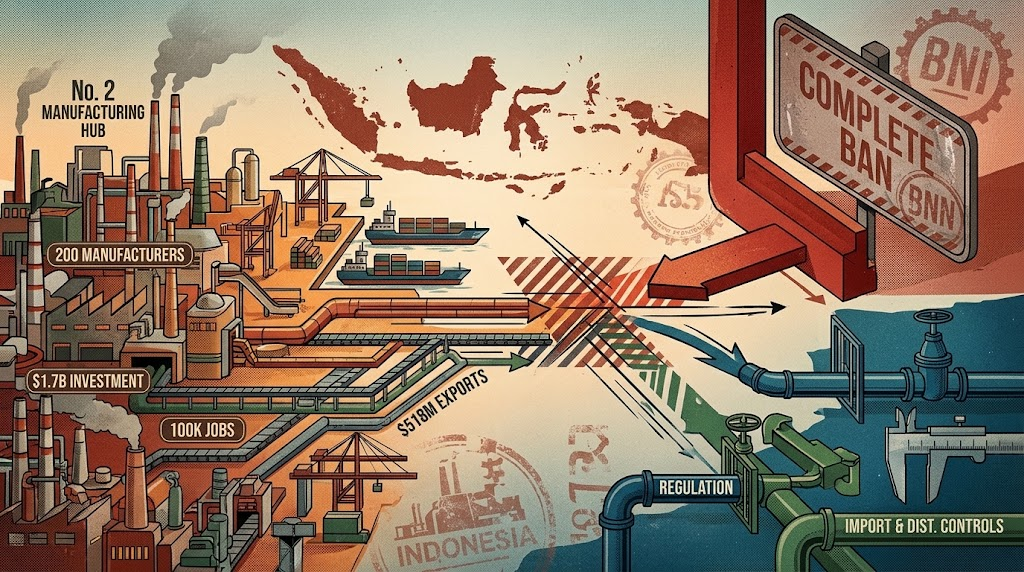
Indonesia's Ministry of Industry said at a November 3, 2026, policy forum that the country has about 200 electronic cigarette companies, Rp31 trillion (approximately $1.71 billion) in cumulative industry investment and around 100,000 jobs across the supply chain. The National Narcotics Agency is seeking a comprehensive ban on vape use and circulation, while the industry ministry favors tighter import, product-standard and distribution controls. Indonesia exported approximately $518 million in vaping products in 2025, and Chinese manufacturers including Smoore, GEEKVAPE and Jinjia Group have established local operations. An international logistics specialist interviewed by 2Firsts said more Chinese vape companies began production in Indonesia from the second half of 2025, accompanied by increased shipments of manufacturing equipment and investment in logistics facilities. The regulatory debate comes as Indonesia expands its role in international vaping manufacturing.
Special Report
Nov.05
Special Report | How Capital Is Reassessing the Global Tobacco and Modern Nicotine Industry: Lessons from a New York Forum
Capital is reassessing the global tobacco and modern nicotine industry as heated tobacco, vaping and nicotine pouches reshape demand, profitability and regulation. At the 2026 New Approaches Summit in New York, investors and analysts examined whether smoke-free growth can sustain earnings, how regulation shapes startup value, and whether shareholder engagement can be more effective than divestment. The debate points to a broader shift: tobacco transition is increasingly becoming a capital-allocation, governance and valuation question.
Capital Markets
Oct.05