Key Points
- Two China Tobacco Hubei patents use dynamic membranes and gradient particle structures to control nicotine release at different stages of pouch use.
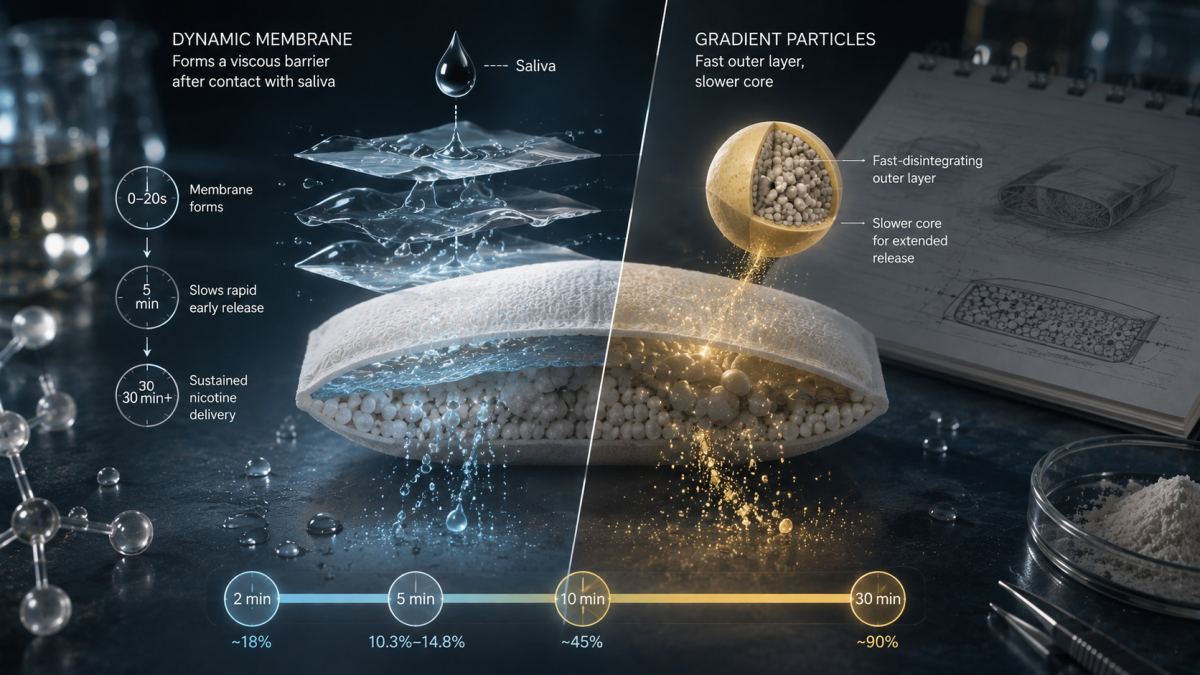
- The dynamic-membrane system forms a viscous barrier within 20 seconds of exposure to saliva, with a cumulative dissolution time of at least 30 minutes.
- Patent examples released 10.3%-14.8% of nicotine within five minutes and 90.2%-92.7% by 30 minutes, compared with 58.4%-74.6% at five minutes for controls that failed to form an effective barrier.
- The gradient particles contain an outer layer and a core, with the outer layer designed to disintegrate two to five times faster than the core.
- In Gradient Particle Example 1, cumulative nicotine release reached 18% at two minutes, 45% at 10 minutes and 90% at 30 minutes.
- The filings primarily report structural designs and in-vitro dissolution data and do not provide human pharmacokinetic results.
2Firsts
September 3, 2026
According to public records from China’s National Intellectual Property Administration (CNIPA), China Tobacco Hubei Industrial Co., Ltd. disclosed several oral nicotine-related patent applications in August 2026, including two that focus specifically on controlling how nicotine is released from pouches over time.
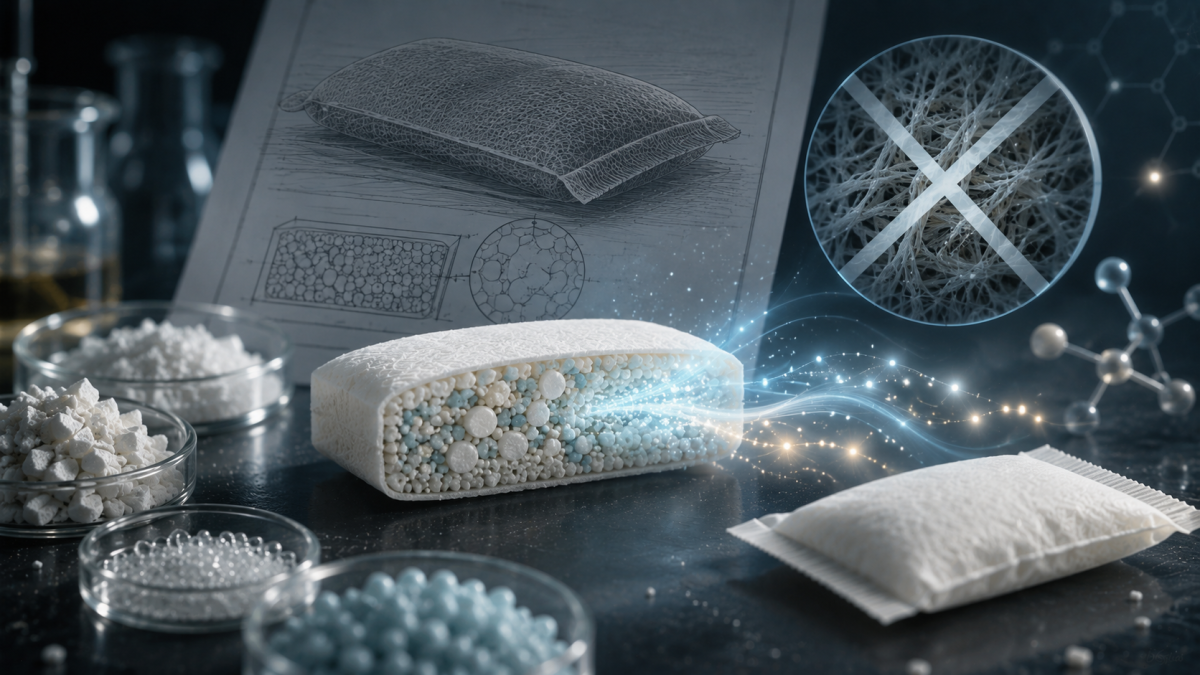
One creates a dynamic membrane inside the pouch after exposure to saliva to restrict rapid early release. The other builds different release rates into individual nicotine particles, combining a faster outer layer with a slower core.
Patent | Applicant | Publication No. | Publication date | Core technology |
Dynamic membrane controlled-release nicotine pouch | China Tobacco Hubei Industrial Co., Ltd. | CN122515501A | August 7, 2026 | Saliva-triggered viscous membrane |
Gradient controlled-release nicotine particles and pouch | China Tobacco Hubei Industrial Co., Ltd.; Hubei Xinye Tobacco Sheet Development Co., Ltd. | CN122604103A | August 21, 2026 | Faster outer layer and slower particle core |
A dynamic membrane forms after the pouch is exposed to saliva
The dynamic-membrane patent places the release-control mechanism inside the pouch contents.
According to the filing, the control agent absorbs water and swells within 20 seconds of contact with water or saliva, forming a viscous, paste-like membrane inside the saliva-permeable pouch.
Nicotine must pass through this barrier as it moves out of the pouch, meaning the membrane’s dissolution rate becomes one factor determining the nicotine release rate.
The patent specifies a dynamic viscosity of at least 20,000 mPa·s and a cumulative dissolution time of at least 30 minutes.
Rather than relying on a permanent barrier pre-applied to the pouch material, the filing describes a repeated “formation-dissolution-reformation” process as saliva continues interacting with the contents.
Potential control agents include hydroxypropyl methylcellulose, hydroxypropyl cellulose, carboxymethyl cellulose and sodium alginate, as well as natural gums and pregelatinized starch. The filing also emphasizes matching the viscosity of the control agent with the pore characteristics of the pouch material.
Five-minute release falls to around 10%-15% in patent examples
In the patent’s in-vitro dissolution testing, three examples showed cumulative nicotine release of 14.8%, 10.3% and 12.6%, respectively, after five minutes.
At 10 minutes, the figures reached 38.2%, 34.7% and 36.1%, before rising above 90% for all three formulations at 30 minutes.
Sample | 5 min | 10 min | 30 min | 60 min |
Example 1 | 14.8% | 38.2% | 92.7% | 99.1% |
Example 2 | 10.3% | 34.7% | 90.2% | 98.4% |
Example 3 | 12.6% | 36.1% | 91.8% | 98.7% |
By comparison, a control using a lower-viscosity release-control agent had already released 62.7% of its nicotine after five minutes. Another control with an oversized pouch-material pore structure reached 58.4%, while a third control reached 74.6%.
Their respective 10-minute release rates were 85.3%, 82.6% and 89.2%.
The applicant uses the results to argue that combining an appropriately viscous control agent with suitable pouch-material properties can reduce the proportion of nicotine released early while still allowing most of the nicotine to be released by around 30 minutes.
The data come from in-vitro dissolution testing and should not be interpreted as direct evidence of equivalent changes in human nicotine uptake or oral irritation.
Gradient particles put fast and sustained release into one particle
The second patent moves the release-control mechanism into individual nicotine particles.
Filed jointly by China Tobacco Hubei and Hubei Xinye Tobacco Sheet Development Co., Ltd., the application uses particles made up of a core and an outer layer. Different disintegrants, or different amounts of those materials, are used so that the outer layer disintegrates two to five times faster than the core.
Saliva first reaches the outer layer, which absorbs water and disintegrates relatively quickly. Water then penetrates further into the particle, where the core breaks down more slowly.
The intended sequence is:
faster outer-layer release → sustained core release
Instead of producing separate fast-release and slow-release particles and then physically mixing them, the filing integrates both functions into a single particle. The applicant says this could reduce risks associated with particle segregation, uneven filling and batch-to-batch variation.
Gradient structure produces a fast-to-sustained release profile
In in-vitro testing using artificial saliva at pH 6.8 and 37±0.5°C, Example 1 released 18% of its nicotine after two minutes, 28% after five minutes, 45% after 10 minutes, 58% after 15 minutes and 90% after 30 minutes. Release reached 96% at 60 minutes.
Example 2 reached 20% at two minutes, 85% at 30 minutes and 90% at 60 minutes. Example 3, which used a weaker outer-layer disintegration system, released 12% at two minutes, 35% at 10 minutes and 88% at 60 minutes.
A control in which the disintegrant was distributed uniformly throughout the particles released 30% within two minutes and 95% within 30 minutes, producing a more pronounced single-stage rapid-release pattern.
Another control using low-disintegration materials in both the core and outer layer released only 5% at two minutes, 65% at 30 minutes and 78% at 60 minutes, resulting in a considerably slower overall profile.
The patent therefore seeks a middle ground between those two patterns: retaining meaningful nicotine release early in use while preserving part of the dose for continued release later.
From controlling release rate to engineering the full release curve
The two patents operate at different structural levels.
The dynamic-membrane system creates a changing diffusion barrier across the pouch contents as a whole, primarily restricting rapid early release. The gradient-particle technology builds different disintegration rates into individual particles, assigning faster and slower release to different structural layers.
Their common goal is not simply to make nicotine release slower.
Taken together, the filings explore how nicotine delivery can be distributed across the full period of pouch use — providing some release early while preventing too much of the nicotine from being concentrated in the initial stage and retaining delivery later.
That represents a shift from controlling a single release rate toward engineering the broader nicotine release curve.
Such profiles could potentially affect early oral sensation, duration of use and perceived nicotine intensity at different stages. The filings, however, primarily provide formulation, structural and in-vitro dissolution data. They do not disclose corresponding human nicotine blood levels, pharmacokinetic studies or consumer-use trials.
The patent applications also do not indicate that either technology has been commercialized in a China Tobacco Hubei nicotine pouch product.
Follow 2Firsts for continuous coverage of global NGPs policies, technology developments, market trends and industry updates.
Cover Image generated by AI
Disclaimer
This article is provided solely for professional research, industry discussion, and informational purposes. Any references to brands, companies, products, technologies, or policies are made for factual reporting and analytical purposes only, and do not constitute endorsement, recommendation, promotion, or advertising by 2Firsts.
Nicotine-containing products, including but not limited to cigarettes, e-cigarettes, heated tobacco products, and nicotine pouches, carry significant health risks. Readers are responsible for complying with all applicable laws and regulations in their respective jurisdictions, including age restrictions and access limitations.
The information contained in this article should not be regarded as investment, legal, medical, regulatory, or commercial advice. While 2Firsts strives to ensure the accuracy and reliability of its content, it does not assume liability for any direct or indirect loss arising from errors, omissions, inaccuracies, or reliance on the information contained herein.
This article is not intended for individuals below the legal age for accessing tobacco or nicotine-related information in their jurisdiction.
Copyright Notice
This article is either original content produced by 2Firsts or content reproduced, translated, summarized, or adapted from third-party sources with attribution where applicable. The intellectual property rights of the original content remain with 2Firsts or the respective original rights holders.
No individual or organization may copy, reproduce, distribute, republish, modify, translate, or otherwise use this content without prior authorization. Any unauthorized use may result in legal action.
For copyright-related inquiries, corrections, or removal requests, please contact: info@2firsts.com.
AI-Assisted Translation and Editing Notice
Portions of this article may have been translated, edited, or reviewed with the assistance of artificial intelligence tools to improve efficiency and readability. Due to the limitations of AI-assisted translation and editing, discrepancies, omissions, or inaccuracies may exist when compared with the original source.
Where applicable, readers are advised to refer to the original source for the most complete and accurate information. If you identify any errors or believe that any content infringes upon your rights, please contact us at info@2firsts.com, and we will review and address the matter promptly.