
Key Points
- ANSES confirms relative harm reduction: France’s national health agency concludes vaping is less harmful than combustible tobacco, though not risk-free, reinforcing its role primarily as a smoking-cessation tool rather than a consumer lifestyle product.
- Regulation shifting toward technical tightening: Instead of prohibition, France is moving toward stricter oversight of ingredients, emissions, device safety and youth appeal, including a proposed negative list naming nornicotine and 6-methyl-nicotine.
- Policy recalibration, not deregulation: The withdrawal of a proposed vape excise tax signals pragmatic adjustment, while upcoming HAS guidance and potential ingredient rules could reshape compliance expectations in 2026.
- Compliance costs and market concentration likely to rise: Higher technical standards, expanded testing requirements and supply-chain scrutiny may favor well-capitalized firms with strong regulatory infrastructure.
- France may signal Europe’s next phase: As a major EU nicotine market, France’s approach could influence broader debates under TPD 3.0, balancing harm-reduction recognition with tighter product governance.
2Firsts, February 23, 2026
France’s national health and safety agency has recalibrated the country’s vaping debate.
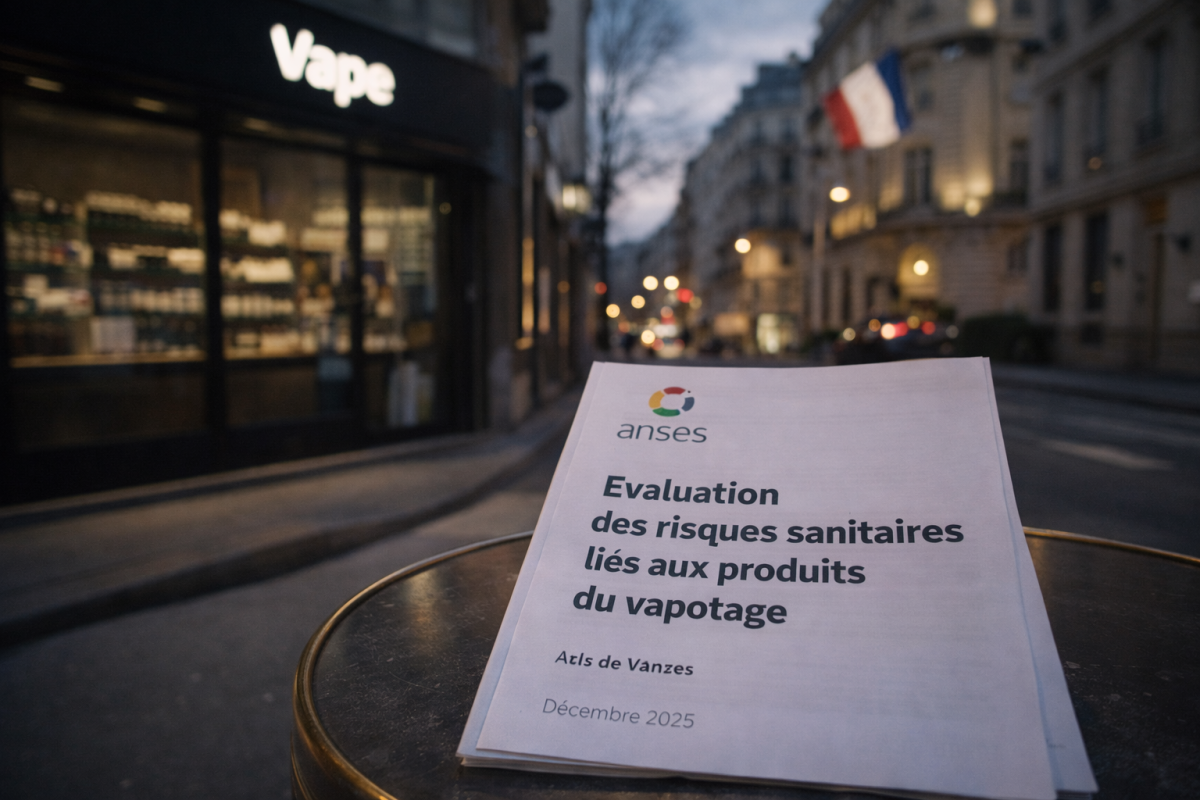
In a 700-page scientific assessment completed in December 2025 and published on February 4, 2026, the Agence nationale de sécurité sanitaire de l’alimentation, de l’environnement et du travail (ANSES) concluded that vaping is less harmful than combustible tobacco, while stressing that it is not risk-free. The report arrives at a pivotal moment for French nicotine policy, following the government’s January decision to withdraw a proposed excise tax on e-liquids from the 2026 budget law.
ANSES operates under the supervision of the Ministry of Health and provides independent scientific risk assessments that inform public policy. Its role is distinct from that of the Haute Autorité de Santé (HAS), France’s national health authority, which is expected to issue recommendations in 2026 on whether and how vaping products might be incorporated into smoking cessation guidance. Together, the two institutions represent the scientific and clinical pillars of France’s regulatory framework.
The ANSES report does not call for prohibition. Instead, it confirms relative risk differences while recommending tighter oversight of ingredients, emissions, and market practices. The result is not deregulation, but a shift toward more granular control.

A Scientific Framework: Relative Risk, Absolute Caution
ANSES applied a dual methodology: a systematic review of epidemiological and experimental literature (évaluation des risques sanitaires, ERS), combined with a quantitative risk assessment model (évaluation quantitative des risques sanitaires, EQRS) focusing on aldehydes generated during vaping.
After reviewing thousands of studies, the agency concluded that the absence of combustion significantly reduces exposure to many toxic substances compared with cigarette smoke. In modeled scenarios examining aldehyde exposure, emissions associated with vaping were markedly lower than those from combustible tobacco — in some scenarios by 80% to near-total reductions — though the agency emphasized that reduced emissions do not equate to zero risk.
- The report identifies:
- Probable cardiovascular effects, particularly when products contain nicotine;
- Possible respiratory and carcinogenic effects, with or without nicotine;
- Possible cardiovascular and respiratory developmental effects in fetuses exposed in utero;
- Significant scientific uncertainty regarding long-term outcomes.
Importantly, ANSES underscores that vaping-related risks, while present, do not exceed in severity or evidentiary weight those firmly established for smoked tobacco. The absence of combustion remains the principal differentiator.
The agency also highlights methodological limits. Most adult vapers in France are current or former smokers, and only a very small proportion — around 2% — have never smoked. This not only complicates efforts to isolate vaping-specific health effects from prior tobacco exposure, but also reinforces the current policy framing of vaping primarily as a harm-reduction tool for smokers rather than an entry product for non-smokers.
Beyond toxicology, ANSES devotes significant attention to addiction dynamics and product attractiveness. It recommends the creation of a prohibited-ingredient “negative list” for e-liquids, explicitly mentioning nornicotine and 6-methyl-nicotine, signaling closer scrutiny of emerging nicotine-related compounds. The report also calls for continuous monitoring of technological innovations — including high-efficiency nicotine delivery systems such as nicotine salts — that may alter absorption dynamics and raise additional questions regarding addictive potential and youth appeal.
Another notable finding concerns do-it-yourself (DIY) mixing practices. Survey data cited by ANSES indicate that roughly half of adult users report engaging in DIY e-liquid preparation. Because users independently mix nicotine base liquids and flavoring agents, ingredient selection, concentration control and product suitability may fall outside standardized manufacturing oversight. ANSES warns that the use of substances not intended for inhalation, or inappropriate formulation practices, could introduce additional health risks, reinforcing its call for improved market surveillance and consumer information.
On taxation, ANSES advises that if excise measures are introduced, they should remain moderate to avoid incentivizing illicit markets or unsafe informal production.
In terms of future research, the agency emphasizes the need for greater methodological standardization. Beyond emissions and aerosol analysis, it points toward the potential expansion of studies using biological markers — such as metabolites measured in blood or urine — to better characterize long-term exposure and strengthen the comparability of health evidence.
Political Signals and Stakeholder Reactions
Shortly before the report’s publication, the French government invoked Article 49.3 of the Constitution to pass the 2026 budget law and removed Article 23, which had proposed a substantial excise tax on e-liquids and restrictions on online sales. While no official statement directly linked the withdrawal to ANSES’ findings, industry groups interpreted the move as a pragmatic recalibration in light of harm-reduction evidence.
On February 19, 2026, Senator Hervé Maurey submitted a formal written question (No. 07703) to the Ministry of Health, citing ANSES’ conclusions and asking whether the government would address widespread public misperceptions. According to France’s latest Cancer Barometer data, a majority of the general population perceives vaping risks as equivalent to or greater than those of combustible tobacco — a perception ANSES describes as inconsistent with current scientific evidence.
Public health organizations responded with nuance. Association Addictions France welcomed the scientific rigor of the report, reiterating that vaping can function as a harm-reduction tool for smokers while cautioning against normalization among non-smokers and youth. In its public commentary, the organization also suggested that “plain packaging” approaches, similar to those applied to combustible cigarettes, could be considered to reduce youth appeal.
The Fédération interprofessionnelle de la vape (FIVAPE), representing independent vape retailers, emphasized the report’s recognition of harm reduction and supported the ingredient-focused regulatory approach rather than broad flavor prohibitions.
France’s Regulatory Landscape: Recent Shifts and 2026 Outlook
France has not entered a phase of comprehensive prohibition. Instead, its trajectory over the past year suggests structural recalibration.
Key developments include:
- A ban on disposable e-cigarettes implemented in 2025;
- A prohibition on nicotine pouches scheduled to take effect in April 2026;
- Alignment with updated EU CLP labeling requirements, effective July 2026;
- Continued implementation of the National Tobacco Control Program (PNLT 2023–2027).
Notably, France does not currently apply a dedicated excise tax on vaping products, following the withdrawal of Article 23.
In 2026, two policy milestones bear watching:
- HAS is expected to issue guidance on the role of vaping in smoking cessation;
- Legislative discussions may emerge around implementing a formal prohibited-ingredient list and strengthening emissions oversight frameworks.
The regulatory direction points toward technical refinement rather than categorical bans.
Structural Implications for Market Participants
Device Manufacturers
The competitive axis may shift from consumer-electronics differentiation toward risk-control performance.
ANSES identifies overheating conditions as a key driver of aldehyde formation and stresses real-world exposure assessment. While AFNOR technical standards remain voluntary, they carry market influence in France.
Implications include:
- Greater emphasis on temperature stability and precise power regulation;
- Demonstrated emissions control even under atypical usage scenarios;
- Rising compliance testing and documentation costs.
The report also links aerosol composition to material integrity, suggesting heightened scrutiny of heating coils and metallic components. Supply-chain transparency may become increasingly important for import approvals.
At present, no draft legislation targets device aesthetics directly. However, as regulators examine product “attractiveness,” differentiation strategies may gradually shift from visual appeal toward durability and safety performance.
E-liquid Manufacturers
The strategic focus may move from flavor innovation toward ingredient defensibility.
ANSES’ call for a prohibited-ingredient list, explicitly naming nornicotine and 6-methyl-nicotine, narrows formulation flexibility and signals stricter oversight of nicotine-related compounds.
Should regulators adopt more formal aerosol-testing requirements inspired by the EQRS framework, manufacturers could face expanded toxicological and emissions data obligations. Laboratory capability and compliance infrastructure may become competitive barriers.
While France has not announced a comprehensive flavor ban, the report’s emphasis on youth appeal ensures continued scrutiny of highly sweet or visually marketed profiles.
Distributors and Retail Channels
Compliance responsibility appears to be moving upstream.
With tightening technical expectations and EU labeling changes approaching, distributors may need to strengthen supplier audits — particularly for non-EU manufacturers — to ensure documentation and labeling completeness at customs.
The removal of disposable products and the impending nicotine pouch ban require inventory restructuring and cash-flow adjustments. Retail models may increasingly rely on refillable systems and longer product cycles.
Although Article 23 was withdrawn, taxation remains a policy variable. ANSES’ recommendation for moderate taxation, if introduced, suggests that pricing strategies may need to retain flexibility.
A Potential New Channel: Healthcare Integration
If HAS formalizes cessation guidance incorporating vaping under medical supervision, a structural shift could follow.
Such a move would not convert vaping into a pharmaceutical product but could expand its presence within clinical cessation pathways. In that scenario, product design, labeling, and marketing narratives may evolve toward medical credibility rather than lifestyle positioning.
Strategic Outlook: Beyond France
According to Alan Zhao, co-founder of 2Firsts, France is not entering a prohibition cycle but a recalibration phase.
“The immediate risk for the industry is not blanket bans,” Zhao said. “It is rising technical standards, tighter ingredient scrutiny, higher compliance costs, and the likelihood of gradual market concentration.”
One of the central considerations in France’s evolving regulatory approach is youth protection. ANSES repeatedly stresses the need to reduce product attractiveness among minors and to avoid normalizing vaping among non-smokers. While France has primarily relied on statutory age limits and product-level controls, broader policy discussions may increasingly examine technological enforcement mechanisms. In the United States, expanded age-verification systems in retail and online channels have been deployed as one tool to limit youth access. Whether similar digital age-gating approaches could operate effectively within continental Europe’s regulatory and data-privacy frameworks remains an open question — and one that may warrant further discussion among regulators, scientists and industry stakeholders.
Zhao added that developments over the past year — including the disposable vape ban, the forthcoming nicotine pouch prohibition and the withdrawal of a proposed excise tax — illustrate the complexity of policymaking in France and, more broadly, within the European Union. National authorities must balance domestic public health priorities, political dynamics and stakeholder pressures, while also operating within EU legal structures and anticipating future revisions such as the Tobacco Products Directive (TPD 3.0).
“This dual-layer governance structure means regulatory decisions are rarely shaped by science alone,” Zhao said. “They emerge from negotiation between national evidence, public perception, political feasibility and EU institutional constraints.”
In that context, Zhao argued, comprehensive and transparent scientific research becomes even more critical as a shared reference point for debate. At the same time, industry actors should not remain passive observers.
“Companies that rely on harm-reduction arguments need to engage constructively in policy discussions, contribute data, and demonstrate compliance capacity,” he said. “Waiting for regulation to settle is not a strategy.”
As one of the European Union’s largest nicotine markets, France may serve as an early indicator of how the bloc reconciles harm-reduction recognition with tightening product governance. For international brands, regulators and supply-chain manufacturers, the French case suggests that the debate is shifting from whether vaping is less harmful than smoking to how its risks are managed within an increasingly layered regulatory environment.
2Firsts will continue to monitor regulatory developments in France throughout 2026.
Cover image: AI-generated image for illustrative purposes (2Firsts).

Disclaimer
This article is provided solely for professional research, industry discussion, and informational purposes. Any references to brands, companies, products, technologies, or policies are made for factual reporting and analytical purposes only, and do not constitute endorsement, recommendation, promotion, or advertising by 2Firsts.
Nicotine-containing products, including but not limited to cigarettes, e-cigarettes, heated tobacco products, and nicotine pouches, carry significant health risks. Readers are responsible for complying with all applicable laws and regulations in their respective jurisdictions, including age restrictions and access limitations.
The information contained in this article should not be regarded as investment, legal, medical, regulatory, or commercial advice. While 2Firsts strives to ensure the accuracy and reliability of its content, it does not assume liability for any direct or indirect loss arising from errors, omissions, inaccuracies, or reliance on the information contained herein.
This article is not intended for individuals below the legal age for accessing tobacco or nicotine-related information in their jurisdiction.
Copyright Notice
This article is either original content produced by 2Firsts or content reproduced, translated, summarized, or adapted from third-party sources with attribution where applicable. The intellectual property rights of the original content remain with 2Firsts or the respective original rights holders.
No individual or organization may copy, reproduce, distribute, republish, modify, translate, or otherwise use this content without prior authorization. Any unauthorized use may result in legal action.
For copyright-related inquiries, corrections, or removal requests, please contact: info@2firsts.com.
AI-Assisted Translation and Editing Notice
Portions of this article may have been translated, edited, or reviewed with the assistance of artificial intelligence tools to improve efficiency and readability. Due to the limitations of AI-assisted translation and editing, discrepancies, omissions, or inaccuracies may exist when compared with the original source.
Where applicable, readers are advised to refer to the original source for the most complete and accurate information. If you identify any errors or believe that any content infringes upon your rights, please contact us at info@2firsts.com, and we will review and address the matter promptly.



