
Key Points
- Shenzhen Huabao Collaborative Innovation Technology Research Institute filed a patent covering a nicotine-ascorbic acid cocrystal, its preparation and applications.
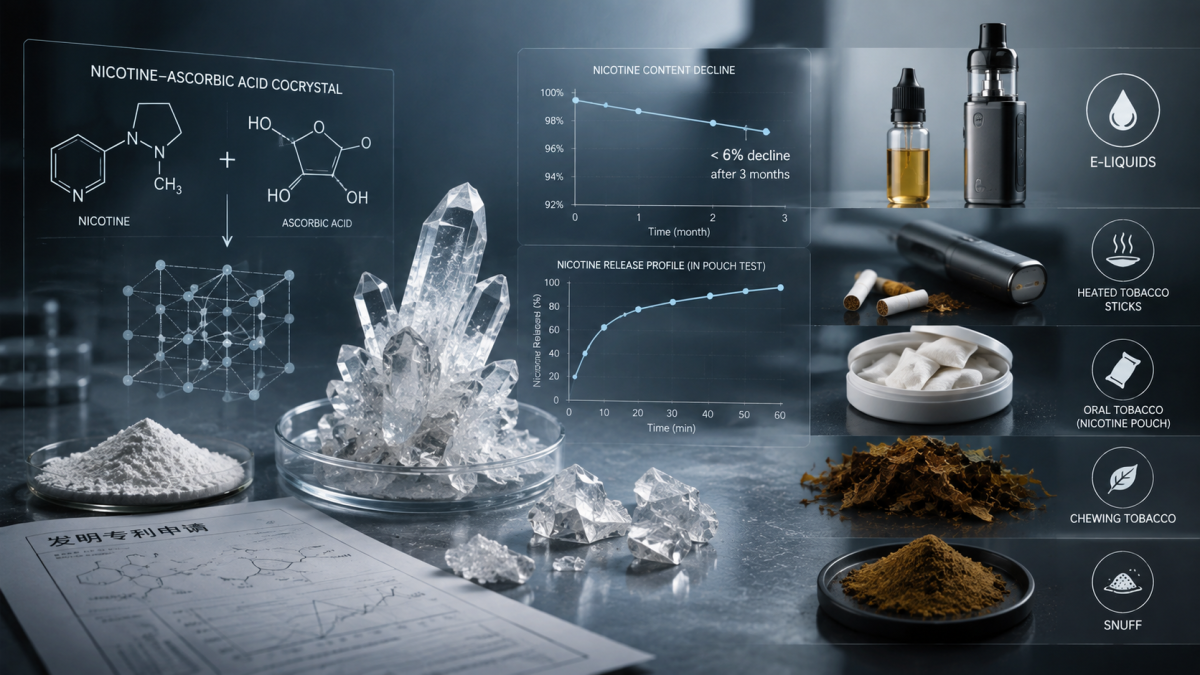
- The patent forms a solid crystalline structure using nicotine and ascorbic acid at molar ratios ranging from 2:1 to 1:2.
- Proposed applications include e-liquids, heated tobacco sticks, oral tobacco products, chewing tobacco and snuff.
- In accelerated storage tests, nicotine content in cocrystal pouch samples declined by less than 6% after three months, compared with 14.76% for the nicotine-base control.
- In dissolution tests, two cocrystal pouch samples released more than 99% of their nicotine over 60 minutes while showing a slower initial release profile than the nicotine-tartrate control.
2Firsts
August 13, 2026
According to public records from China’s National Intellectual Property Administration (CNIPA), Shenzhen Huabao Collaborative Innovation Technology Research Institute Co., Ltd. has filed a patent application covering a nicotine-ascorbic acid cocrystal, its preparation method and potential use in tobacco and nicotine products.
The filing proposes forming nicotine and ascorbic acid into a new solid crystalline structure and applying the material across several product categories.
The application, titled “Nicotine-Ascorbic Acid Cocrystal, Preparation Method and Applications Thereof,” was filed on April 14, 2026, and published as CN122344184A on July 7, 2026.
Moving beyond nicotine base and nicotine salts
The patent describes nicotine base and nicotine salts as the dominant nicotine forms used in newer tobacco products. It identifies volatility, sensitivity to oxygen, light and heat, and release-profile limitations among the issues associated with existing forms.
The application proposes a nicotine-ascorbic acid cocrystal as another approach to nicotine formulation.
Item | Details |
Applicant | Shenzhen Huabao Collaborative Innovation Technology Research Institute Co., Ltd. |
Patent title | Nicotine-Ascorbic Acid Cocrystal, Preparation Method and Applications Thereof |
Application No. | CN202610492097.5 |
Publication No. | CN122344184A |
Filing date | April 14, 2026 |
Publication date | July 7, 2026 |
Technology area | Nicotine cocrystals, stability and release control |
The patent specifies nicotine-to-ascorbic-acid molar ratios ranging from 2:1 to 1:2. Its preparation process involves dissolution in a water-ethanol system, crystallization under light-protected and temperature-controlled conditions, low-temperature washing and vacuum drying.
The resulting material was characterized using X-ray diffraction, infrared spectroscopy and differential scanning calorimetry. The filing states that the results indicate a crystalline structure distinct from ascorbic acid alone or a simple physical mixture of the two components.
Pouch tests show improved nicotine stability under accelerated storage
The patent compares nicotine-ascorbic acid cocrystal pouch formulations with pouches containing nicotine base and nicotine tartrate.
Samples were stored at 40°C ±2°C and 75% ±5% relative humidity for up to three months.
The two cocrystal samples began with nicotine contents of 6.02 mg and 5.99 mg. After three months, these declined to 5.66 mg and 5.64 mg, representing losses of less than 6%.
By comparison, the nicotine-base control declined from 6.03 mg to 5.14 mg, a 14.76% loss over three months. The nicotine-tartrate sample declined from 5.98 mg to 5.57 mg, a 6.86% reduction.
The patent attributes the result in part to converting liquid nicotine into a solid crystalline lattice and to properties associated with ascorbic acid. These findings, however, were generated under the experimental conditions described in the patent and do not constitute commercial shelf-life validation.
Cocrystal formulation produces a different release profile
The filing also reports dissolution testing of the four pouch formulations using an open-flow system designed to simulate the oral environment.
The two cocrystal samples released 10.13% and 10.21% of their nicotine after five minutes, rising to 25.91% and 26.54% after 10 minutes, 50.17% and 52.33% after 30 minutes, and 99.34% and 99.49% after 60 minutes.
The nicotine-base control released 71.14% after 60 minutes. The nicotine-tartrate control, by contrast, reached 51.83% after just 10 minutes and 89.83% after 30 minutes.
The patent characterizes the cocrystal profile as combining rapid initial release with sustained release at later stages.
The filing also makes claims related to absorption and bioavailability. Those claims should be interpreted cautiously: the disclosed comparison is an in-vitro dissolution experiment, and the patent does not provide human pharmacokinetic data demonstrating actual systemic absorption or bioavailability.

Patent claims applications across multiple nicotine product categories
Beyond the pouch experiments, the patent claims potential use of the nicotine-ascorbic acid cocrystal in e-liquids, heated tobacco sticks, oral tobacco products, chewing tobacco and snuff.
From a patent perspective, the filing therefore focuses not only on a specific finished product but on the nicotine ingredient form itself, using crystal engineering to explore changes in storage stability, processing characteristics and nicotine release.
The application represents a technical proposal and does not indicate that the cocrystal has been commercialized in any product. Nor does the filing establish its real-world pharmacokinetic or risk profile.
Follow 2Firsts for continuous coverage of global NGPs policies, technology developments, market trends and industry updates.
Cover Image generated by AI
Disclaimer
This article is provided solely for professional research, industry discussion, and informational purposes. Any references to brands, companies, products, technologies, or policies are made for factual reporting and analytical purposes only, and do not constitute endorsement, recommendation, promotion, or advertising by 2Firsts.
Nicotine-containing products, including but not limited to cigarettes, e-cigarettes, heated tobacco products, and nicotine pouches, carry significant health risks. Readers are responsible for complying with all applicable laws and regulations in their respective jurisdictions, including age restrictions and access limitations.
The information contained in this article should not be regarded as investment, legal, medical, regulatory, or commercial advice. While 2Firsts strives to ensure the accuracy and reliability of its content, it does not assume liability for any direct or indirect loss arising from errors, omissions, inaccuracies, or reliance on the information contained herein.
This article is not intended for individuals below the legal age for accessing tobacco or nicotine-related information in their jurisdiction.
Copyright Notice
This article is either original content produced by 2Firsts or content reproduced, translated, summarized, or adapted from third-party sources with attribution where applicable. The intellectual property rights of the original content remain with 2Firsts or the respective original rights holders.
No individual or organization may copy, reproduce, distribute, republish, modify, translate, or otherwise use this content without prior authorization. Any unauthorized use may result in legal action.
For copyright-related inquiries, corrections, or removal requests, please contact: info@2firsts.com.
AI-Assisted Translation and Editing Notice
Portions of this article may have been translated, edited, or reviewed with the assistance of artificial intelligence tools to improve efficiency and readability. Due to the limitations of AI-assisted translation and editing, discrepancies, omissions, or inaccuracies may exist when compared with the original source.
Where applicable, readers are advised to refer to the original source for the most complete and accurate information. If you identify any errors or believe that any content infringes upon your rights, please contact us at info@2firsts.com, and we will review and address the matter promptly.



