Key Points
- RELAZO surveyed 49,879 Japanese consumers aged 20 to 69.
- Around 40% of respondents indicated potential quitting intentions at a ¥600 (approximately US$4.1) price level.
- Nearly 90% indicated potential quitting intentions at a ¥1,000 (approximately US$6.8) price level.
- Lower-income groups showed greater sensitivity to tobacco price increases.
- Heated tobacco accounted for 39.9% of current smokers’ main tobacco choices.
2Firsts
July 24, 2026
As Japan moves forward with heated tobacco tax adjustments, the impact of tobacco price increases on consumer behavior has become a market focus.
According to a consumer survey released by Japanese heated tobacco information platform RELAZO, some Japanese consumers may reconsider their smoking choices as tobacco prices rise.
The survey covered 49,879 men and women aged 20 to 69 nationwide and examined how price changes could affect smoking behavior and quitting intentions.
Heated Tobacco Becomes Major Choice Among Japanese Smokers
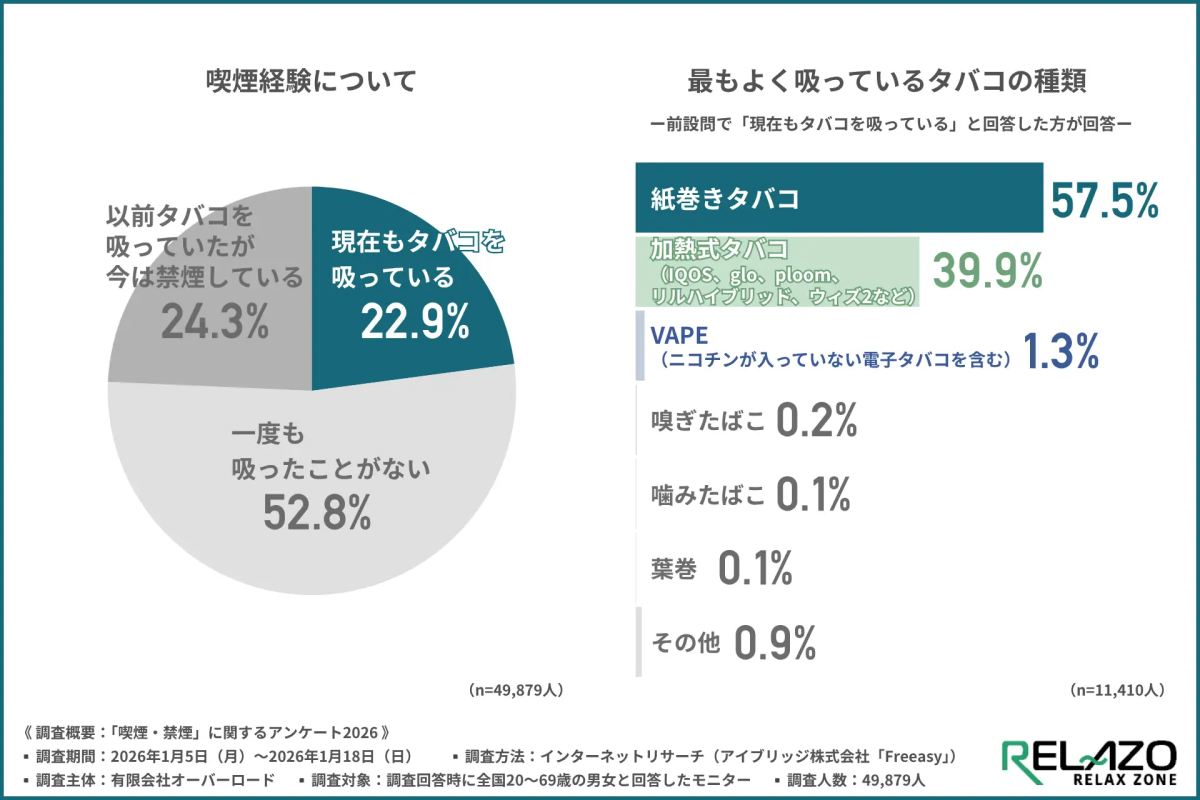
RELAZO’s survey showed that current smokers accounted for 22.9% of respondents, while 24.3% said they previously smoked but had quit, and 52.8% had never smoked.
Among current smokers, combustible cigarettes remained the most common choice at 57.5%, followed by heated tobacco products at 39.9% and VAPE products at 1.3%.
The findings suggest heated tobacco has become an established consumption category among Japanese smokers.
In recent years, brands including IQOS, glo and Ploom have expanded their presence in Japan’s tobacco market.
Rising Prices May Influence Consumer Decisions
RELAZO asked cigarette and heated tobacco users how they would respond to future price increases linked to tax changes.
The survey found that 49.6% of respondents wanted to continue using their current products despite price increases, while 25.6% would consider switching to cheaper products and 17.4% would consider quitting.
The results suggest that price increases may not immediately change all consumer behavior but could become a factor in reassessing smoking habits.
¥600 (Approx. US$4.1) Emerges as Potential Price Turning Point
RELAZO examined quitting intentions at different tobacco price levels.
The survey found that when prices reached ¥600 (approximately US$4.1) per pack, cumulative quitting intentions reached around 40%. At above ¥700 (approximately US$4.8), the cumulative share rose to about 60%, while at ¥1,000 (approximately US$6.8), nearly 90% of respondents indicated potential quitting intentions.
However, the figures represent stated intentions under hypothetical pricing scenarios rather than actual quitting rates.
The survey suggests that rising prices may serve as a trigger for some consumers to reconsider tobacco use.
Income Differences Affect Price Sensitivity
RELAZO analyzed how income levels influenced responses to higher tobacco prices.
Among respondents from households earning less than ¥4 million (approximately US$27,000) annually, 47.0% indicated potential quitting intentions when prices reached ¥600.
Among those with household incomes above ¥15 million (approximately US$102,000), the figure was 25.6%.
The difference suggests that income levels may influence how consumers respond to tobacco price increases.
For lower-income households, higher tobacco costs may place greater pressure on daily expenses.
Financial Pressure Becomes Major Quitting Factor
Among respondents who had successfully quit smoking, RELAZO examined their reasons for quitting.
The leading factors included:
- Rising tobacco costs or saving money: 27.9%;
- Concerns about future health: 27.2%;
- Illness or health problems: 18.4%.
The findings suggest financial pressure and health concerns are both important drivers of quitting decisions.
Tax Changes May Further Reshape Japan’s Tobacco Market
Japan has continued adjusting its tobacco tax framework, with heated tobacco taxation changes expected to influence product pricing.
As prices rise, consumers may choose between continuing their current products, switching to lower-cost alternatives or quitting.
For tobacco companies, pricing strategies, product positioning and changing consumer structures will become increasingly important competitive factors.
For the heated tobacco industry, tax reforms may influence not only prices but also consumer choices between tobacco product categories.
Follow 2Firsts for the latest updates on global nicotine markets, consumer trends and regulatory developments.
Cover Image source: RELAZO
Disclaimer
This article is provided solely for professional research, industry discussion, and informational purposes. Any references to brands, companies, products, technologies, or policies are made for factual reporting and analytical purposes only, and do not constitute endorsement, recommendation, promotion, or advertising by 2Firsts.
Nicotine-containing products, including but not limited to cigarettes, e-cigarettes, heated tobacco products, and nicotine pouches, carry significant health risks. Readers are responsible for complying with all applicable laws and regulations in their respective jurisdictions, including age restrictions and access limitations.
The information contained in this article should not be regarded as investment, legal, medical, regulatory, or commercial advice. While 2Firsts strives to ensure the accuracy and reliability of its content, it does not assume liability for any direct or indirect loss arising from errors, omissions, inaccuracies, or reliance on the information contained herein.
This article is not intended for individuals below the legal age for accessing tobacco or nicotine-related information in their jurisdiction.
Copyright Notice
This article is either original content produced by 2Firsts or content reproduced, translated, summarized, or adapted from third-party sources with attribution where applicable. The intellectual property rights of the original content remain with 2Firsts or the respective original rights holders.
No individual or organization may copy, reproduce, distribute, republish, modify, translate, or otherwise use this content without prior authorization. Any unauthorized use may result in legal action.
For copyright-related inquiries, corrections, or removal requests, please contact: info@2firsts.com.
AI-Assisted Translation and Editing Notice
Portions of this article may have been translated, edited, or reviewed with the assistance of artificial intelligence tools to improve efficiency and readability. Due to the limitations of AI-assisted translation and editing, discrepancies, omissions, or inaccuracies may exist when compared with the original source.
Where applicable, readers are advised to refer to the original source for the most complete and accurate information. If you identify any errors or believe that any content infringes upon your rights, please contact us at info@2firsts.com, and we will review and address the matter promptly.