Key Points
- Industry representatives said unclear product characterization standards are restricting investment, fundraising and long-term viability for small ENDS manufacturers; FDA responded that regulatory flexibility is limited by statutory requirements.
- Manufacturers argued that without objective, measurable benchmarks, small businesses lack a clear pathway to PMTA compliance; FDA said product characterization remains a threshold condition for review.
- Industry participants questioned how testing ranges are defined for open-system products; FDA replied that applicants must justify their testing approaches on a product-specific basis.
- Manufacturers asked whether long-pending PMTAs can be updated; FDA confirmed that amendments submitted before scientific review begins may be considered, depending on scope.
- Industry sought greater efficiency through product grouping; FDA stated that while internal bundling may occur, products with different names or labels generally require separate PMTAs.
2Firsts, February 10, 2026-
Small manufacturers opened the first session of a U.S. Food and Drug Administration (FDA) roundtable on premarket tobacco product applications (PMTAs) by warning that uncertainty around product characterization standards is translating into real financial pressure, limiting their ability to invest, raise capital and remain viable.
FDA officials responded that while the agency is seeking dialogue with small businesses, its flexibility is constrained by statutory and procedural boundaries.
The discussion marked the opening panel of FDA’s PMTA roundtable on electronic nicotine delivery systems (ENDS), held in a hybrid format and limited to manufacturers with fewer than 350 employees.
Participants
The Product Characterization session was moderated by Todd Cecil, Ph.D., of the FDA.
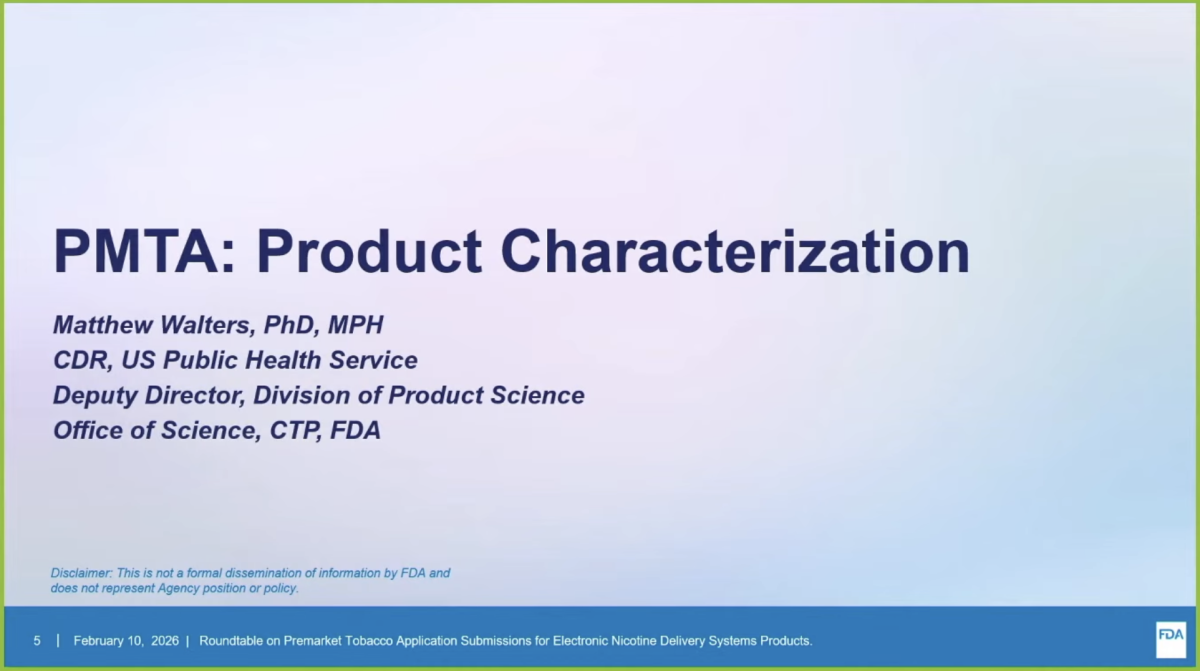
FDA panelists included Colleen Rogers, Ph.D., Director of the Division of Product Science; CDR Matthew Walters, Ph.D., Deputy Director of the Division of Product Science; and Karen Coyne, Ph.D., also a Deputy Director of the division with an engineering background.
Industry participants represented a range of small ENDS manufacturers, including Mark Anton, Chief Executive Officer of What A Smoke, LLC; Geoff Habicht (Jeff), Co-founder and President of Mi-One Brands (SV3, LLC); William Tang of ZOVOO (Shenzhen) Technology; Bill Wikstrom of Vaporized & Paradigm; and Ryan Muckenthaler of Lotus Vaping Technologies.

Industry warns regulatory uncertainty threatens survival
Raising one of the most pointed interventions of the session, Geoff Habicht, co-founder and president of Mi-One Brands, told FDA officials that the absence of clear, objective benchmarks for product characterization is creating a structural disadvantage for small manufacturers.
Habicht said that without measurable outcome standards, small companies are effectively shut out of capital markets. “If we don’t know what the target is, we can’t invest, we can’t raise money, and we can’t access capital,” he said.
He contrasted the financial position of small manufacturers with that of large tobacco companies, adding: “We’re not sitting on $6 billion in cash that allows us to test everything. When we go to market, we have to be extremely smart and highly strategic.”
Habicht argued that without defined benchmarks, small businesses have no reliable way to determine how to move PMTAs forward. He urged FDA to work in partnership with small manufacturers by providing clearer reference points, such as device power limits, ingredient “safe lists,” or “do-not-use” lists, to help companies make informed compliance decisions.
Several industry participants echoed those concerns, with the remarks resonating across the panel as a reflection of the survival costs associated with navigating the PMTA process.
Manufacturers question testing scope and standards
Beyond financing concerns, industry representatives also questioned how product characterization expectations translate into testing requirements, particularly for open-system products intended for use across a wide range of devices.
Manufacturers pointed to variability in device power, temperature and user behavior, arguing that defining “high” and “low” operating ranges for emissions testing can be arbitrary. Some suggested that standards anchored more directly to the physical properties of e-liquids, such as boiling points, could provide a more consistent scientific framework.
FDA frames product characterization as a threshold requirement
FDA officials responded by reiterating that product characterization is not a standalone technical exercise but a prerequisite for PMTA review.
Colleen Rogers, director of the Division of Product Science, said her office is responsible for evaluating product composition, design features and manufacturing information, which together form the foundation for subsequent scientific assessments.
Matthew Walters, deputy director of the division, added that without complete product characterization, FDA cannot assess aerosol chemistry, toxicological risk or determine whether a product meets the statutory standard of being appropriate for the protection of public health.
Boundaries on literature use and TPMFs
Addressing concerns over testing burden, FDA said peer-reviewed literature may be considered when scientifically justified, but stressed that product-specific data remain central to PMTA review. Applicants, officials said, must clearly explain how literature relates to the specific product under review.
For products involving proprietary ingredients, including flavor formulations, FDA reiterated the role of tobacco product master files (TPMFs). Officials said TPMFs can support product characterization and method validation, but only when accompanied by a valid letter of authorization. FDA emphasized that it cannot independently access or aggregate TPMFs across applications.
FDA clarifies amendment pathway
One of the most closely watched exchanges concerned whether long-pending PMTAs can be updated.
FDA officials confirmed that amendments submitted before the formal start of scientific review may be considered, depending on the nature and scope of the changes. Amendments involving fundamental product characteristics, however, could require a new submission.
The clarification addressed concerns raised by manufacturers who said they learned only years later that amendments might be possible, limiting their ability to align applications with evolving FDA expectations.
Bundling possible, but products remain distinct
FDA also said it may apply internal “bundling” or “bracketing” approaches during scientific review, such as grouping similar flavors or nicotine concentrations to improve efficiency.
However, officials stressed that from a regulatory standpoint, products with different names, labels or market presentations are considered distinct and generally require separate PMTAs.
The PMTA roundtable continues with additional panels on manufacturing, harmful and potentially harmful constituents (HPHCs) and behavioral science. As of publication, the meeting remains ongoing. FDA has said transcripts and recordings will be released publicly after the roundtable concludes.
2Firsts will continue to follow the discussions and report further developments.
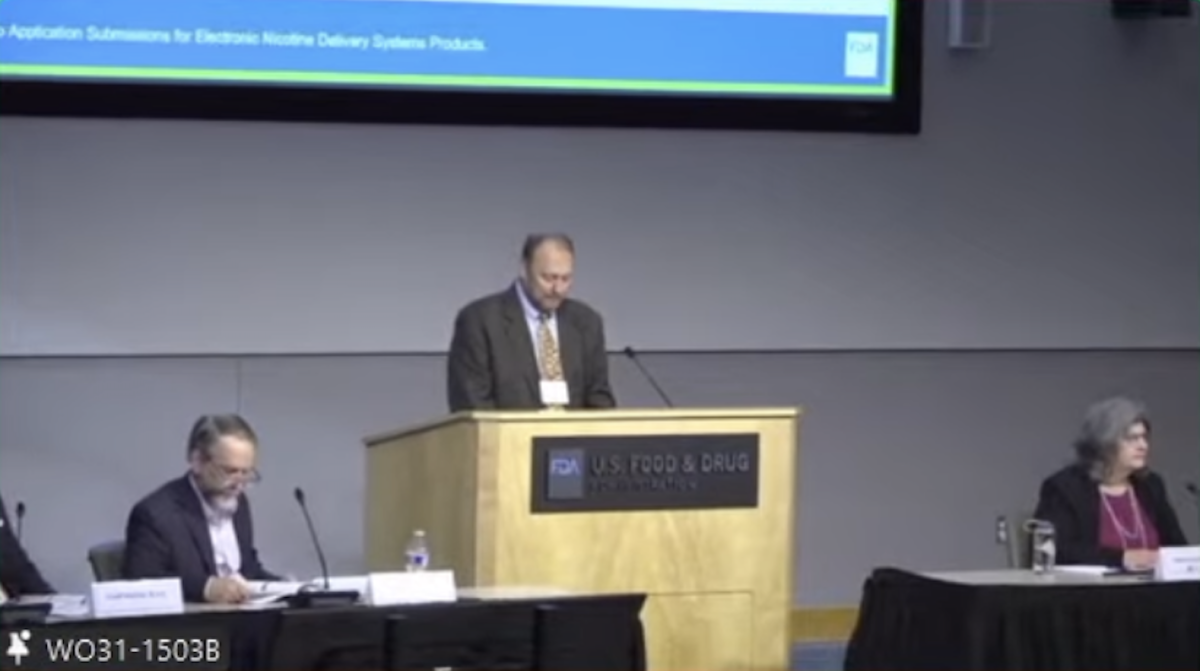
(The cover image is a screenshot from the FDA’s livestream of the PMTA roundtable.)

Click here to read the full coverage