Key Points
- R.J. Reynolds Vapor, Modoral Brands and American Snuff are seeking to intervene in the lawsuit filed by Helix Innovations and NJOY on September 2.
- Plaintiffs challenge the FDA's use of Acceptance, Filing and completeness determinations in establishing when the statutory 180-day period begins.
- Helix cites long-pending on! nicotine pouch applications and the review timeline for on! PLUS in support of its challenge.
- The FDA has been reducing its PMTA backlog and accelerating reviews, while the court has yet to rule on the 180-day timing issue raised in the case.
2Firsts
September 14, 2026
According to Law360 on September 10, 2026, three R.J. Reynolds companies have asked to intervene in a lawsuit brought by Altria subsidiaries against the U.S. Food and Drug Administration, challenging the agency's current premarket tobacco product application, or PMTA, rule and its treatment of a statutory 180-day decision period.
The companies seeking to intervene are R.J. Reynolds Vapor Company, Modoral Brands Inc. and American Snuff Company LLC. They also submitted a proposed intervening complaint.
Altria subsidiaries Helix Innovations LLC and NJOY LLC filed the original lawsuit on September 2 in the U.S. District Court for the Northern District of Texas.
Reynolds' motion expands the challenge to the FDA's 2021 PMTA final rule from Altria subsidiaries to companies controlled by Reynolds.
Dispute Centers on When the 180-Day Clock Begins
At the center of the case is the Tobacco Control Act's timeline for PMTA decisions.
Under 21 U.S.C. § 387j(c)(1)(A), the FDA must act as promptly as possible and no later than 180 days after receiving an application under Section 910(b).
The FDA's current PMTA process includes Acceptance Review, Filing Review, Application Review and final Action. Under the agency's existing framework, completeness determinations also play a role in determining when an application proceeds into substantive review.
The plaintiffs argue that the FDA uses Acceptance, Filing and completeness determinations to establish when the 180-day clock begins, allowing applications to remain in preliminary stages for extended periods before that clock starts.
The dispute therefore turns on competing interpretations of the statutory trigger: whether the clock begins upon receipt of an application satisfying Section 910(b), as the plaintiffs argue, or only after the FDA determines that an application is complete under its current review framework.
Helix, NJOY and the Reynolds companies are asking the court to vacate the FDA's 2021 PMTA final rule and require the agency to adopt a process consistent with their interpretation of the statutory deadline.
The plaintiffs also seek limits on FDA enforcement of premarket authorization requirements against certain products with applications that have remained pending for extended periods.
The court has not ruled on those claims.
Helix Cites Long-Pending on! Applications
Helix has cited several nicotine pouch applications in support of its challenge.
The company says some unresolved applications from a group of original on! nicotine pouch PMTAs submitted in 2020 had been pending for more than 2,270 days by the time the lawsuit was filed in September.
The review of a separate group of on! PLUS products illustrates the different timelines used by the company and the FDA.
Helix resubmitted six on! PLUS applications in December 2024. FDA records show the applications later completed Acceptance Review and Filing Review before receiving marketing authorization in December 2025.
The FDA previously described the review efficiency of those products by reference to the period after they entered substantive scientific review. Helix instead measures the total period from resubmission to final authorization, which it says was 361 days.
Those different starting points form part of the broader dispute over the statutory 180-day period.
Reynolds Links PMTA Backlog to Unauthorized Market Competition
Reynolds also argues that the FDA's current process leaves manufacturers following the PMTA pathway waiting for regulatory decisions while unauthorized products continue to compete in the U.S. market.
In its proposed intervening complaint, Reynolds cited an earlier FDA estimate that illegal vaping products may account for as much as 54% of U.S. vape sales.
Reynolds uses that figure to support its argument that manufacturers following the federal review process face competitive pressure from unauthorized products.
Whether prolonged PMTA reviews directly contributed to the growth of the unauthorized market remains a causal claim advanced by the plaintiffs.
FDA Has Been Reducing Its PMTA Backlog
At the same time, the FDA has been taking steps to accelerate premarket review.
Bret Koplow, head of the FDA's Center for Tobacco Products, has said the center reduced its premarket application backlog by about 70% during 2025 and has pursued efficiency improvements in Acceptance and Filing reviews.
The FDA has also launched a nicotine pouch PMTA pilot program aimed at shortening scientific review timelines for certain applications.
In August 2026, the agency issued a series of marketing authorizations covering products including additional on! nicotine pouches, ZYN ULTRA products and JUUL2.
Despite the faster pace of recent reviews, the Altria and Reynolds companies are asking the court to determine whether the FDA's current treatment of the statutory 180-day period is lawful.
Companies From Two Major Tobacco Groups Challenge the Same Rule
Reynolds' intervention request came roughly a week after the Altria subsidiaries filed the original lawsuit.
Helix, NJOY, R.J. Reynolds Vapor, Modoral Brands and American Snuff operate across vaping, nicotine pouch and other smokeless tobacco categories.
If the court adopts the plaintiffs' interpretation of the 180-day requirement and the challenged rule, the FDA could be required to adjust its PMTA review process and the handling of some pending applications.
The court has not yet issued a substantive ruling.
U.S. courts have previously heard challenges involving PMTA procedures, flavored ENDS review standards and FDA administrative practices. The timing question at the center of this case — when the statutory 180-day period begins — remains unresolved in this litigation.
With Reynolds seeking to intervene, the industry's long-running dispute over PMTA backlogs and review efficiency is moving further into judicial scrutiny of the legality of the FDA's 2021 PMTA rule.
Follow 2Firsts for timely updates on global tobacco and nicotine regulations, market developments and industry trends.
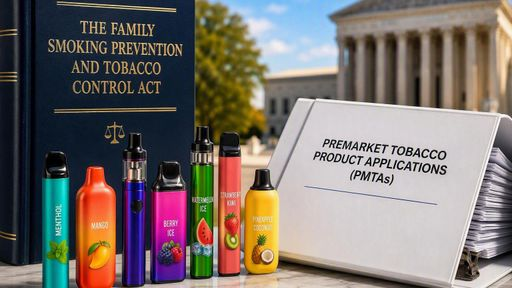
Cover Image generated by AI
Disclaimer
This article is provided solely for professional research, industry discussion, and informational purposes. Any references to brands, companies, products, technologies, or policies are made for factual reporting and analytical purposes only, and do not constitute endorsement, recommendation, promotion, or advertising by 2Firsts.
Nicotine-containing products, including but not limited to cigarettes, e-cigarettes, heated tobacco products, and nicotine pouches, carry significant health risks. Readers are responsible for complying with all applicable laws and regulations in their respective jurisdictions, including age restrictions and access limitations.
The information contained in this article should not be regarded as investment, legal, medical, regulatory, or commercial advice. While 2Firsts strives to ensure the accuracy and reliability of its content, it does not assume liability for any direct or indirect loss arising from errors, omissions, inaccuracies, or reliance on the information contained herein.
This article is not intended for individuals below the legal age for accessing tobacco or nicotine-related information in their jurisdiction.
Copyright Notice
This article is either original content produced by 2Firsts or content reproduced, translated, summarized, or adapted from third-party sources with attribution where applicable. The intellectual property rights of the original content remain with 2Firsts or the respective original rights holders.
No individual or organization may copy, reproduce, distribute, republish, modify, translate, or otherwise use this content without prior authorization. Any unauthorized use may result in legal action.
For copyright-related inquiries, corrections, or removal requests, please contact: info@2firsts.com.
AI-Assisted Translation and Editing Notice
Portions of this article may have been translated, edited, or reviewed with the assistance of artificial intelligence tools to improve efficiency and readability. Due to the limitations of AI-assisted translation and editing, discrepancies, omissions, or inaccuracies may exist when compared with the original source.
Where applicable, readers are advised to refer to the original source for the most complete and accurate information. If you identify any errors or believe that any content infringes upon your rights, please contact us at info@2firsts.com, and we will review and address the matter promptly.