
Key Points:
● Legal ambiguity between federal and regional authority persists
● Enforcement gaps create uncertainty for retailers and regulators
● Policy fragmentation may accelerate informal vape distribution channels
2Firsts
Eastern Europe, May 28, 2026
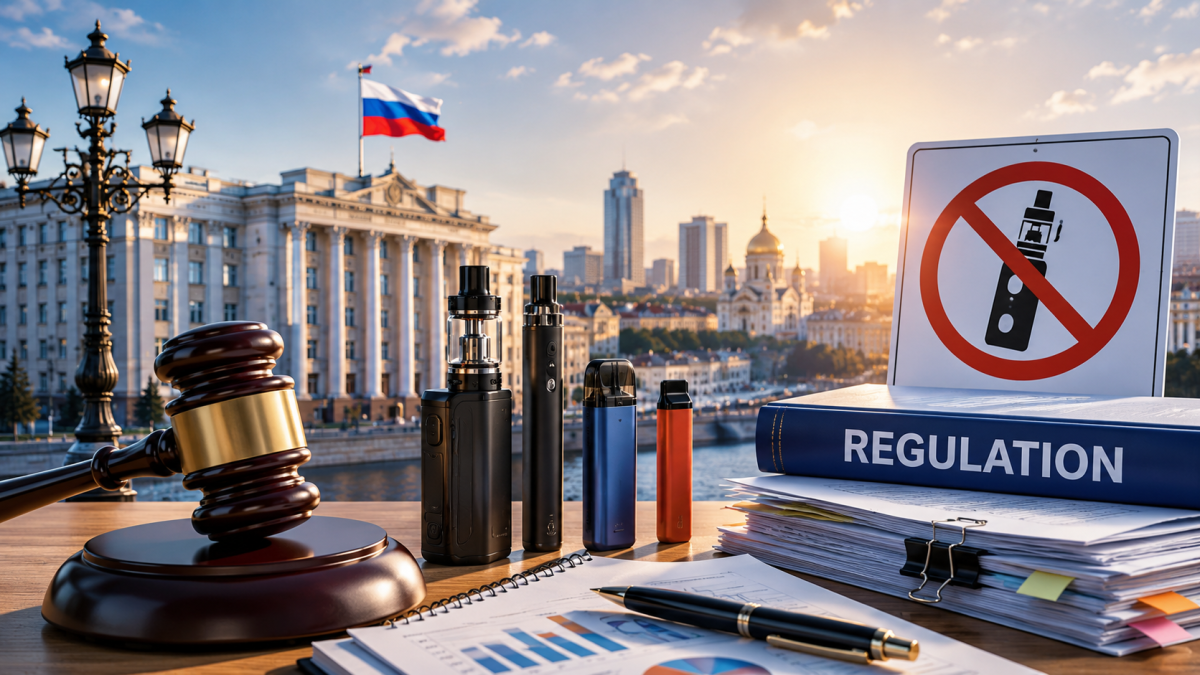
A Russian initiative allowing regional authorities to ban vape sales — initially seen as a compromise alternative to a nationwide prohibition debated for months in Moscow — is already encountering early challenges. Several regions have rushed to introduce restrictions even before the legislation has completed its passage through parliament, prompting pushback from businesses warning that the approach could still destabilise the legal market and create uneven regulatory conditions across the country.
The parliament of Perm Krai, a region on the eastern edge of European Russia with a population of around 2.5 million, has passed a bill in two readings banning the storage and distribution of vapes, with the measure set to take effect on September 1, 2026.
The move expands restrictions already introduced earlier this year. Since March 1, 2026, Perm Krai has prohibited the sale of vapes, although the initial rules did not cover storage or distribution.
Regional officials say the new law is intended to close that gap. “Today, when the sale of vapes is formally banned, the mere presence of these products in warehouses or distribution points remains in a grey zone,” Valery Sukhikh, chairman of the regional legislative assembly, said in an explanatory note to the bill.
Legal Uncertainty Over Regional Vape Bans
The Perm initiative emerged as federal officials moved, at least for now, toward a regional-ban model, allowing regions to decide independently whether to restrict or prohibit sales. However, Perm moved ahead before the federal legislation had been fully adopted and signed into law, prompting criticism from lawyers and business groups, many of whom argue the measure lacks a clear legal basis and could be challenged in court.
For example, Alexey Kurinny, deputy chairman of the State Duma’s health committee, criticised regional vape restrictions introduced ahead of federal legislation, warning that such steps risk fragmenting Russia’s legal and economic space.
Speaking to Russian media outlet NSN, Kurinny said the federal law has not yet formally delegated such powers to the regions.
“This is premature regulation, because the federal law has only passed its first reading so far. The legislator has not yet delegated this right to the regions,” he said. “I would not rule out that the law could be overturned by prosecutors or fail to come into force. More time is needed to refine the legislation and introduce it at the federal level.”
Still, the situation in Perm Krai remains somewhat paradoxical. While federal lawmakers question the legality of early regional action, the ban on sales of electronic cigarettes has been in force since March 1, 2026. The legal status of storage, distribution and possible online workarounds remains less clear.
At the time of writing, the State Duma is preparing to consider the bill’s second reading by the end of May. Even if adopted, the legislation is expected to allow regions to ban vape sales from 2027, although the exact effective date remains unclear. Lawmakers have also discussed how far restrictions should extend beyond retail sales, although such measures are expected to target businesses and distribution chains rather than individual consumers.
A dangerous precedent
As the Perm experiment unfolds, the emerging consensus around the federal bill appears increasingly fragile.
The business lobby group Opora Russia has appealed to President Vladimir Putin to withdraw provisions that would allow Russian regions to impose their own bans on the sale of electronic nicotine delivery systems and related liquids, according to Kommersant and RBC.
Opora Russia criticised the drafting process, arguing that the bill was prepared without meaningful public consultation and only became widely known to businesses and consumers after it had already passed its first reading in the State Duma and following a presentation by a Finance Ministry representative.
“In essence, instead of organising a discussion, businesses and consumers were presented with a fait accompli,” the letter said.
Formally, however, the process was not entirely unexpected. The bill follows two years of intense debate over the future of Russia’s vape market. Several senior officials and lawmakers, including State Duma Speaker Vyacheslav Volodin, previously supported a complete nationwide ban, which at one stage appeared increasingly likely.
Ultimately, the Industry and Trade Ministry backed a softer approach, supporting a regulatory experiment that would allow regions to restrict vape sales while assessing the effectiveness of such measures.
Business groups warn that the approach could undermine one of the key principles of the Russian economic system — its unified internal market. In theory, they argue, it could set a precedent with broader consequences beyond the vape sector.
“Such an approach will inevitably lead to a dangerous precedent of fragmenting the constitutionally established unified economic space of the state, whereby electronic nicotine delivery systems — and subsequently any other products legally circulating at the federal level — may be permitted for sale in one region, banned in another, and subject to sudden prohibition in a third, solely at the discretion of regional authorities,” Opora Russia said.
However, business involvement in the debate also carries risks. In recent months, some lawmakers have floated even more radical proposals, including calls to treat electronic cigarettes in the same way as narcotics. The idea was supported by Dmitry Gusev, first deputy chairman of the State Duma, who expressed frustration over delays in adopting stricter regulations allowing regional bans.
Gusev argued that vape industry taxation generates only around 11 billion rubles ($154 million) annually for the state budget — an amount he said Russia could forgo in exchange for improved public health outcomes.
Under Russia’s Criminal Code, illicit drug trafficking carries severe penalties, including multi-year prison sentences and heavy fines. By contrast, vape-related violations currently fall under administrative or commercial regulations, typically resulting in fines or licensing restrictions.
The anti-vaping lobby also points out that the idea of a nationwide ban has been publicly endorsed by President Vladimir Putin.
For now, the compromise designed to balance competing approaches to Russia’s vape policy is beginning to look increasingly fragile. Observers warn that if business groups push too hard against the regional-ban framework, they may unintentionally strengthen the hand of lawmakers who favour a stricter nationwide prohibition. That, in turn, could reopen the door to more radical proposals — including stricter nationwide restrictions — and ultimately leave the industry facing a far harsher regulatory environment than the one it is trying to avoid.
For more coverage of Russia and Eastern Europe’s emerging tobacco and nicotine markets, follow 2Firsts.
(Cover Image generated by AI)

Disclaimer
This article is provided solely for professional research, industry discussion, and informational purposes. Any references to brands, companies, products, technologies, or policies are made for factual reporting and analytical purposes only, and do not constitute endorsement, recommendation, promotion, or advertising by 2Firsts.
Nicotine-containing products, including but not limited to cigarettes, e-cigarettes, heated tobacco products, and nicotine pouches, carry significant health risks. Readers are responsible for complying with all applicable laws and regulations in their respective jurisdictions, including age restrictions and access limitations.
The information contained in this article should not be regarded as investment, legal, medical, regulatory, or commercial advice. While 2Firsts strives to ensure the accuracy and reliability of its content, it does not assume liability for any direct or indirect loss arising from errors, omissions, inaccuracies, or reliance on the information contained herein.
This article is not intended for individuals below the legal age for accessing tobacco or nicotine-related information in their jurisdiction.
Copyright Notice
This article is either original content produced by 2Firsts or content reproduced, translated, summarized, or adapted from third-party sources with attribution where applicable. The intellectual property rights of the original content remain with 2Firsts or the respective original rights holders.
No individual or organization may copy, reproduce, distribute, republish, modify, translate, or otherwise use this content without prior authorization. Any unauthorized use may result in legal action.
For copyright-related inquiries, corrections, or removal requests, please contact: info@2firsts.com.
AI-Assisted Translation and Editing Notice
Portions of this article may have been translated, edited, or reviewed with the assistance of artificial intelligence tools to improve efficiency and readability. Due to the limitations of AI-assisted translation and editing, discrepancies, omissions, or inaccuracies may exist when compared with the original source.
Where applicable, readers are advised to refer to the original source for the most complete and accurate information. If you identify any errors or believe that any content infringes upon your rights, please contact us at info@2firsts.com, and we will review and address the matter promptly.



