
Disclaimer:
This article is published by 2Firsts with the author’s permission. The views expressed are solely those of the author and do not necessarily represent those of 2Firsts. The headline, key points and editor’s note were prepared by the 2Firsts editorial team.
Key Points
In this contributed article, Samrat Chowdhery provides the following information and views:
- Export volatility: India’s tobacco exports reached a high in 2024–25, but FCV leaf exports later declined sharply, exposing the vulnerability of the traditional cigarette supply chain to market swings.
- Industrial paradox: India is emerging as an important global supplier of pharmaceutical-grade liquid nicotine, while its domestic law still bans the sale, import and manufacture of e-cigarettes.
- Agricultural constraints: Indian FCV farmers cannot easily shift to tobacco for nicotine extraction because of soil conditions, curing assets, auction systems and price gaps.
- Transition pathway: Chowdhery argues that a more practical route is not large-scale crop substitution, but a “waste-to-wealth” supply chain using broken leaves, stems and tobacco dust for nicotine extraction.
- Policy proposal: He calls for India to adjust PECA and related rules, allow “manufacture for export,” and gradually build a trade and regulatory framework better aligned with new nicotine products and tobacco harm reduction.
May 29, 2026
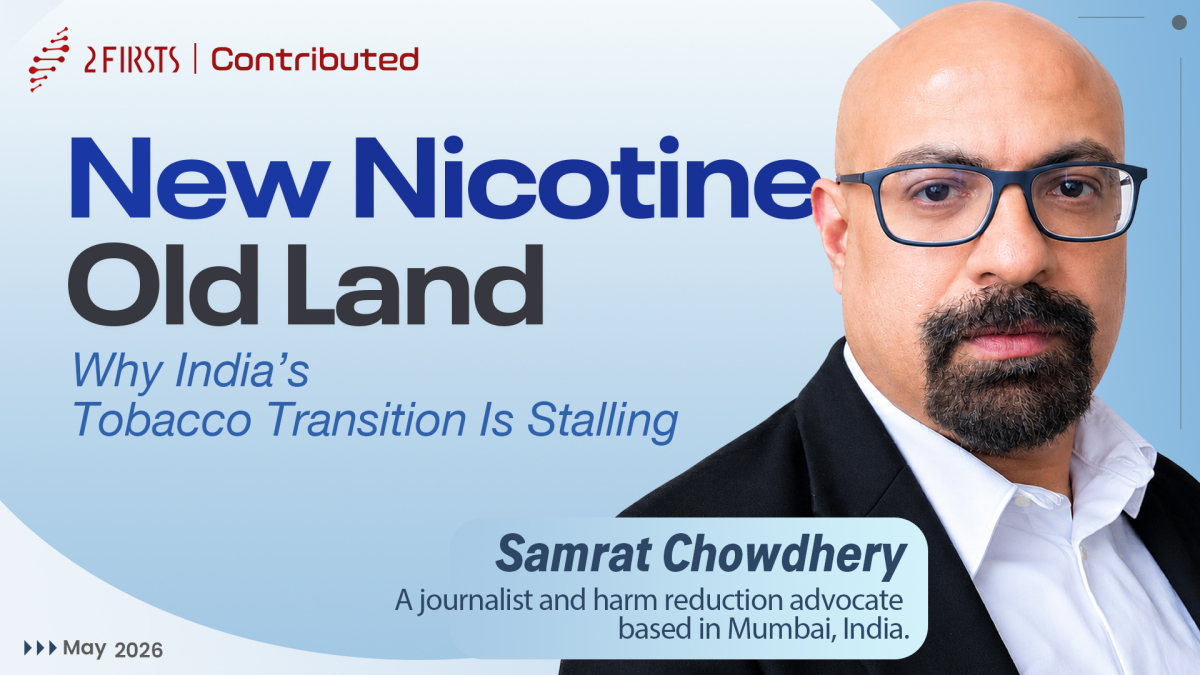
Why India's Tobacco Transition is Stalling
India is rapidly emerging as the premier global supplier of pharmaceutical-grade liquid nicotine. Yet, a complex web of agricultural economics, stranded assets and rigid regulatory frameworks keeps its farmers locked in the combustible cigarette supply chain. For the global safer nicotine products industry, unlocking India's potential requires moving beyond health policy debates and addressing the ground reality.
Samrat Chowdhery
India's tobacco economy has gone from triumph to alarm with startling speed. Strong global demand pushed tobacco exports to a record ₹16,728 crore ($2 billion) in 2024–25, raising hopes for millions of farmers. But by April this year, Flue-Cured Virginia (FCV) exports had fallen 34.81% year-on-year as overproduction, higher taxes and Middle East shipping disruptions left growers sitting on large unsold stocks.
The reversal has destroyed any sense of comfort. Farmers who only months ago rode an export boom are now seeking emergency state support to avoid financial ruin. This is not a passing slump. It is a clear sign that the global tobacco market is being rewritten.
The force behind this severe volatility is a shift in consumer behavior. Adult smokers are moving away from combustible cigarettes toward reduced-risk products such as vapes and nicotine pouches. As the market for traditional leaf shrinks, the global system is losing its ability to absorb supply gluts and even a localized production surge can trigger a price collapse.
The Liquid Nicotine Paradox
Nowhere is India's policy confusion clearer than in its nicotine strategy. At home, the government bans the sale, import and manufacture of e-cigarettes under the Prohibition of Electronic Cigarettes Act (PECA) of 2019. Yet India has become an important supplier to the global vaping chain and an unlikely powerhouse in alternative nicotine production, comprising 21% share of global pure nicotine market.
Through legitimate chemical and pharmaceutical export codes, Indian firms turn low-grade tobacco into highly purified Nicotine Polacrilex and liquid nicotine salts. Millions of liters are shipped to manufacturing hubs in the United States, Europe and China. The irony is that some finished products then flow back through India's thriving, untaxed black market.
So why are Indian farmers not pivoting to this new trade? Not because they are resistant to change. They are boxed in by agronomy and capital. The barrier is not attitude; it is the collision between soil chemistry and farm economics.
The Agronomic Trap
Conventional policy thinking treats agricultural adaptation as simply swapping seeds. By that logic, FCV farmers should stop growing mild cigarette leaf and shift to Nicotiana rustica, a coarser, heavy-feeding tobacco prized by extraction labs for its high alkaloid yield.
That theory, like most crop substitution policies, fails in the field. Premium cigarette leaf depends on the light, sandy loam soils in the coastal southern states of Andhra Pradesh and Karnataka, where low nitrogen produces a bright, mild cure. Rustica, by contrast, thrives in the heavy clay soils of Gujarat and requires aggressive nitrogen fertilization to produce its high nicotine content. In sandy soil, extraction crops turn stunted and low-yielding.
Farmers are also locked into the combustible economy by infrastructure they cannot abandon cheaply. Producing high-grade FCV tobacco requires specialized flue-curing barns that cost up to ₹8 lakh ($9,600) each. Extraction biomass, by contrast, requires only open sun-curing. Asking farmers to leave FCV is effectively asking them to write off their costliest asset.
The Pricing Chasm
FCV tobacco is sold through a tightly monitored, government-backed auction system run by the Tobacco Board. It offers transparent price discovery, open bidding and secure electronic payments directly to growers' bank accounts.
At these auctions, top-tier FCV leaf often sells for well above ₹250 ($3.00) per kilogram. Extraction tobacco and tobacco dust, by contrast, move through volatile, unorganized markets where buyers typically pay only ₹70 to ₹115 ($0.84 to $1.38) per kilogram. No serious policy can ignore this gap: farmers are being asked to leave a protected, high-margin system and enter a cheap biomass trade built around industrial processors.
This is the trap. Indian cultivators are pushed to chase short-term bumper crops while remaining exposed to the fast decline of global combustible markets. If India wants to spare the sector repeated crashes, it must drop simplistic crop-substitution policies and build practical links to the harm-reduction economy. The question is whether that chain can be rebuilt from within.
Workable Supply-Chain Integration
The most practical way forward is not a fantasy crop revolution but a "waste-to-wealth" model built on existing harvests. About 15% to 20% of a standard FCV crop consists of broken leaves, stems and dust that fail cigarette grading standards. Extractors do not need visually perfect leaf; they need chemical density. Selling this waste directly to chemical firms instead of funneling it through traditional auctions could create a badly needed new revenue stream.
Research policy should follow the same realism. Indian scientists have already introduced resilient varieties such as CTRI Sulakshana to stabilize yields under changing weather. The next step is to breed FCV hybrids that survive in sandy soils while yielding higher solanesol and nicotine profiles.
To de-risk the transition, extraction companies require the legal ability to engage in contract farming. Currently, FCV must be sold via auction. Regulators should permit "Biomass Contracts" where a chemical company, a farmer cooperative and the Tobacco Board agree on a Minimum Support Price (MSP) strictly for extraction-grade crops. This guarantees volume for the manufacturer and price security for the grower.
A Blueprint for Global Integration
None of this will scale until trade policy catches up with economic reality. PECA 2019's manufacturing ban is a legal dead end. The first fix is a targeted amendment to Section 4 allowing "Manufacture for Export," so firms can build assembly facilities and let India capture more value without immediately reopening the domestic market. But that market cannot be wished away: India has nearly 100 million smokers, many of whom need realistic alternatives to combustible tobacco. The government should therefore begin planning a gradual repeal of PECA and move users toward regulated lower-risk products to cut disease burden.
In PECA's place, India should build a comprehensive framework under the Cigarettes and Other Tobacco Products Act (COTPA) to automatically apply existing marketing restrictions and age verification laws. The Bureau of Indian Standards (BIS) can impose strict safety rules, including nicotine caps and medical-grade purity standards, while risk-proportionate taxation can undercut the dangerous, counterfeit-heavy black market that currently dominates the subcontinent.
Reform must also confront India's other nicotine crisis: an estimated 200 million users of highly toxic smokeless tobacco (SLT) products such as khaini and gutkha, which help drive some of the world's highest oral cancer rates. A legal, regulated market for pharmaceutical-grade nicotine pouches could offer these users a familiar but far safer alternative.
India has the farm base and chemical-engineering capacity to anchor the global harm-reduction supply chain. But this potential will remain locked behind the doors of black-market smugglers and stranded curing barns until policymakers acknowledge that the shift away from combustibles is not a passing health fad but an industrial reality. Aligning agricultural economics with phased trade reform will protect both farmers' livelihoods and public health.
The author is a journalist and harm reduction advocate based in Mumbai, India.
Editor’s Note
The development of new nicotine technologies and products is driving a global industrial transition. This shift is affecting not only regulation, business, trade and consumption, but also upstream parts of the industry, including tobacco farming. Although global consumption of traditional tobacco is declining gradually, it is reasonable for tobacco growers to assess future risks and prepare in advance.
India is both a significant participant in the global nicotine supply chain and an important traditional tobacco-growing region. Against the backdrop of strict restrictions on new tobacco products, India’s tobacco transition offers a particularly relevant case for observation. Chowdhery’s research and perspective provide researchers and industry observers with a useful new lens.
Tobacco farming is not only an issue for the tobacco industry. It is also closely linked to agricultural development, farming populations, farmers’ income and poverty reduction. This area requires deeper research and wider discussion. 2Firsts will continue to follow and report on these issues, and welcomes contributions and news tips. Please contact: alan@2firsts.com


Disclaimer
This article is provided solely for professional research, industry discussion, and informational purposes. Any references to brands, companies, products, technologies, or policies are made for factual reporting and analytical purposes only, and do not constitute endorsement, recommendation, promotion, or advertising by 2Firsts.
Nicotine-containing products, including but not limited to cigarettes, e-cigarettes, heated tobacco products, and nicotine pouches, carry significant health risks. Readers are responsible for complying with all applicable laws and regulations in their respective jurisdictions, including age restrictions and access limitations.
The information contained in this article should not be regarded as investment, legal, medical, regulatory, or commercial advice. While 2Firsts strives to ensure the accuracy and reliability of its content, it does not assume liability for any direct or indirect loss arising from errors, omissions, inaccuracies, or reliance on the information contained herein.
This article is not intended for individuals below the legal age for accessing tobacco or nicotine-related information in their jurisdiction.
Copyright Notice
This article is either original content produced by 2Firsts or content reproduced, translated, summarized, or adapted from third-party sources with attribution where applicable. The intellectual property rights of the original content remain with 2Firsts or the respective original rights holders.
No individual or organization may copy, reproduce, distribute, republish, modify, translate, or otherwise use this content without prior authorization. Any unauthorized use may result in legal action.
For copyright-related inquiries, corrections, or removal requests, please contact: info@2firsts.com.
AI-Assisted Translation and Editing Notice
Portions of this article may have been translated, edited, or reviewed with the assistance of artificial intelligence tools to improve efficiency and readability. Due to the limitations of AI-assisted translation and editing, discrepancies, omissions, or inaccuracies may exist when compared with the original source.
Where applicable, readers are advised to refer to the original source for the most complete and accurate information. If you identify any errors or believe that any content infringes upon your rights, please contact us at info@2firsts.com, and we will review and address the matter promptly.



