Key Points
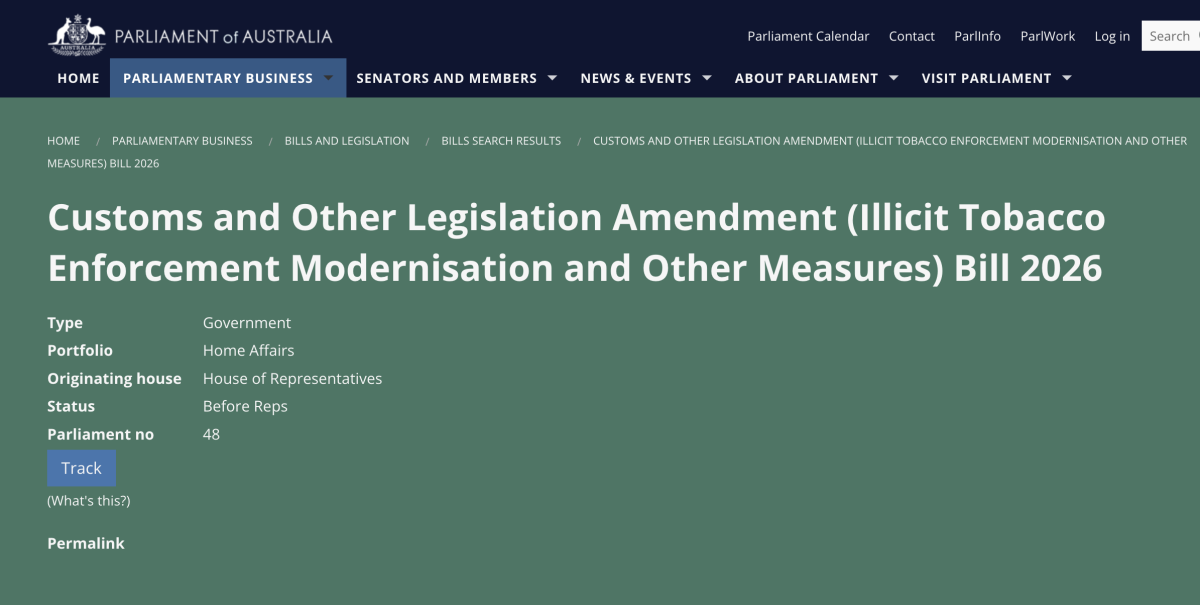
- The government introduced the Customs and Other Legislation Amendment (Illicit Tobacco Enforcement Modernisation and Other Measures) Bill 2026 in the House of Representatives on September 10.
- The bill would expand evidentiary presumptions, representative sampling and seizure and forfeiture mechanisms aimed at reducing proof barriers in large illicit tobacco cases.
- It would also strengthen duties for licensed customs brokers, warehouses and depots to prevent their businesses and facilities from being used in illicit tobacco supply chains.
- The measure follows the Combatting Illicit Tobacco Act 2026, which strengthened penalties, investigative powers and proceeds-of-crime tools in August.
2Firsts
September 14, 2026
Australia's federal government introduced the Customs and Other Legislation Amendment (Illicit Tobacco Enforcement Modernisation and Other Measures) Bill 2026 in the House of Representatives on September 10, proposing further changes to evidence rules, seizure and forfeiture procedures, proceeds-of-crime measures and customs supply-chain obligations.
The bill has completed its first reading and is now before the House.
It follows less than a month after the Combatting Illicit Tobacco Act 2026 received Royal Assent on August 26. That earlier legislation increased penalties for illicit tobacco offenses and expanded investigative and asset-recovery powers, while the latest bill extends the government's reforms further into imports, warehousing, customs licensing and evidentiary procedures.
Bill Targets Evidentiary Barriers in Large Tobacco Cases
One of the bill's key elements is a further overhaul of how illicit tobacco cases can be proved.
Explanatory material indicates that the government plans to introduce or expand evidentiary presumptions in certain circumstances and allow representative sampling of homogeneous bulk seizures.
The measures are intended to reduce the burden on enforcement agencies of proving the nature, tax status and relevant characteristics of every item in large illicit tobacco consignments.
Australian law already uses a reasonable-suspicion framework for some illicit tobacco offenses.
The Combatting Illicit Tobacco Act 2026, which took effect in August, expanded offenses covering possession, sale, supply and purchase of certain quantities of tobacco where there are reasonable grounds to suspect excise or customs duty has not been paid.
The September bill therefore does not introduce the reasonable-suspicion concept for the first time. It builds on that framework by further modifying evidence and enforcement procedures.
Seizure and Forfeiture Procedures to Be Expanded
The bill would also strengthen customs seizure and forfeiture powers.
The proposed changes include an expanded use of existing "special forfeited goods" mechanisms, allowing some tobacco products imported in breach of licensing or customs requirements to be seized or forfeited through more direct procedures.
The government also plans to streamline parts of the administrative process following seizure.
The measures are designed to shorten the enforcement path between identifying suspected illicit tobacco and securing forfeiture and disposal.
Duties Extend to Customs Brokers, Warehouses and Depots
Another major element of the proposal is the extension of obligations across the legitimate customs supply chain.
The reforms would apply to licensed customs brokers, warehouses and depots, requiring relevant operators to take reasonable steps to prevent their facilities, licences or businesses from being used in illicit tobacco movements.
The government also plans to expand the role of the existing National Customs Broker Licensing Advisory Committee to cover a wider group of customs-licensed operators, including warehouses and depots.
The changes would extend illicit tobacco compliance beyond importers and retailers into the infrastructure that supports international trade and domestic distribution.
For legitimate businesses, illicit tobacco exposure would increasingly involve internal controls, customer due diligence and management of facilities as well as the goods themselves.
Proceeds-of-Crime Measures Strengthened Further
The bill also proposes amendments to the Proceeds of Crime Act 2002.
The changes are intended to strengthen authorities' ability to identify, restrain and confiscate criminal benefits associated with illicit tobacco and to revise aspects of how financial penalties are calculated.
The proposal continues a direction established by the August legislation.
The Combatting Illicit Tobacco Act 2026 had already expanded tools involving restraining orders, search powers, access to electronic data, unexplained wealth and other proceeds-of-crime mechanisms.
Taken together, the two rounds of legislation move Australia's enforcement strategy beyond higher penalties toward disrupting the financial, logistical and supply-chain foundations of illicit tobacco networks.
August Raised the Cost of Offending; September Targets the Enforcement Chain
The August legislation focused on higher penalties for illicit importation, possession, sale, supply and manufacture of tobacco, while expanding investigative and asset-recovery powers.
The September bill addresses additional issues involving proof, product identification, seizure, forfeiture and supply-chain responsibilities.
The two measures therefore form a broader sequence of reforms: the first raises penalties and strengthens investigative tools, while the latest proposal seeks to reduce procedural and evidentiary barriers and push compliance obligations further upstream into the import and logistics chain.
Enforcement Expands Across Borders and Retail Channels
The legislation comes amid a broader acceleration of illicit tobacco enforcement in Australia.
During 2026, the Australian Border Force has carried out operations targeting petrol stations, retail networks and suspected import channels, while also working with overseas authorities, including Chinese enforcement agencies, on transnational tobacco-smuggling networks.
State governments have also increased enforcement.
Victoria, for example, has activated powers allowing authorities to temporarily close premises suspected of selling illicit tobacco and to seek longer closure orders through the courts.
The combination of federal and state measures shows Australia's illicit tobacco response expanding beyond traditional seizures and fines into criminal prosecution, asset recovery, supply-chain controls, cross-border cooperation and retail shutdowns.
Tax Debate Continues as Government Prioritizes Enforcement
Australia continues to debate the relationship between high tobacco excise rates and the growth of the illicit market.
A Senate inquiry into illicit tobacco this year recommended reconsidering further excise increases and examining options for tax changes.
The September bill, however, does not alter tobacco tax rates. Instead, it continues the federal government's emphasis on customs, criminal and supply-chain enforcement.
While the tax debate remains unresolved, the government's latest legislative move continues to expand enforcement capacity against illicit tobacco networks and the businesses and infrastructure that support them.
Follow 2Firsts for timely updates on global tobacco and nicotine regulations, market developments and industry trends.
Cover Image: Australian Border Force / Australian Parliament
Disclaimer
This article is provided solely for professional research, industry discussion, and informational purposes. Any references to brands, companies, products, technologies, or policies are made for factual reporting and analytical purposes only, and do not constitute endorsement, recommendation, promotion, or advertising by 2Firsts.
Nicotine-containing products, including but not limited to cigarettes, e-cigarettes, heated tobacco products, and nicotine pouches, carry significant health risks. Readers are responsible for complying with all applicable laws and regulations in their respective jurisdictions, including age restrictions and access limitations.
The information contained in this article should not be regarded as investment, legal, medical, regulatory, or commercial advice. While 2Firsts strives to ensure the accuracy and reliability of its content, it does not assume liability for any direct or indirect loss arising from errors, omissions, inaccuracies, or reliance on the information contained herein.
This article is not intended for individuals below the legal age for accessing tobacco or nicotine-related information in their jurisdiction.
Copyright Notice
This article is either original content produced by 2Firsts or content reproduced, translated, summarized, or adapted from third-party sources with attribution where applicable. The intellectual property rights of the original content remain with 2Firsts or the respective original rights holders.
No individual or organization may copy, reproduce, distribute, republish, modify, translate, or otherwise use this content without prior authorization. Any unauthorized use may result in legal action.
For copyright-related inquiries, corrections, or removal requests, please contact: info@2firsts.com.
AI-Assisted Translation and Editing Notice
Portions of this article may have been translated, edited, or reviewed with the assistance of artificial intelligence tools to improve efficiency and readability. Due to the limitations of AI-assisted translation and editing, discrepancies, omissions, or inaccuracies may exist when compared with the original source.
Where applicable, readers are advised to refer to the original source for the most complete and accurate information. If you identify any errors or believe that any content infringes upon your rights, please contact us at info@2firsts.com, and we will review and address the matter promptly.