Key Points
- New Zealand Associate Health Minister Casey Costello said legal tobacco sales have fallen by more than half over the past decade.
- Legal tobacco sales declined more than 20% in 2025 compared with 2024.
- Costello said falling sales may partly reflect increased availability of black-market cigarettes rather than only declining smoking rates.
- New Zealand government data shows per-capita cigarette sales have fallen by about 80% since 2010.
- New Zealand health authorities conducted more than 11,000 tobacco and vape retail compliance activities between July 2025 and June 2026.
2Firsts
August 26, 2026
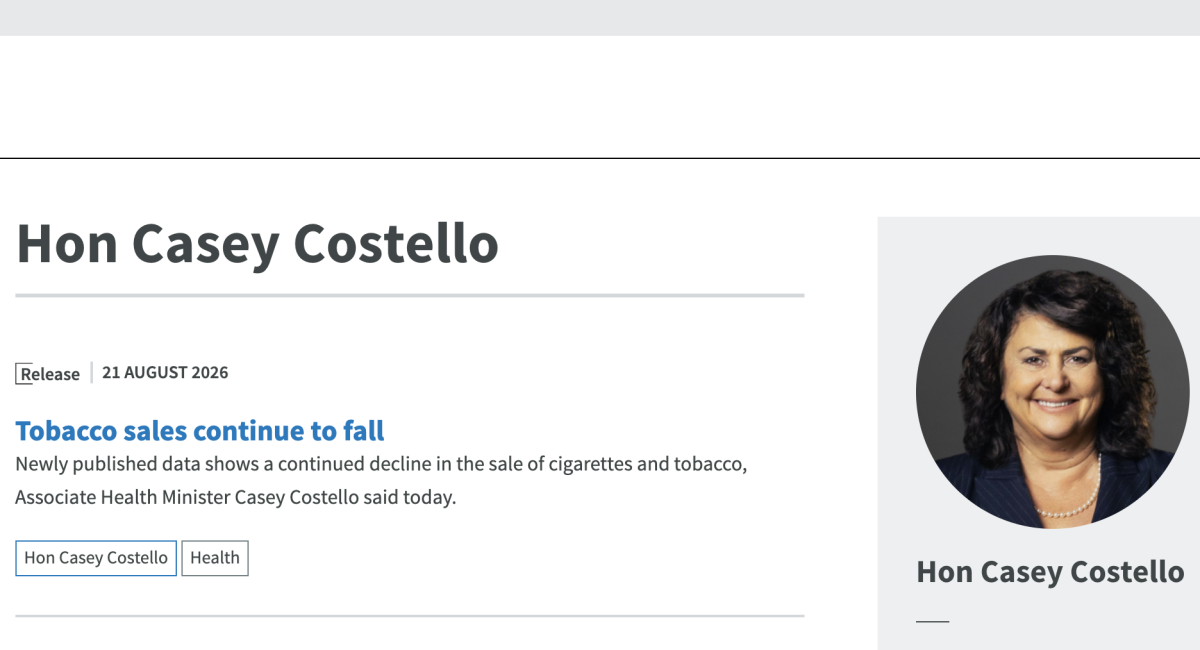
New Zealand Associate Health Minister Casey Costello said legal tobacco sales in the country have continued to decline, falling by more than half over the past decade, but warned that growth in the illicit cigarette market could affect the impact of tobacco control policies.
According to information released by the New Zealand government on August 21, Costello said legal tobacco sales declined by more than 20% in 2025 compared with the previous year.
She said the decline would be a positive development if it fully reflected lower smoking rates, but noted that increased availability of black-market cigarettes may also be contributing.
“It would be great if that reflected a corresponding decline in smoking rates, but it is likely that it is also to do with the availability of black-market cigarettes,” Costello said.
Legal Tobacco Sales Halve Over Decade
New Zealand government data shows that legal tobacco sales have continued to decline in recent years.
Over the past decade, legal tobacco sales have fallen by more than half. Since 2010, total tobacco sales have declined by about two-thirds, while per-capita cigarette sales have fallen by nearly 80%.
Costello said the decline reflects long-term tobacco control measures and changing consumer behavior, but added that the government must also monitor the potential impact of illicit tobacco.
If consumers shift toward unregulated illicit cigarettes, the public health benefits associated with declining legal sales could be reduced while tax revenue losses increase.
Government Raises Concerns Over Illicit Tobacco Supply
New Zealand has continued to focus on preventing illicit tobacco activity.
Costello said cheaper illicit cigarettes could undermine efforts to help smokers quit or switch to lower-risk alternatives, including vaping products.
She said illicit tobacco not only creates tax revenue losses but can also be linked to broader criminal activity.
For policymakers, changes in legal tobacco sales and illicit market activity need to be considered together rather than relying only on legal sales data as an indicator of smoking behavior.
Tobacco and Vape Retail Enforcement Expands
Alongside concerns over illicit tobacco, the New Zealand government has continued strengthening tobacco and vape retail enforcement.
Government data showed that New Zealand health authorities conducted more than 11,000 tobacco and vape retail compliance activities between July 2025 and June 2026.
The activities included more than 6,300 compliance inspections and more than 4,900 controlled purchase operations.
The government has also introduced additional vape retail measures, including restrictions on disposable vapes, stronger display requirements and increased penalties for sales of tobacco and vaping products to minors.
Vaping Remains Regulated as an Alternative Product
In her comments, Costello also noted that illicit low-cost cigarettes could affect efforts to encourage smokers to quit or move toward lower-risk alternatives, including vaping products.
However, New Zealand has not removed regulatory requirements for vaping products.
The country continues to regulate vape sales, retail compliance and youth access protections.
The latest tobacco sales data shows continued contraction in New Zealand’s legal tobacco market, while the government is also monitoring whether growth in illicit supply could affect tobacco control, taxation and regulatory objectives.
Follow 2Firsts for the latest global tobacco and nicotine regulation, market developments and policy updates.
Cover Image:beehive
Disclaimer
This article is provided solely for professional research, industry discussion, and informational purposes. Any references to brands, companies, products, technologies, or policies are made for factual reporting and analytical purposes only, and do not constitute endorsement, recommendation, promotion, or advertising by 2Firsts.
Nicotine-containing products, including but not limited to cigarettes, e-cigarettes, heated tobacco products, and nicotine pouches, carry significant health risks. Readers are responsible for complying with all applicable laws and regulations in their respective jurisdictions, including age restrictions and access limitations.
The information contained in this article should not be regarded as investment, legal, medical, regulatory, or commercial advice. While 2Firsts strives to ensure the accuracy and reliability of its content, it does not assume liability for any direct or indirect loss arising from errors, omissions, inaccuracies, or reliance on the information contained herein.
This article is not intended for individuals below the legal age for accessing tobacco or nicotine-related information in their jurisdiction.
Copyright Notice
This article is either original content produced by 2Firsts or content reproduced, translated, summarized, or adapted from third-party sources with attribution where applicable. The intellectual property rights of the original content remain with 2Firsts or the respective original rights holders.
No individual or organization may copy, reproduce, distribute, republish, modify, translate, or otherwise use this content without prior authorization. Any unauthorized use may result in legal action.
For copyright-related inquiries, corrections, or removal requests, please contact: info@2firsts.com.
AI-Assisted Translation and Editing Notice
Portions of this article may have been translated, edited, or reviewed with the assistance of artificial intelligence tools to improve efficiency and readability. Due to the limitations of AI-assisted translation and editing, discrepancies, omissions, or inaccuracies may exist when compared with the original source.
Where applicable, readers are advised to refer to the original source for the most complete and accurate information. If you identify any errors or believe that any content infringes upon your rights, please contact us at info@2firsts.com, and we will review and address the matter promptly.