Key Points
- HHS formally appointed Bret Koplow as director of the FDA’s Center for Tobacco Products after his acting tenure.
- Koplow has worked at the FDA since 2011, with a long record in tobacco regulation, law and policy.
- During his acting tenure, CTP said it reduced the PMTA backlog by about 70% in 2025 and accelerated review processes.
- HHS said CTP will prioritize innovation and access to less harmful alternatives for adult smokers alongside youth protection.
2Firsts
September 9, 2026
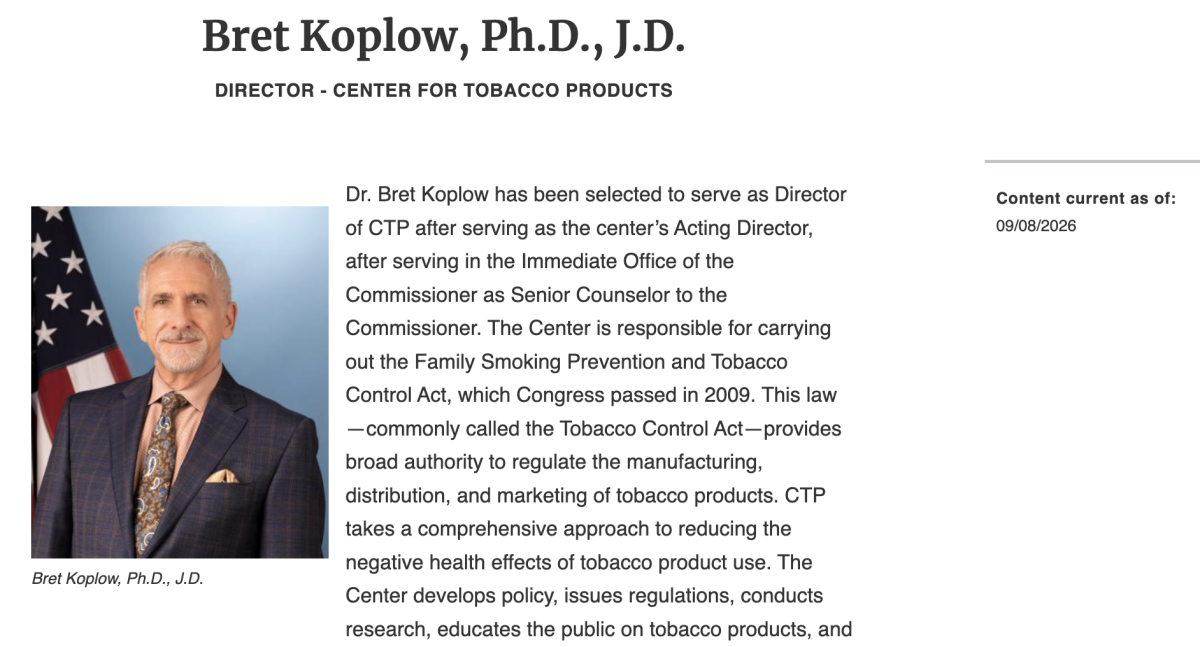
According to an announcement by the U.S. Department of Health and Human Services on September 8, 2026, Bret Koplow has been formally appointed director of the U.S. Food and Drug Administration’s Center for Tobacco Products.
Koplow had already been serving as acting director. The appointment ends the center’s acting-leadership period and places the agency’s tobacco and nicotine regulatory arm under a permanent director.
Longstanding FDA Tobacco Policy Background
Koplow has worked at the FDA since 2011.
Before joining CTP leadership, he served from 2020 as a senior adviser to the FDA commissioner, focusing heavily on tobacco regulation, policy and operations.
Earlier roles included positions in the FDA Office of Chief Counsel and the Office of Legislation.
Koplow has both legal and clinical psychology training, giving him a background centered on regulatory law, policy implementation and agency operations rather than a purely scientific or public-health track.
Acting Tenure Focused on Faster PMTA Reviews
During his time as acting CTP director, Koplow made product-review efficiency a visible priority.
In a May 2026 statement, he said CTP had reduced the PMTA backlog by roughly 70% during 2025 and had eliminated queues at the acceptance stage.
The center also said it was working to improve filing and scientific-review efficiency and develop faster review pathways for certain supplemental PMTAs.
Nicotine pouches were another major focus.
CTP launched a nicotine pouch PMTA pilot and said the first decisions were completed within three months of scientific review beginning. The center said lessons from that pilot would be applied more broadly to nicotine pouch applications.
2Firsts previously reported that Koplow’s May statement placed increased emphasis on innovation and review efficiency, signaling a stronger focus on accelerating regulatory decision-making for tobacco and nicotine products.
HHS Highlights Innovation and Lower-Risk Alternatives
HHS also used the appointment announcement to define CTP’s priorities under Koplow’s permanent leadership.
The department said Koplow will lead efforts to advance innovation and increase access to less harmful alternatives for adult smokers while taking decisive action to protect American youth from tobacco and nicotine harms.
The wording places adult access to alternative products alongside youth protection as part of CTP’s formal priorities.
For vaping, nicotine pouch and heated tobacco companies, the statement indicates that product innovation and regulatory market access will remain central parts of the agency’s agenda.
Recent Authorizations Reflect Review Direction
During Koplow’s acting tenure, the FDA continued issuing decisions across several newer nicotine categories.
The agency advanced nicotine pouch reviews and authorized additional ZYN products and other pouches.
On August 28, the FDA also authorized the JUUL2 device and two 1.6% pods for marketing in the United States.
Those decisions are consistent with the center’s stated emphasis on improving review efficiency.
At the same time, the FDA has continued enforcement against unauthorized products, products with strong youth appeal and companies that violate marketing or sales requirements.
Koplow’s formal appointment therefore does not signal deregulation. It is more likely to continue the dual approach already visible under his acting leadership: faster review of compliant products combined with continued enforcement against unauthorized and youth-focused products.
CTP Enters a Permanent Leadership Phase
CTP oversees U.S. market authorization, product standards, marketing rules and enforcement for tobacco and nicotine products, making it one of the world’s most influential tobacco regulators.
Koplow’s move from acting to permanent director gives the center greater leadership continuity as it manages a large and evolving regulatory workload.
For industry, that stability also matters commercially.
PMTA, MRTP and other tobacco product regulatory pathways are lengthy, and companies depend heavily on predictable review standards, communication and enforcement timelines.
Under Koplow’s permanent leadership, the pace of review, treatment of innovative products and balance between adult access and youth protection will remain key regulatory signals for the U.S. vaping, nicotine pouch and heated tobacco markets.
Follow 2Firsts for timely updates on global tobacco and nicotine regulations, market developments and industry trends.
Cover Image:FDA
Disclaimer
This article is provided solely for professional research, industry discussion, and informational purposes. Any references to brands, companies, products, technologies, or policies are made for factual reporting and analytical purposes only, and do not constitute endorsement, recommendation, promotion, or advertising by 2Firsts.
Nicotine-containing products, including but not limited to cigarettes, e-cigarettes, heated tobacco products, and nicotine pouches, carry significant health risks. Readers are responsible for complying with all applicable laws and regulations in their respective jurisdictions, including age restrictions and access limitations.
The information contained in this article should not be regarded as investment, legal, medical, regulatory, or commercial advice. While 2Firsts strives to ensure the accuracy and reliability of its content, it does not assume liability for any direct or indirect loss arising from errors, omissions, inaccuracies, or reliance on the information contained herein.
This article is not intended for individuals below the legal age for accessing tobacco or nicotine-related information in their jurisdiction.
Copyright Notice
This article is either original content produced by 2Firsts or content reproduced, translated, summarized, or adapted from third-party sources with attribution where applicable. The intellectual property rights of the original content remain with 2Firsts or the respective original rights holders.
No individual or organization may copy, reproduce, distribute, republish, modify, translate, or otherwise use this content without prior authorization. Any unauthorized use may result in legal action.
For copyright-related inquiries, corrections, or removal requests, please contact: info@2firsts.com.
AI-Assisted Translation and Editing Notice
Portions of this article may have been translated, edited, or reviewed with the assistance of artificial intelligence tools to improve efficiency and readability. Due to the limitations of AI-assisted translation and editing, discrepancies, omissions, or inaccuracies may exist when compared with the original source.
Where applicable, readers are advised to refer to the original source for the most complete and accurate information. If you identify any errors or believe that any content infringes upon your rights, please contact us at info@2firsts.com, and we will review and address the matter promptly.