Disclaimer:
This article is intended solely for global tobacco and nicotine industry research and information purposes. It does not constitute investment advice, securities trading advice or a forecast of the future performance of any company.
Key Points
- Profit Warning: China Tobacco International (HK) expects first-half 2026 revenue to fall 25%-30%, with profit attributable to owners down 10%-15%.
- Main Drivers: The company cited lower tobacco leaf imports and delayed cigarette shipments to China’s domestic duty-free market as key factors behind the expected decline.
- Revenue Structure: In 2025, tobacco leaf imports, exports and Brazilian operations contributed about 88% of group revenue, while new tobacco products accounted for less than 1%.
- Core Variables: Although CTIHK serves as China Tobacco’s international platform, its performance remains shaped by domestic leaf demand, import planning, duty-free mechanisms and global trade conditions.
- Next Watch: Key questions for the second half include whether leaf imports and duty-free cigarette shipments recover, and whether business diversification can reduce reliance on traditional tobacco leaf imports.
2Firsts
Shenzhen, June 18, 2026
China Tobacco International (HK) Company Limited, or CTIHK, stock code 6055, expects its revenue and profit to decline year on year in the first half of 2026, mainly due to lower tobacco leaf imports and delayed cigarette shipments to China’s domestic duty-free market.
The profit warning points not only to short-term earnings pressure, but also to the multiple variables affecting the company’s core traditional tobacco trading business. Tobacco leaf imports, tobacco leaf exports, Brazilian operations and cigarette exports make up its main revenue sources, while those businesses are exposed to domestic Chinese demand, import arrangements, duty-free business processes, international trade conditions and competition in the global tobacco leaf market.
Lower Leaf Imports, Delayed Cigarette Shipments Weigh on First-Half Performance
In a profit warning issued on June 18, CTIHK said that, based on a preliminary assessment of the group’s unaudited consolidated management accounts for the five months ended May 31, 2026, and information currently available to the board, the group expects revenue for the six months ending June 30, 2026, to fall by about 25% to 30% year on year. Profit attributable to owners of the company is expected to decline by about 10% to 15%.
The company cited two main factors behind the expected decrease in revenue and profit.
First, in its tobacco leaf products import business, the volume of tobacco leaf imported from the United States and other regions fell from a year earlier due to factors including international trade relations and shipment schedules, leading to lower revenue and gross profit in the segment.
Second, in its cigarette export business, a phased impact from business process adjustments in the domestic duty-free market delayed cigarette shipments to that market, reducing revenue from the segment.
The information in the announcement has not been audited or reviewed by the company’s independent auditor. CTIHK said detailed financial information for the period will be disclosed in its interim results announcement, expected to be published on or before August 31, 2026.
2025 Revenue and Profit Rose Before the First-Half Warning
The warning follows a year in which CTIHK reported growth in both revenue and profit.
According to the company’s 2025 annual report, disclosed on April 23, 2026, group revenue in 2025 was HK$14.579 billion, up 11.5% year on year. Gross profit was HK$1.473 billion, up 6.9%, while profit attributable to owners of the company was HK$980 million, up 14.8%.
In its June 18 announcement, the company also said that from 2021 to 2025, group revenue increased from HK$3.48 billion in 2020 to HK$14.58 billion in 2025, representing a compound annual growth rate of 33%. Profit attributable to owners of the company rose from HK$110 million in 2020 to HK$980 million in 2025, with a compound annual growth rate of 56%.
The company said it had also signed cooperation agreements during the period with duty-free operators including Zhuhai Duty Free International Co., Ltd. and Shenzhen Duty Free (HK) Limited to consolidate the long-term development advantages of its domestic duty-free cigarette business, optimize its operating model and improve long-term profitability.
Sole Listed Tobacco Business Platform, Revenue Structure Concentrated in Leaf
CTIHK said in its 2025 annual report that it is the only listed tobacco business company within China’s tobacco system. Its businesses cover tobacco leaf, cigarettes, new tobacco products and cigars, with market coverage across East Asia, South Asia, North and South America, Central and Eastern Europe and more than 50 countries and regions.
The company’s main businesses include tobacco leaf products imports, tobacco leaf products exports, cigarette exports, new tobacco products exports and Brazilian operations.
In 2025, the tobacco leaf products import business generated revenue of HK$9.538 billion, accounting for about 65% of total group revenue. Tobacco leaf products exports generated HK$2.481 billion, or about 17%. Brazilian operations generated HK$829 million, or about 6%. Cigarette exports generated HK$1.666 billion, or about 11%. New tobacco products exports generated HK$64.3 million, accounting for less than 1%.
That structure provides context for the profit warning. The company’s largest revenue source is tobacco leaf imports, which was also the first source of pressure mentioned in the announcement. Cigarette exports account for less revenue than the leaf businesses, but delayed shipments to the domestic duty-free market were significant enough to affect first-half revenue.

China Tobacco International (HK)’s 2025 revenue structure shows that tobacco leaf imports, exports and Brazilian operations together contributed about 88% of group revenue, while new tobacco products accounted for less than 1%. | Source: CTIHK 2025 Annual Report; graphic by 2Firsts.
Traditional Tobacco Remains the Core, But Faces Multiple Uncertainties
(1)Nearly 90% of Revenue Comes From Tobacco Leaf, While New Tobacco Products Account for Less Than 1%
Based on 2025 revenue, tobacco leaf products imports, tobacco leaf products exports and Brazilian operations together contributed about 88% of group revenue. Cigarette exports accounted for about 11%, while new tobacco products exports accounted for less than 1%.
This shows that CTIHK’s current revenue base remains concentrated in the traditional tobacco supply chain, rather than in new tobacco products. New tobacco products may remain an area to watch, but based on disclosed 2025 data, they have not yet become a major revenue source for the company.
The annual report showed that revenue from new tobacco products exports fell 52.5% year on year in 2025 to HK$64.3 million. The company attributed the decline mainly to the adverse impact of geopolitical conflicts and regulatory changes in target markets on supply chains, reduced shipments in major markets, and slower product introductions as suppliers upgraded manufacturing equipment, phased out older products and carried out product iterations.
(2)Tobacco Leaf Imports Account for About 65% of Revenue and Are Tied to Chinese Demand and Planning
Tobacco leaf imports are CTIHK’s largest revenue source. In 2025, the business generated HK$9.538 billion in revenue, accounting for about 65% of total group revenue.
The business is closely linked to China’s domestic traditional tobacco market. The annual report said that, for the tobacco leaf products import business, China Tobacco International is the group’s sole customer and the only entity qualified to import overseas tobacco leaf products into China.
That means the revenue pace of the import business depends not only on international tobacco leaf supply, but also on Chinese domestic demand for imported leaf, product mix, annual import plans, procurement arrangements and shipment schedules.
The latest announcement said the volume of tobacco leaf imported from the United States and other regions fell year on year, further underscoring the business’s sensitivity to supply sources, trade relations and logistics timing.
(3)International Leaf Business Grew Faster, But Faces Competition and Trade Risk
Unlike the import business, tobacco leaf exports and Brazilian operations are more exposed to international markets. In 2025, tobacco leaf products exports and Brazilian operations generated combined revenue of about HK$3.31 billion, or about 23% of total group revenue.
These businesses give CTIHK broader international growth exposure. The annual report showed that revenue from tobacco leaf products exports rose 20.4% year on year in 2025, while gross profit increased 86.8%. The company said the growth mainly reflected stronger customized services, improved pricing strategy, broader supply channels and closer cooperation with key domestic suppliers.
But international leaf operations also face more complex external variables, including procurement systems of multinational tobacco companies, competition among producing regions, changes in customer structure, foreign exchange volatility, logistics cycles, international trade relations and geopolitical risks.
CTIHK’s tobacco leaf business therefore has a dual character: the import business is more affected by China’s traditional tobacco market demand and planning arrangements, while the export and Brazil businesses are more exposed to global tobacco leaf trade competition and international supply chain uncertainty.
(4)Cigarette Exports Account for About 10%, But Duty-Free Process Changes Have Already Hit Revenue
Cigarette exports account for a smaller share of CTIHK’s revenue than the leaf businesses, but their importance to profit and channel structure should not be underestimated.
In 2025, cigarette export revenue was HK$1.666 billion, up 5.9% year on year. Gross profit was HK$381 million, up 37.2%. The company said in its annual report that the revenue and gross profit growth mainly reflected continued expansion of self-operated channels, optimization of brand mix and business structure, and continued expansion of the self-operated business scale.
The annual report also showed that the cigarette export business is closely linked to duty-free channels. The company’s exclusive operating area for cigarettes includes duty-free shops in Hong Kong, Singapore, Thailand and Macao, as well as duty-free shops in China’s mainland customs-supervised areas. The annual report also said customers of the cigarette export business include end retailers in duty-paid markets, duty-free operators and cigarette wholesalers.
The latest profit warning said business process adjustments in the domestic duty-free market delayed cigarette shipments and affected revenue. The annual report did not disclose the specific share of domestic duty-free sales within cigarette export revenue, but the announcement indicates that duty-free channels and related operating mechanisms can have a clear impact on CTIHK’s interim performance.
(5)Global Platform Remains Exposed to Both Domestic Mechanisms and International Variables
CTIHK is often viewed as a platform for observing China Tobacco’s internationalization. But its revenue structure shows that the company’s development does not depend solely on overseas market expansion.
Its tobacco leaf import business is affected by China’s traditional tobacco market demand, import plans and procurement arrangements. Its cigarette export business is affected by duty-free channels and mainland customs-supervised market mechanisms. Its tobacco leaf export and Brazil businesses face changes in global trade, supply chains and competition.
That places CTIHK between two sets of variables: global tobacco industry transformation, international trade relations and supply chain restructuring on one side; and China’s traditional tobacco market demand structure, regulatory mechanisms and business process arrangements on the other.
Whether the company can reduce its reliance on tobacco leaf imports and traditional trading models will depend on its actual progress in tobacco leaf exports, Brazilian operations, cigar exports, duty-free channel optimization and international business for new tobacco products.
Second-Half Focus: Shipment Recovery and Business Diversification
Market and industry observers may focus on three questions in the coming months.
First, whether the decline in tobacco leaf imports from the United States and other regions is only a phased shipment timing issue, or whether it will continue over a longer period.
Second, whether delayed cigarette shipments to the domestic duty-free market will be recovered in the second half, or whether they reflect a longer-term change in business processes.
Third, whether CTIHK’s positioning in tobacco leaf exports, Brazilian operations, cigar exports, duty-free channels and new tobacco products can reduce its reliance on traditional tobacco leaf imports.
Overall, the profit warning is not only a listed-company earnings alert. It also offers a window into the structure of China’s international tobacco business. Traditional tobacco supply chains remain the core base of CTIHK’s business, but that base itself is shaped by domestic demand, planning arrangements, duty-free mechanisms, international trade relations and competition in the global tobacco leaf market.
For continued coverage of China’s tobacco market, regulatory mechanisms and international business developments, follow 2Firsts.
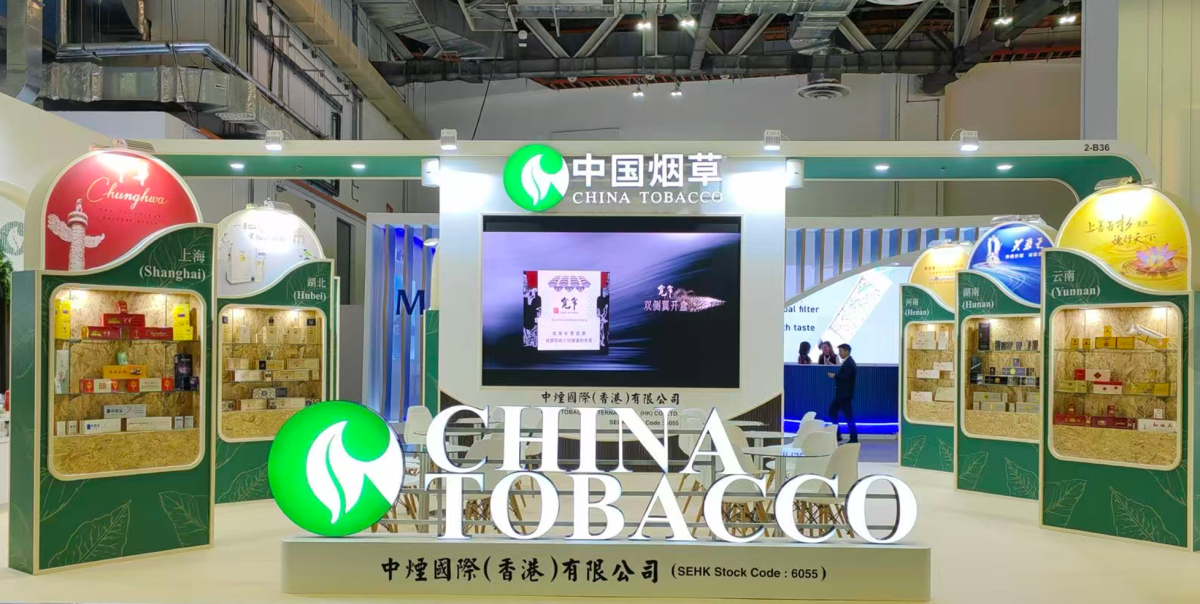
China Tobacco International (HK) participates in an international trade show. |Photo by 2Firsts.
Disclaimer
This article is provided solely for professional research, industry discussion, and informational purposes. Any references to brands, companies, products, technologies, or policies are made for factual reporting and analytical purposes only, and do not constitute endorsement, recommendation, promotion, or advertising by 2Firsts.
Nicotine-containing products, including but not limited to cigarettes, e-cigarettes, heated tobacco products, and nicotine pouches, carry significant health risks. Readers are responsible for complying with all applicable laws and regulations in their respective jurisdictions, including age restrictions and access limitations.
The information contained in this article should not be regarded as investment, legal, medical, regulatory, or commercial advice. While 2Firsts strives to ensure the accuracy and reliability of its content, it does not assume liability for any direct or indirect loss arising from errors, omissions, inaccuracies, or reliance on the information contained herein.
This article is not intended for individuals below the legal age for accessing tobacco or nicotine-related information in their jurisdiction.
Copyright Notice
This article is either original content produced by 2Firsts or content reproduced, translated, summarized, or adapted from third-party sources with attribution where applicable. The intellectual property rights of the original content remain with 2Firsts or the respective original rights holders.
No individual or organization may copy, reproduce, distribute, republish, modify, translate, or otherwise use this content without prior authorization. Any unauthorized use may result in legal action.
For copyright-related inquiries, corrections, or removal requests, please contact: info@2firsts.com.
AI-Assisted Translation and Editing Notice
Portions of this article may have been translated, edited, or reviewed with the assistance of artificial intelligence tools to improve efficiency and readability. Due to the limitations of AI-assisted translation and editing, discrepancies, omissions, or inaccuracies may exist when compared with the original source.
Where applicable, readers are advised to refer to the original source for the most complete and accurate information. If you identify any errors or believe that any content infringes upon your rights, please contact us at info@2firsts.com, and we will review and address the matter promptly.