Key Points
- The Zhengzhou Tobacco Research Institute of China National Tobacco Corporation filed a patent covering end-to-end analysis of chemical migration and transformation in heated tobacco products.
- The method uses comparable GC-Orbitrap/MS non-targeted analysis on tobacco substrate and aerosol samples to trace compound origins.
- The patent establishes a high-resolution mass spectral library covering more than 749 tobacco-related compounds.
- Analysis of nine heated tobacco products identified 17 newly formed thermal decomposition compounds and 38 compounds transferred from the tobacco substrate into the aerosol.
- Across the tested samples, nicotine transfer rates ranged from about 20% to 50%, while propylene glycol ranged from about 10% to 30%.
2Firsts
August 13, 2026
According to public records from China’s National Intellectual Property Administration (CNIPA), the Zhengzhou Tobacco Research Institute of China National Tobacco Corporation has filed a patent application for a method to analyze the migration and transformation of chemical compounds in heated tobacco products.
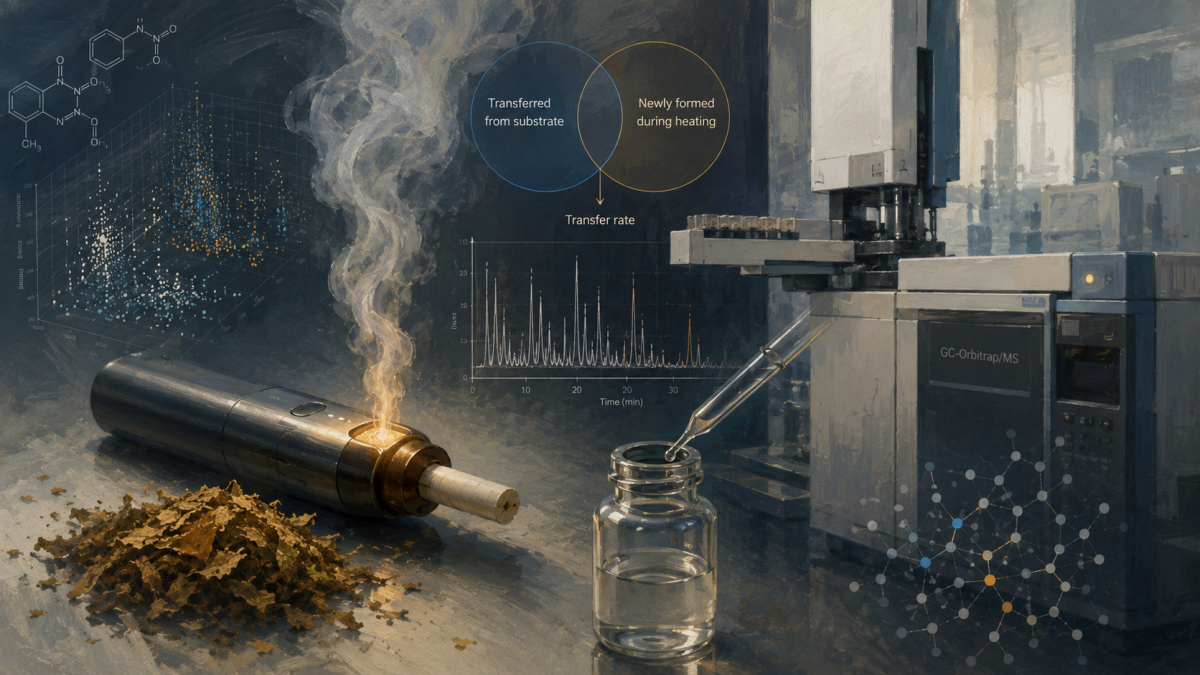
The proposed method compares chemical profiles in the tobacco substrate with those in the aerosol generated during use, aiming to determine which compounds are transferred directly from the substrate, which are newly formed during heating, and how much of individual compounds is transferred into the aerosol.
The application, titled “An End-to-End Quantitative Migration and Transformation Analysis Method for Chemical Components of Heated Tobacco Products and Applications Thereof,” was filed on May 9, 2026, and published as CN122361690A on July 10, 2026.
From detecting compounds to tracing their origins
The patent focuses on establishing a comparable analytical framework for both the tobacco substrate and the resulting aerosol, rather than measuring only selected target compounds such as nicotine or menthol.
The proposed process first establishes a high-resolution mass spectral library of tobacco-related compounds. GC-Orbitrap/MS is then used to conduct non-targeted relative quantification of compounds in the tobacco substrate and in aerosol collected after heating.
The two datasets are compared to determine compound origins. A substance detected quantitatively in the aerosol but not in the tobacco substrate, or found at a higher level in the aerosol than in the substrate, is categorized as a newly formed thermal decomposition compound. A compound present at a lower level in the aerosol than in the substrate is categorized as a transferred compound, allowing its transfer rate to be calculated.
The method therefore attempts to move beyond determining what chemicals are present toward identifying where they come from and how they change during heating.
Nine-product analysis identifies 17 newly formed and 38 transferred compounds
In one example, researchers analyzed nine heated tobacco products using comparable high-resolution non-targeted methods for both their tobacco substrates and aerosols.
The patent describes a high-resolution mass spectral library containing more than 749 tobacco-related compounds, covering categories including alcohols, phenols, aldehydes, ketones, esters, nitrogen-containing compounds and sulfur-containing compounds.
The analysis identified 17 newly formed thermal decomposition compounds. Six were below the quantification limit in the tobacco substrate, while another 11 were detected at higher levels in the aerosol than in the substrate.
The patent also identified 38 compounds transferred from the tobacco substrate into the aerosol.
Across the nine samples, nicotine transfer rates ranged from approximately 20% to 50%, while propylene glycol ranged from 10% to 30% and limonene from 1% to 23%.
The filing also reported substantial variation in the transfer behavior of flavor-related compounds including menthol, menthone, isomenthone, menthyl acetate and caryophyllene, indicating that tobacco substrate formulation can materially affect the transfer of some flavor compounds during heating.
Data could support formulation and heating-system analysis
The patent further analyzes possible sources of several newly formed compounds. It attributes some furan compounds to the thermal decomposition of sugars and describes 3-chloro-1,2-propanediol and acetaldehyde glycerol acetal as compounds associated with glycerol during heating.
According to the filing, identifying newly formed compounds and their possible precursors could provide data for adjusting raw materials, additives and processing conditions. Transfer-rate measurements could also be used to compare the delivery efficiency of compounds across different formulations or heating conditions.
The patent states that the method could support what it describes as “harm reduction and quality improvement” design, including analysis of potentially harmful compound sources, evaluation of compound transfer efficiency and optimization of formulations and heating systems.
That wording reflects the intended application described in the patent and does not establish that the analytical method itself demonstrates reduced health risk.
Zhengzhou Tobacco Research Institute provides industry-level technical support
The Zhengzhou Tobacco Research Institute is a comprehensive research institute directly under China National Tobacco Corporation and carries out research across tobacco chemistry, processing and related technical fields. It also hosts industry-level technical platforms including the National Tobacco Quality Supervision and Inspection Center and the China Tobacco Standardization Research Center.
Against that background, the patent is notable not only as an analytical method but also as an attempt to establish a systematic framework for comparing chemical behavior across heated tobacco formulations, production processes and heating conditions.
The patent application, however, does not indicate that the method has been adopted as a Chinese industry standard, regulatory review method or product approval requirement.
Follow 2Firsts for continuous coverage of global NGPs policies, technology developments, market trends and industry updates.
Cover Image generated by AI
Disclaimer
This article is provided solely for professional research, industry discussion, and informational purposes. Any references to brands, companies, products, technologies, or policies are made for factual reporting and analytical purposes only, and do not constitute endorsement, recommendation, promotion, or advertising by 2Firsts.
Nicotine-containing products, including but not limited to cigarettes, e-cigarettes, heated tobacco products, and nicotine pouches, carry significant health risks. Readers are responsible for complying with all applicable laws and regulations in their respective jurisdictions, including age restrictions and access limitations.
The information contained in this article should not be regarded as investment, legal, medical, regulatory, or commercial advice. While 2Firsts strives to ensure the accuracy and reliability of its content, it does not assume liability for any direct or indirect loss arising from errors, omissions, inaccuracies, or reliance on the information contained herein.
This article is not intended for individuals below the legal age for accessing tobacco or nicotine-related information in their jurisdiction.
Copyright Notice
This article is either original content produced by 2Firsts or content reproduced, translated, summarized, or adapted from third-party sources with attribution where applicable. The intellectual property rights of the original content remain with 2Firsts or the respective original rights holders.
No individual or organization may copy, reproduce, distribute, republish, modify, translate, or otherwise use this content without prior authorization. Any unauthorized use may result in legal action.
For copyright-related inquiries, corrections, or removal requests, please contact: info@2firsts.com.
AI-Assisted Translation and Editing Notice
Portions of this article may have been translated, edited, or reviewed with the assistance of artificial intelligence tools to improve efficiency and readability. Due to the limitations of AI-assisted translation and editing, discrepancies, omissions, or inaccuracies may exist when compared with the original source.
Where applicable, readers are advised to refer to the original source for the most complete and accurate information. If you identify any errors or believe that any content infringes upon your rights, please contact us at info@2firsts.com, and we will review and address the matter promptly.