BAT Fiji invests $1 million to upgrade tobacco curing barn, achieving annual savings of $200,000

Sep.09.2025
BAT Fiji invests $1 million to upgrade tobacco curing barn, achieving annual savings of $200,000
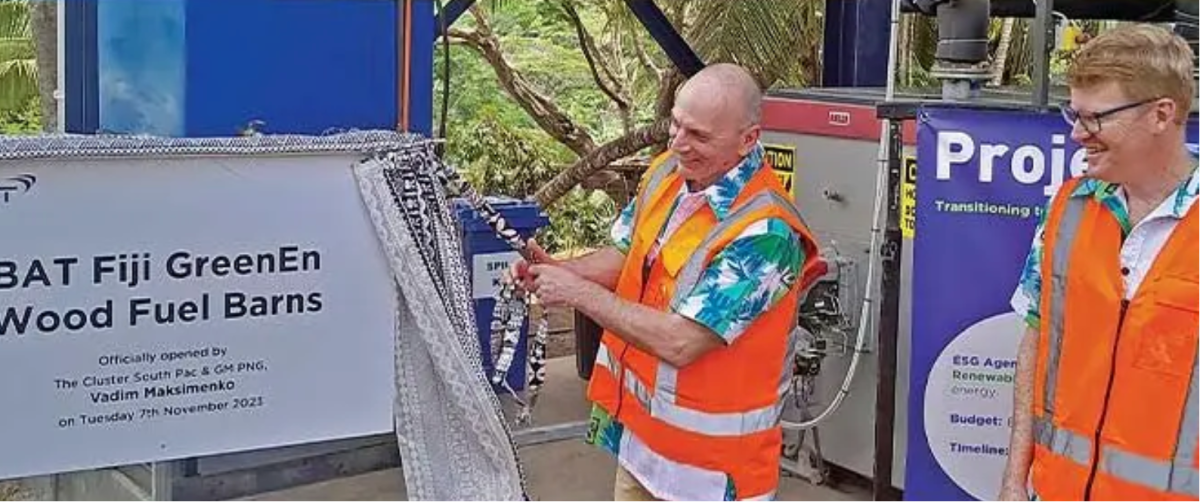
British American Tobacco (BAT) Fiji has completed a $1 million upgrade to a curing barn in Votualevu, Nadi, shifting from diesel to a more sustainable fuel source. The project—part of BAT’s ESG programme—targets an annual reduction of 428 tonnes of carbon emissions and up to $200,000 in yearly cost savings.

Key Points


  • Investment & scope: $1 million “Project GreenEN” upgrade to the curing barn at BAT Fiji’s leaf division in Votualevu, Nadi.
  • Emissions impact: Projected 428 tonnes of CO₂ reductions per year.
  • Operational savings: Up to $200,000 in annual cost savings after completion in Q3 this year.
  • ESG framework: Part of wider initiatives including Project GreenEN, Alliance for Water Stewardship, and Grow+.
  • Local footprint: Fiji is among the few countries where BAT conducts leaf farming, supporting about 1,100 seasonal workers and hundreds of local farmers.


2Firsts, Sep 9, 2025 — British American Tobacco (BAT) Fiji has commissioned an upgraded curing barn at its Votualevu leaf facility, enabling a transition away from diesel to a more sustainable fuel source. The $1 million project—delivered in the third quarter under BAT’s Environmental, Social and Governance (ESG) programme—is expected to reduce the site’s carbon emissions by 428 tonnes annually and generate up to $200,000 in yearly cost savings.


The initiative forms part of BAT’s broader ESG agenda, which also includes Project GreenEN, Alliance for Water Stewardship efforts, and the Grow+ programme aimed at advancing environmental and social outcomes across the company’s “seed-to-consumer” operations.


“This marks some major achievements for the business,” said Vadim Maksimenko, BAT Cluster General Manager South Pacific. “The successful implementation of Project GreenEN will allow us to reduce our carbon footprint and deliver material cost efficiencies.”


BAT noted that Fiji is one of the few countries where the company undertakes leaf farming, supporting approximately 1,100 seasonal workers alongside hundreds of local farmers. According to the company, the curing-barn upgrade is intended to strengthen the resilience and sustainability of its local leaf supply while contributing to national emissions-reduction goals.

FDA Highlights Product Characterization as a Foundational Requirement in ENDS PMTA Reviews
During its ongoing PMTA roundtable, FDA emphasized that product characterization is a foundational element in the review of electronic nicotine delivery systems (ENDS). The agency underscored the need for complete product identifying information, validation and verification of test methods on the specific product type, and the appropriate use of tobacco product master files (TPMFs) to support complex or proprietary ingredients in PMTA submissions.
Feb.10
The UK government plans to expand the scope of its e-cigarette ban to include playgrounds, off-campus areas, and areas outside hospitals.
Government plans would ban vaping in cars carrying children and restrict smoking, vaping and heated tobacco in settings including playgrounds and outside schools across England, subject to a 12-week public consultation. The proposals also say indoor spaces where smoking is already banned would become vape- and heated-tobacco-free, and areas outside hospitals would be included.
Feb.13 by 2FIRSTS.ai
Rethinking Nicotine Harm Reduction: A Neuroscientist’s Perspective on Scientific Gaps and Future Directions — By Dr. Xin-an Liu
After France’s ANSES report on nicotine products and harm reduction, Dr. Xin-an Liu wrote to 2Firsts reassessing the field’s foundations. She argues the debate reveals gaps in evidence on long-term behavioral substitution, addiction pathways and neurobiological impacts, and calls for longitudinal research, integrated behavioral science and neuroimaging, clearer risk assessment and stronger transparency to ensure policy and next-generation product development rest on solid evidence.
Industry Insight
Feb.24
Thailand’s DDC Files Complaint Over Online Sales of Nicotine Pouches
Thailand’s Department of Disease Control has lodged a complaint over the alleged online sale of nicotine pouches. The department said its monitoring found the products were being advertised and sold through electronic media, and a further inquiry later identified a physical shop linked to a store in Pathum Thani province.
Mar.23 by 2FIRSTS.ai
Texas college data show rapid shifts in top vaping brands, with Geek Bar/Vape surging by 2025
A short communication in Drug and Alcohol Dependence examined changes in the most commonly used nicotine vaping brands among Texas college students from 2023 to 2025. The study analyzed 6,049 students aged 18–25 who reported past-30-day nicotine vaping across three repeated cross-sectional spring surveys. The report found that use of Esco Bar, Elf Bar, JUUL, and Puff Bar declined from 2023 to 2025, while Geek Bar/Vape increased.
Feb.27 by 2FIRSTS.ai
Nebraska weighs child-safety lock requirement for vapes sold in the state
Nebraska lawmakers heard testimony on LB1254, which would require electronic smoking devices sold in the state to include built-in child safety features. Violations would be a Class IV misdemeanor carrying a fine of up to $500. Supporters argued young children can easily activate unprotected devices by inhaling, risking exposure to nicotine and other toxic chemicals, and said safeguards should mirror child-resistant measures used for medications and other household products.
Feb.28 by 2FIRSTS.ai