Key Points
- The German Federal Council has called for a ban on disposable e-cigarettes, citing environmental and economic threats.
- Improper disposal of e-cigarettes could lead to resource depletion and high disposal costs.
- The government is opposed to legislative changes, but acknowledges the issues surrounding resource and health protection.
- Several experts have already supported the ban and are advocating for expanding producer responsibility.
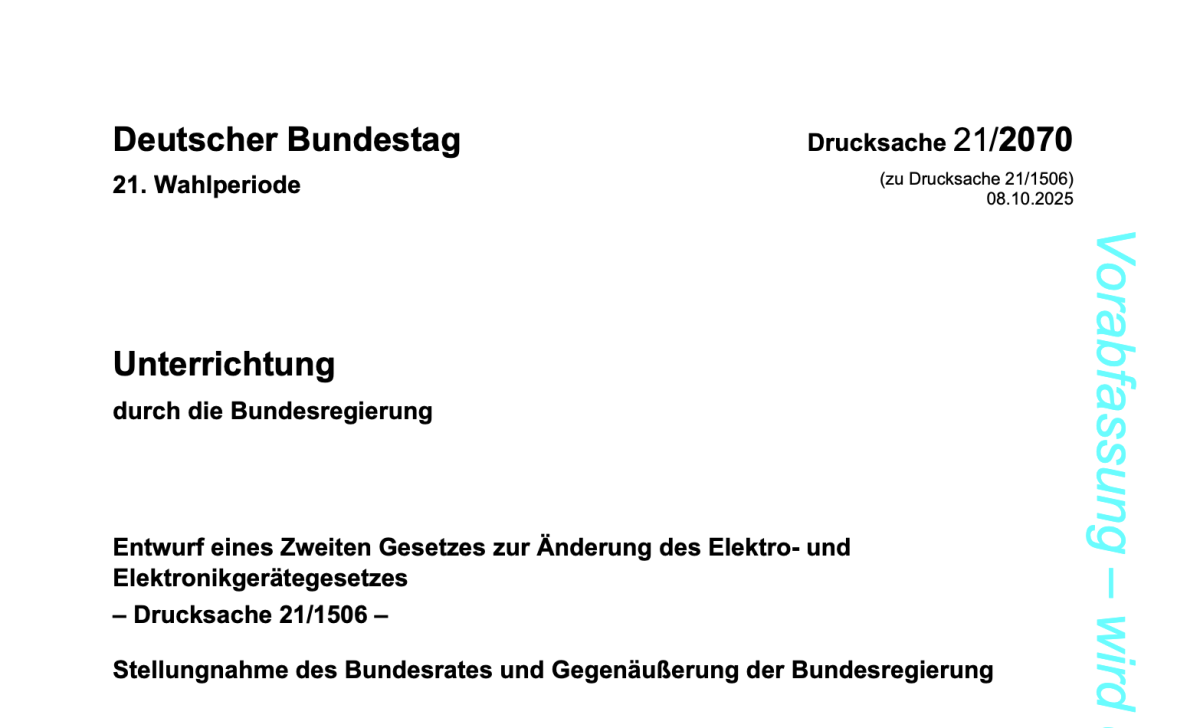
In a report by the German Federal Parliament Information Service (hib 498/2025) on October 14, 2025, the German Federal Council (Bundesrat) has once again formally requested the government to ban disposable e-cigarettes. The reason cited is the serious environmental threat they pose and the increased burden on waste management.
In this statement submitted to the government, the Senate pointed out that disposable e-cigarettes, if carelessly disposed of in household waste, not only result in the waste of rare resources such as lithium, but also pose a fire hazard due to battery short circuits, causing the recycling and disposal industry to incur significant economic losses.
The Senate also criticized the draft of the Federal Government's proposed Electrical and Electronic Equipment Act (ElektroG) for being insufficient in increasing recycling rates and reducing the risk of battery waste fires, urging the government to directly ban the disposal and sale of disposable e-cigarettes. The statement also mentioned that EU member states such as France and Belgium have already implemented similar bans.
In addition, the Senate has proposed strengthening manufacturer responsibility by requiring them to share the costs of electronic device recycling and disposal, in order to avoid local public sectors bearing the financial burden unilaterally.
The federal government acknowledged concerns regarding disposable e-cigarettes in terms of resources and health protection, but refused to amend the law, citing the need to follow a "technical notification procedure" for imposing a ban, which would delay legislation. The government stated that a more viable approach would be to promote product regulation measures at the EU level.
According to reports, last week the federal Parliament's Environment Committee held a hearing where several environmental groups and representatives from local recycling companies also supported the ban on disposable e-cigarettes, and advocated for the expansion of producer responsibility schemes.
The German e-cigarette association opposes bans on disposable e-cigarettes and flavors
During InterTabac 2025, 2Firsts also engaged in discussions with the German e-cigarette trade association (VdeH) and the German Smoke-Free Enjoyment Alliance (BfTG).
In response to 2Firsts' question about whether Germany may consider implementing a ban on disposable e-cigarettes similar to the UK, BfTG responded by stating that Germany is more likely to look to the Netherlands model and introduce a flavor ban rather than directly banning disposable e-cigarettes.
Oliver Pohland, Managing Director of VdeH, pointed out that while the e-cigarette market in Germany continues to grow, the size of the black market is now close to half the size of the legal market. The rise of disposable products is reshaping the distribution landscape. The association strongly opposes flavor bans and bans on disposable products, believing that such policies will fuel the expansion of the black market, drive consumers back to traditional cigarettes, and call for policy makers to maintain logic and coherence in policy development.
Image credit: hib/SAS
We welcome news tips, article submissions, interview requests, or comments on this piece.
Please contact us at info@2firsts.com, or reach out to Alan Zhao, CEO of 2Firsts, on LinkedIn
Notice
1. This article is intended solely for professional research purposes related to industry, technology, and policy. Any references to brands or products are made purely for objective description and do not constitute any form of endorsement, recommendation, or promotion by 2Firsts.
2. The use of nicotine-containing products — including, but not limited to, cigarettes, e-cigarettes, nicotine pouchand heated tobacco products — carries significant health risks. Users are responsible for complying with all applicable laws and regulations in their respective jurisdictions.
3. This article is not intended to serve as the basis for any investment decisions or financial advice. 2Firsts assumes no direct or indirect liability for any inaccuracies or errors in the content.
4. Access to this article is strictly prohibited for individuals below the legal age in their jurisdiction.
Copyright
This article is either an original work created by 2Firsts or a reproduction from third-party sources with proper attribution. All copyrights and usage rights belong to 2Firsts or the original content provider. Unauthorized reproduction, distribution, or any other form of unauthorized use by any individual or organization is strictly prohibited. Violators will be held legally accountable.
For copyright-related inquiries, please contact: info@2firsts.com
AI Assistance Disclaimer
This article may have been enhanced using AI tools to improve translation and editorial efficiency. However, due to technical limitations, inaccuracies may occur. Readers are encouraged to refer to the cited sources for the most accurate information.
We welcome any corrections or feedback. Please contact us at: info@2firsts.com