Key Points
- Vaping growth levels off: Approximately 5.4 million adults in Great Britain used e-cigarettes in 2025, accounting for 9.9% of people aged 16 and over, compared with 10.0% in 2024. The latest estimate interrupts four consecutive years of rising prevalence.
- Smoking continues to decline: Vaping prevalence first exceeded cigarette smoking prevalence in 2024, at 10.0% versus 9.1%. In 2025, the rates stood at 9.9% and 8.7%, respectively, widening the gap to 1.2 percentage points.
- Usage patterns diverge: Daily vaping prevalence declined from 6.7% to 6.5%, occasional use edged up from 3.3% to 3.4%, and the proportion of previous e-cigarette users increased to 7.2%.
- Age groups move in different directions: Vaping prevalence among adults aged 25–34 rose from 12.9% to 16.4%, making them the age group with the highest usage rate. All other age groups recorded declines.
2Firsts
October 14, 2026
Vaping prevalence in Great Britain was broadly unchanged at 9.9% in 2025, compared with 10.0% in 2024, with the estimated number of adult e-cigarette users holding at approximately 5.4 million for a second consecutive year, according to figures released by the Office for National Statistics (ONS) on October 6, 2026.
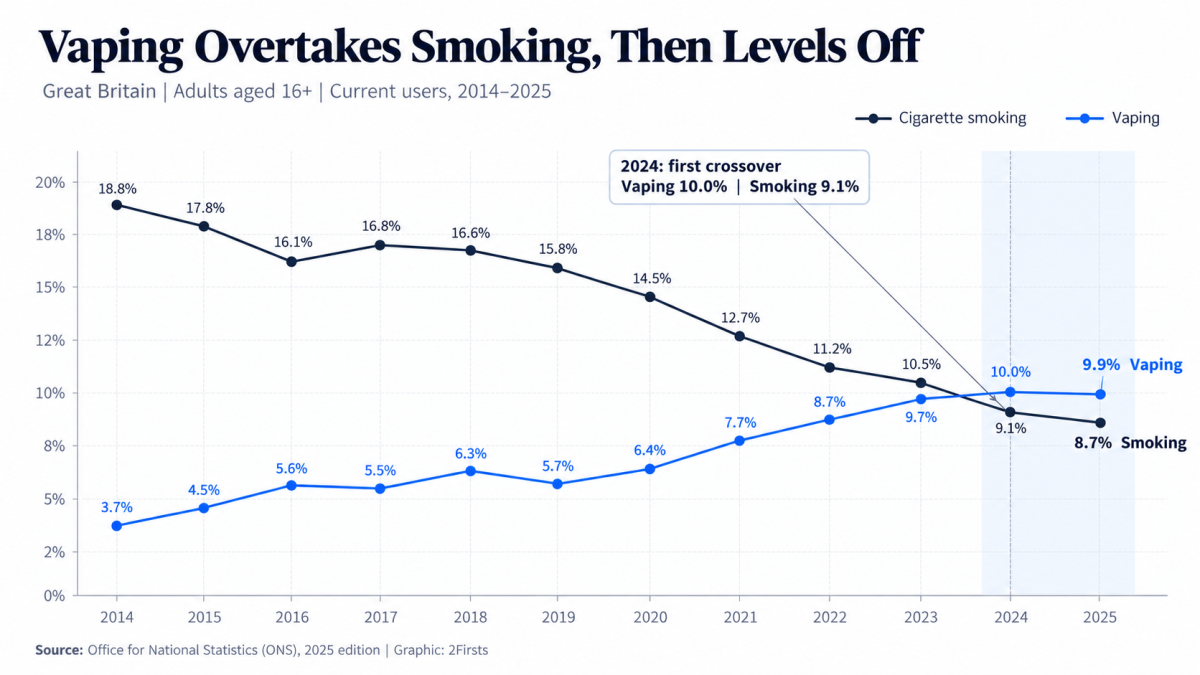
The slowdown followed a milestone in 2024, when vaping prevalence overtook cigarette smoking prevalence for the first time in the ONS Opinions and Lifestyle Survey (OPN). E-cigarette use reached 10.0% that year, compared with a cigarette smoking rate of 9.1%.
In 2025, vaping prevalence edged down to 9.9%, while cigarette smoking fell further to 8.7%. The gap between the two measures widened from 0.9 to 1.2 percentage points, driven by the larger decline in cigarette smoking.
An analysis by 2Firsts of the ONS's underlying data from 2014 to 2025 shows that vaping prevalence rose in each year from 2020 to 2024, increasing from 6.4% to 10.0%, before leveling off in 2025. Changes in daily and occasional use, age groups and smoking histories were less uniform.
The ONS figures measure population prevalence rather than product sales or consumption volumes. E-cigarette users and cigarette smokers are also overlapping populations, so the crossover in their prevalence rates does not establish that vaping has fully replaced cigarette smoking.
Vaping Overtakes Cigarette Smoking in 2024, Then Levels Off as Smoking Continues to Fall
The relative prevalence of vaping and cigarette smoking shifted in 2024.
According to the ONS Opinions and Lifestyle Survey, 9.7% of adults aged 16 and over in Great Britain used e-cigarettes in 2023, below the cigarette smoking rate of 10.5%.
A year later, vaping prevalence increased to 10.0%, while cigarette smoking prevalence declined to 9.1%, marking the first time the vaping rate exceeded the smoking rate in the survey.
That relationship continued in 2025, although the two measures moved differently. Vaping prevalence edged down from 10.0% to 9.9%, while smoking prevalence fell from 9.1% to 8.7%.
The gap consequently widened from 0.9 percentage points in 2024 to 1.2 percentage points in 2025. The widening was driven not by further growth in vaping prevalence, but by a larger decline in cigarette smoking.
The longer-term figures illustrate how substantially the relationship between the two products has changed.
In 2014, cigarette smoking prevalence stood at 18.8%, compared with 3.7% for vaping, a gap of 15.1 percentage points.
By 2020, smoking prevalence had declined to 14.5%, while vaping reached 6.4%, narrowing the difference to 8.1 percentage points.
The gap narrowed further to 0.8 percentage points in 2023 before the rates crossed in 2024.
In 2025, approximately 5.4 million adults used e-cigarettes, compared with about 4.8 million cigarette smokers, a difference of roughly 600,000 people. Both figures are rounded population estimates published by the ONS.
Although vaping prevalence has now exceeded cigarette smoking prevalence for two consecutive years, the figures do not mean that all former cigarette users have switched to e-cigarettes.
In 2025, 33.8% of current cigarette smokers also reported daily or occasional e-cigarette use, compared with 32.8% in 2024.
The crossover therefore represents a change in the relative prevalence of two potentially overlapping behaviors rather than the replacement of one mutually exclusive user population by another.
Vaping Prevalence Gains 3.6 Percentage Points From 2020 to 2024 Before Edging Down in 2025
The longer-term vaping series provides further evidence of slowing growth.
When the ONS began collecting e-cigarette use data in 2014, prevalence among people aged 16 and over in Great Britain was 3.7%.
It increased to 5.6% in 2016 and 6.3% in 2018 before falling to 5.7% in 2019.
Vaping prevalence reached 6.4% in 2020 and then increased for four consecutive years: 7.7% in 2021, 8.7% in 2022, 9.7% in 2023 and 10.0% in 2024.
The rate slipped to 9.9% in 2025.

The annual figures indicate a marked change in momentum.
Vaping prevalence rose by 1.3 percentage points in 2021, followed by gains of 1.0 percentage point in both 2022 and 2023. The increase slowed to 0.3 percentage points in 2024 before turning marginally negative in 2025.
The pattern suggests that the rapid increase observed between 2020 and 2023 had weakened by 2024 and largely stalled in 2025.
The ONS estimated 2025 vaping prevalence at 9.9%, with a 95% confidence interval of 9.1% to 10.7%. The small difference from the 2024 estimate of 10.0% does not establish a statistically significant decline.
The data support a characterization of broadly stable vaping prevalence in 2025, but do not yet establish whether the market has entered a sustained plateau.
Daily Vaping Falls to 6.5% as Previous E-Cigarette Use Rises to 7.2%
While overall prevalence remained broadly unchanged, the composition of vaping behavior shifted.
In 2025, 6.5% of adults in Great Britain reported using e-cigarettes daily, down from 6.7% in 2024. Occasional use increased marginally from 3.3% to 3.4%.
Together, daily and occasional users accounted for the overall current-vaping prevalence of 9.9%.
The share of adults who had previously used e-cigarettes but were no longer current users increased from 6.6% in 2024 to 7.2% in 2025.
Meanwhile, the proportion reporting that they had never used an e-cigarette declined from 83.4% to 83.0%.
E-Cigarette Use Status Among Adults in Great Britain
| Usage status | 2023 | 2024 | 2025 |
|---|---|---|---|
| Daily users | 5.9% | 6.7% | 6.5% |
| Occasional users | 3.9% | 3.3% | 3.4% |
| All current users | 9.7% | 10.0% | 9.9% |
| Previous users | 6.1% | 6.6% | 7.2% |
| Never users | 84.2% | 83.4% | 83.0% |
Over a longer period, daily vaping prevalence remained substantially higher than in 2020, when it stood at 3.8%. Occasional use also increased from 2.6% in 2020 to 3.4% in 2025.
The latest annual figures nevertheless show different movements: daily vaping declined slightly, occasional use was broadly stable, and the proportion reporting previous use increased.
The ONS suggested that some daily users may have stopped using e-cigarettes altogether. Among former cigarette smokers, some may also have moved from daily to occasional vaping or ceased vaping.
However, the data come from repeated cross-sectional surveys rather than the continuous tracking of individual users. They cannot establish how many people moved between daily use, occasional use and non-use.
Vaping Rises to 16.4% Among Adults Aged 25–34 While Other Age Groups Decline
Age-specific figures reveal another divergence beneath the stable national vaping rate.
In 2025, 16.4% of adults aged 25 to 34 in Great Britain used e-cigarettes, compared with 12.9% in 2024, an increase of 3.5 percentage points.
Usage among adults aged 16 to 24 edged down from 13.0% to 12.9%. For those aged 35 to 49, prevalence declined from 12.4% to 11.0%.
Among adults aged 50 to 59, it fell from 11.9% to 9.9%, while prevalence among those aged 60 and over declined from 4.8% to 4.6%.
Vaping Prevalence by Age Group, 2024–2025
| Age group | 2024 | 2025 | Change |
|---|---|---|---|
| 16–24 | 13.0% | 12.9% | -0.1 pp |
| 25–34 | 12.9% | 16.4% | +3.5 pp |
| 35–49 | 12.4% | 11.0% | -1.4 pp |
| 50–59 | 11.9% | 9.9% | -2.0 pp |
| 60 and over | 4.8% | 4.6% | -0.2 pp |
The change made 25-to-34-year-olds the age group with the highest vaping prevalence in 2025, overtaking adults aged 16 to 24.
Among women aged 25 to 34, vaping prevalence reached 18.3%, compared with 13.7% in 2024. Among men of the same age, it stood at 14.4%, up from 12.0%.
For adults aged 16 to 24, the respective female and male estimates were 15.7% and 10.2%.
The 18.3% estimate among women aged 25 to 34 was the highest recorded for that demographic since the ONS began collecting vaping data in 2014. It was also the highest point estimate among all age-by-sex groups in 2025.
The 3.5-percentage-point increase among all 25-to-34-year-olds between 2024 and 2025 does not meet the conventional 5% statistical significance threshold under an approximate test based on the published confidence intervals.
The differences nevertheless illustrate why broadly stable overall vaping prevalence should not be interpreted as uniform trends across the population.
One-Third of Current Cigarette Smokers Also Vape, While Use Among Former Smokers Holds Near 21%
E-cigarette use also varies according to cigarette smoking history.
In 2025, 33.8% of current cigarette smokers reported using e-cigarettes daily or occasionally, compared with 32.8% in 2024.
Among former cigarette smokers, vaping prevalence was 20.7%, broadly unchanged from 20.8% a year earlier.
Among people who had never smoked cigarettes, vaping prevalence increased slightly from 2.7% in 2024 to 2.9% in 2025.
The ONS estimated that approximately 1.1 million adults who had never smoked cigarettes were current e-cigarette users in 2025, compared with about 940,000 in 2024.
| Cigarette smoking status | 2024 vaping rate | 2025 vaping rate |
|---|---|---|
| Current cigarette smokers | 32.8% | 33.8% |
| Former cigarette smokers | 20.8% | 20.7% |
| Never cigarette smokers | 2.7% | 2.9% |
Over the longer term, vaping prevalence among current cigarette smokers increased from 10.6% in 2014 to 33.8% in 2025.
Among former cigarette smokers, it rose from 6.8% to 20.7%, while the rate among adults who had never smoked cigarettes increased from 0.2% to 2.9%.
The figures show that vaping is used not only by former cigarette smokers but also by a substantial proportion of adults who continue to smoke.
They do not establish a causal relationship between vaping and successful smoking cessation, nor do they indicate how many cigarette smokers switched exclusively to e-cigarettes.
Cigarette Smoking Continues to Decline as the Longer-Term Vaping Outlook Remains Uncertain
The longer-term decline in cigarette smoking provides a contrast to the recent leveling-off in vaping prevalence.
Using the OPN survey, which also provides the vaping estimates, cigarette smoking prevalence among adults aged 16 and over in Great Britain declined from 18.8% in 2014 to 14.5% in 2020.
It fell further to 9.1% in 2024 and 8.7% in 2025.
The ONS separately produces the UK's official cigarette-smoking prevalence estimate from the Annual Population Survey (APS).
That survey covers people aged 18 and over across England, Scotland, Wales and Northern Ireland. It estimated that 9.8% of UK adults smoked cigarettes in 2025, down from 10.6% in 2024 and 20.2% in 2011.
The APS and OPN measures should not be directly compared because they differ in geographical coverage, age range, survey methodology and definitions of current cigarette smoking.
The stabilization of vaping prevalence in 2025 also coincided with Britain's ban on the sale of disposable vapes, which took effect on June 1, 2025.
However, the ONS annual survey does not provide a breakdown by disposable and reusable vaping products or longitudinal evidence sufficient to measure the ban's effect. The findings therefore do not establish that the policy caused vaping prevalence to level off.
By 2025, vaping prevalence had exceeded cigarette smoking prevalence in Great Britain for a second consecutive year, but the two measures were following different trends.
Cigarette smoking continued to decline, while vaping prevalence remained broadly unchanged after four consecutive years of growth.
The ONS data do not determine whether this marks the beginning of a sustained plateau in vaping use. Nor do the figures establish how the change affects e-cigarette sales volumes, consumer spending or the use of other nicotine products.
Follow 2Firsts for timely updates on global tobacco and nicotine industry developments, market data and consumer trends.
Cover Image: UK Office for National Statistics (ONS), Adult smoking habits in the UK: 2025. Visualizations prepared by 2Firsts using ONS data.
Disclaimer
This article is provided solely for professional research, industry discussion, and informational purposes. Any references to brands, companies, products, technologies, or policies are made for factual reporting and analytical purposes only, and do not constitute endorsement, recommendation, promotion, or advertising by 2Firsts.
Nicotine-containing products, including but not limited to cigarettes, e-cigarettes, heated tobacco products, and nicotine pouches, carry significant health risks. Readers are responsible for complying with all applicable laws and regulations in their respective jurisdictions, including age restrictions and access limitations.
The information contained in this article should not be regarded as investment, legal, medical, regulatory, or commercial advice. While 2Firsts strives to ensure the accuracy and reliability of its content, it does not assume liability for any direct or indirect loss arising from errors, omissions, inaccuracies, or reliance on the information contained herein.
This article is not intended for individuals below the legal age for accessing tobacco or nicotine-related information in their jurisdiction.
Copyright Notice
This article is either original content produced by 2Firsts or content reproduced, translated, summarized, or adapted from third-party sources with attribution where applicable. The intellectual property rights of the original content remain with 2Firsts or the respective original rights holders.
No individual or organization may copy, reproduce, distribute, republish, modify, translate, or otherwise use this content without prior authorization. Any unauthorized use may result in legal action.
For copyright-related inquiries, corrections, or removal requests, please contact: info@2firsts.com.
AI-Assisted Translation and Editing Notice
Portions of this article may have been translated, edited, or reviewed with the assistance of artificial intelligence tools to improve efficiency and readability. Due to the limitations of AI-assisted translation and editing, discrepancies, omissions, or inaccuracies may exist when compared with the original source.
Where applicable, readers are advised to refer to the original source for the most complete and accurate information. If you identify any errors or believe that any content infringes upon your rights, please contact us at info@2firsts.com, and we will review and address the matter promptly.