NYS Youth Tobacco Use Down 29% Since 2022, Lowest Since 2000

Oct.24.2025
NYS Youth Tobacco Use Down 29% Since 2022, Lowest Since 2000
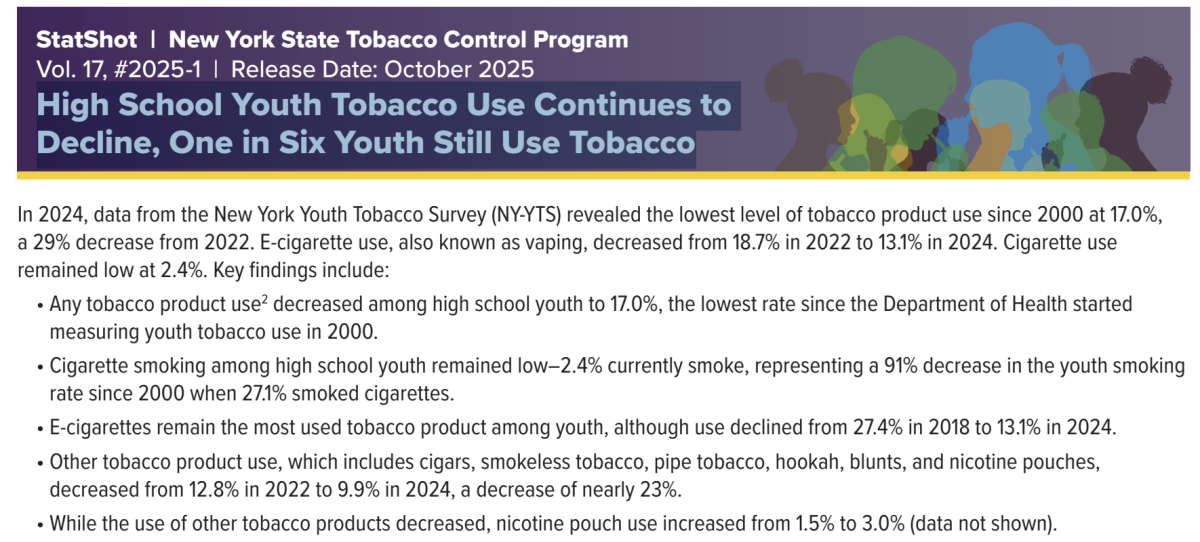
According to the New York State Department of Health’s latest StatShot (Vol.17, #2025-1), high school tobacco product use in 2024 fell to 17.0%, the lowest rate since 2000, marking a 29% decline from 2022. E-cigarette use decreased from 18.7% to 13.1%, while cigarette use remained low at 2.4%.However, nicotine pouch use increased from 1.5% to 3.0%.


Key Highlights (Expanded)


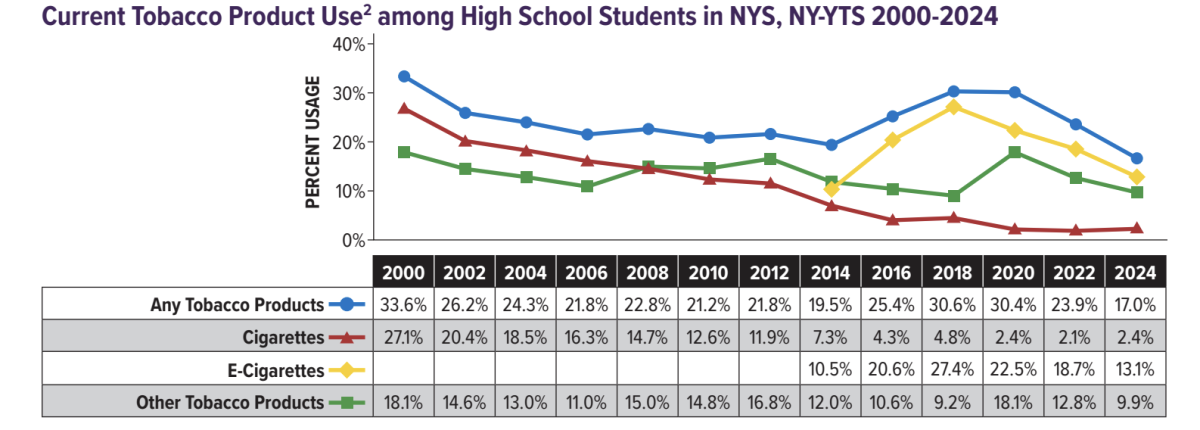
  • Overall youth tobacco use dropped to 17.0%, the lowest since data collection began in 2000 — a 29% decline since 2022.
  • E-cigarette use fell to 13.1%, down from 18.7% in 2022 and 27.4% in 2018.
  • Cigarette smoking remains low at 2.4%, a 91% decline from 27.1% in 2000.
  • Other tobacco use decreased to 9.9%, though nicotine pouch use doubled to 3.0%.
  • State laws since 2020 include bans on pharmacy tobacco sales, flavored vape products, and school-area advertising.


2Firsts, October 23, 2025 — According to the New York State Department of Health’s StatShot (Vol.17, #2025-1), youth tobacco use among high school students in New York reached a record low of 17.0% in 2024, down from 23.9% in 2022, marking a 29% decline.


E-cigarette use, though still the most prevalent form of tobacco consumption among teens, declined from 18.7% to 13.1% over the same period. Cigarette use held steady at 2.4%, a dramatic 91% drop from the 27.1% recorded in 2000.


Usage of other tobacco products, including cigars, smokeless tobacco, hookah, blunts, and nicotine pouches, decreased from 12.8% to 9.9%, while nicotine pouch use rose from 1.5% to 3.0%.
 

NYS Youth Tobacco Use Down 29% Since 2022, Lowest Since 2000
Report data | Source: StatShot


Health officials warn that nicotine exposure during adolescence leads to addiction and brain harm. Since 2020, the state has enforced pharmacy tobacco sales bans, flavor restrictions on vape products, and limitations on discounts and school-area advertising. The department stresses that continued surveillance is essential to track emerging nicotine products and ensure health equity.


Image source: New York State Department of Health / StatShot Vol.17.


We welcome news tips, article submissions, interview requests, or comments on this piece.

Please contact us at info@2firsts.com, or reach out to Alan Zhao, CEO of 2Firsts, on LinkedIn


Notice

1.  This article is intended solely for professional research purposes related to industry, technology, and policy. Any references to brands or products are made purely for objective description and do not constitute any form of endorsement, recommendation, or promotion by 2Firsts.

2.  The use of nicotine-containing products — including, but not limited to, cigarettes, e-cigarettes, nicotine pouchand heated tobacco products — carries significant health risks. Users are responsible for complying with all applicable laws and regulations in their respective jurisdictions.

3.  This article is not intended to serve as the basis for any investment decisions or financial advice. 2Firsts assumes no direct or indirect liability for any inaccuracies or errors in the content.

4.  Access to this article is strictly prohibited for individuals below the legal age in their jurisdiction.


Copyright


This article is either an original work created by 2Firsts or a reproduction from third-party sources with proper attribution. All copyrights and usage rights belong to 2Firsts or the original content provider. Unauthorized reproduction, distribution, or any other form of unauthorized use by any individual or organization is strictly prohibited. Violators will be held legally accountable.

For copyright-related inquiries, please contact: info@2firsts.com


AI Assistance Disclaimer


This article may have been enhanced using AI tools to improve translation and editorial efficiency. However, due to technical limitations, inaccuracies may occur. Readers are encouraged to refer to the cited sources for the most accurate information.

We welcome any corrections or feedback. Please contact us at: info@2firsts.com

WSJ: White House Pushes for More Flavored Vape Approvals as FDA Commissioner Makary Blocks Move
According to The Wall Street Journal, the White House is pushing to allow more flavored vape products onto the market for the first time in years, but FDA Commissioner Marty Makary opposes the move and has blocked the plan. The report said a memo from Makary’s office prevented authorization of several flavors from vape maker Glas, even after FDA scientific reviewers had supported them.
Apr.20 by 2FIRSTS.ai
Imperial Brands Pulls myblu Vape Business From U.S., Citing Prolonged FDA Approval Process
Imperial Brands said it will phase out its myblu vaping business in the United States, citing prolonged FDA approval timelines for new vape products. The company said it will instead focus on modern oral nicotine products in the U.S., including the expansion of its Zone brand and new flavors. While overall next-generation product revenue continued to grow, revenue from the category in the Americas declined sharply.
May.12
FDA Tobacco Center Pushes Review-Efficiency Statement After Commissioner’s Exit
FDA CTP issued a May 7 statement on accelerating product review and improving PMTA efficiency, but did not push it via official X and newsletter until May 13, one day after FDA Commissioner Marty Makary’s resignation was confirmed. FDA has not explained the delay, and no public evidence links it directly to the leadership change. The timing is notable given CTP’s usual 24-hour distribution practice.
Special Report
May.14
Japan to Raise Tobacco Taxes and Corporate Income Tax From April 1 to Help Fund Defense Spending
Japan will raise tobacco product taxes and corporate income tax from April 1 as part of a package of levies to help fund a five-year defense spending increase totaling JPY 43 trillion. Tobacco taxes will be raised in two stages, with the first increase taking effect on April 1 and the second in October, while personal income tax is planned to rise in January.
Mar.27 by 2FIRSTS.ai
From myblu to Zone: Imperial Brands Refocuses NGP Strategy in HY26
mperial Brands’ HY26 results point to a more selective NGP transition. The company is using cash flow from traditional tobacco to fund targeted investments in modern oral nicotine, heated tobacco and reusable vaping systems. Its decision to exit the legacy myblu vaping business in the U.S., while expanding Zone nicotine pouches. In Europe, Imperial’s NGP growth is being driven by a multi-category portfolio including blu, Pulze and Zone/Skruf.
Special Report
May.12
French Lawmakers Move to Extend Plain Packaging Rules to Vaping Product
French lawmakers Nicolas Thierry and Pierre Cazenave said on April 15 that they will file a cross-party bill to extend plain packaging requirements to vaping products. Under the proposal, unit packs and outer packaging for vaping products, including those without nicotine, would become neutral and standardized in the same way cigarette packs have been since 2017.
Apr.16 by 2FIRSTS.ai