Number of Vapers in Britain Surpasses Smokers for the First Time, Government Tightens Nicotine Regulations

Nov.05.2025
 Number of Vapers in Britain Surpasses Smokers for the First Time, Government Tightens Nicotine Regulations
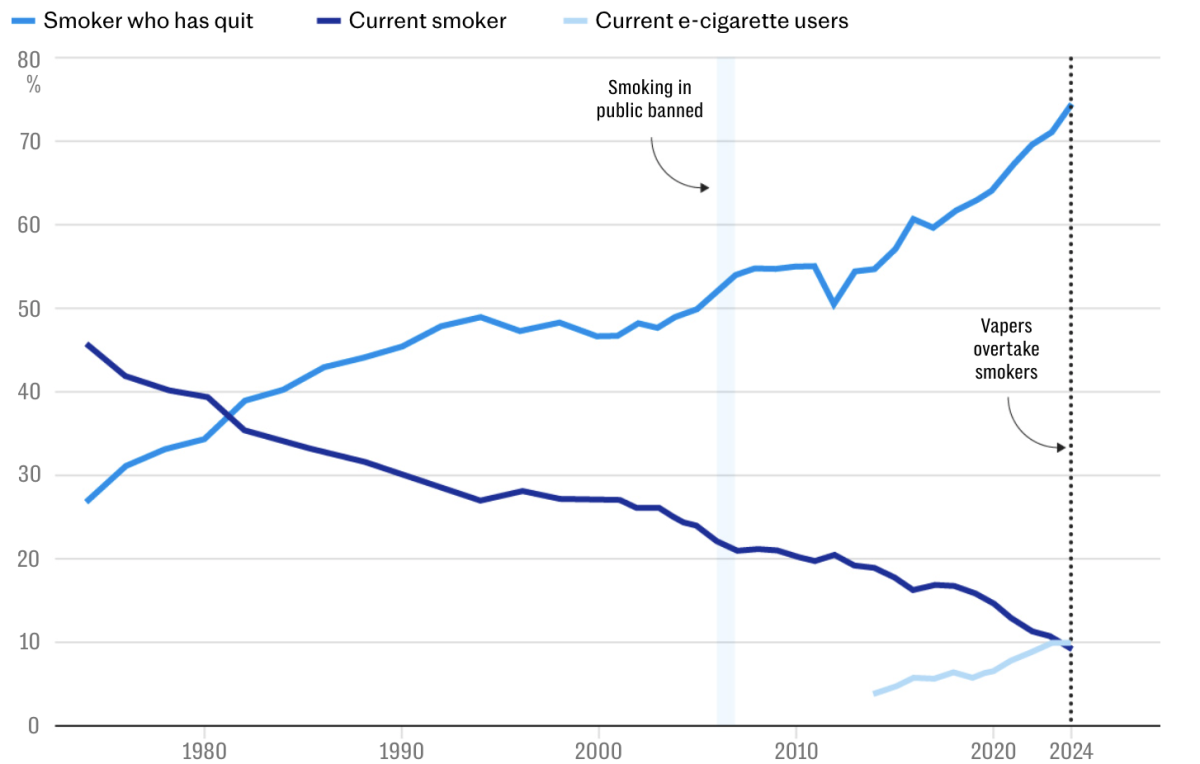
For the first time, more people in Britain now vape than smoke. According to the Office for National Statistics (ONS), 10% of adults (5.4 million) regularly use e-cigarettes compared with 9.1% (4.9 million) who smoke cigarettes. The government credits vaping for the decline in smoking but plans tougher rules through the Tobacco and Vapes Bill, including a generational smoking ban and restrictions on nicotine pouch flavours, packaging, and sales.

Key Points


  • Historic shift: 2024 marks the first year vapers outnumber smokers in the UK.
  • Age trends: Vaping most common among 16–24s (13%), while smoking peaks in 25–34s (12.6%).
  • Long-term decline: Smoking among 18–24s dropped from 25% in 2011 to under 10%.
  • Expert reactions: Health groups hail vaping’s role in cutting smoking, but urge tighter controls.
  • New legislation: Tobacco and Vapes Bill introduces age-based sales bans and nicotine pouch rules.


2Firsts, November 5, 2025 — The number of vapers in Britain has overtaken the number of smokers for the first time, marking a milestone in the country’s tobacco control history, the Office for National Statistics (ONS) confirmed.
 

 Number of Vapers in Britain Surpasses Smokers for the First Time, Government Tightens Nicotine Regulations
Proportion of current smokers, ex-smokers, and current e-cigarette users among the population aged 16 and over in the UK from 1974 to 2024 | Source: Office for National Statistics, Opinions and Lifestyle Survey.


In 2024, 10% of adults (around 5.4 million) reported regular e-cigarette use compared with 9.1% (4.9 million) who smoke cigarettes. “For the first time, e-cigarette users have surpassed smokers,” said David Mais of ONS, calling it consistent with “the long-term decline in smoking over the past decade.”


Vaping rates fell slightly among men but rose among women, while 16–24-year-olds remain the heaviest users at 13%. Smoking remains most prevalent among 25–34-year-olds (12.6%), and lowest among those 65+ (7.1%).


Public health experts welcomed the crossover as evidence that vaping is displacing smoking, though concerns remain over youth uptake. Hazel Cheeseman of Action on Smoking and Health (ASH) said: “This is a significant moment… but non-smokers and young people taking up vaping remain a worry.”


At University College London, Dr. Deborah Arnott added that vaping “is not risk-free and should only be used to quit smoking.”


The government’s Tobacco and Vapes Bill, now before the House of Lords, will:


  • Ban cigarette sales to anyone born on or after 1 January 2009;
  • Restrict vape flavours, packaging, and advertising;
  • Ban nicotine pouch sales to under-18s;
  • Set nicotine content limits and prohibit fruity flavours;
  • Impose £200 fines on retailers selling to minors.


Health officials said the rules will “set clear standards on strength, flavour, and packaging to keep young people safe.”


Critics, however, warned that the government is “targeting products that help smokers quit.”


Source: The Telegraph


We welcome news tips, article submissions, interview requests, or comments on this piece.

Please contact us at info@2firsts.com, or reach out to Alan Zhao, CEO of 2Firsts, on LinkedIn


Notice

1.  This article is intended solely for professional research purposes related to industry, technology, and policy. Any references to brands or products are made purely for objective description and do not constitute any form of endorsement, recommendation, or promotion by 2Firsts.

2.  The use of nicotine-containing products — including, but not limited to, cigarettes, e-cigarettes, nicotine pouchand heated tobacco products — carries significant health risks. Users are responsible for complying with all applicable laws and regulations in their respective jurisdictions.

3.  This article is not intended to serve as the basis for any investment decisions or financial advice. 2Firsts assumes no direct or indirect liability for any inaccuracies or errors in the content.

4.  Access to this article is strictly prohibited for individuals below the legal age in their jurisdiction.


Copyright


This article is either an original work created by 2Firsts or a reproduction from third-party sources with proper attribution. All copyrights and usage rights belong to 2Firsts or the original content provider. Unauthorized reproduction, distribution, or any other form of unauthorized use by any individual or organization is strictly prohibited. Violators will be held legally accountable.

For copyright-related inquiries, please contact: info@2firsts.com


AI Assistance Disclaimer


This article may have been enhanced using AI tools to improve translation and editorial efficiency. However, due to technical limitations, inaccuracies may occur. Readers are encouraged to refer to the cited sources for the most accurate information.

We welcome any corrections or feedback. Please contact us at: info@2firsts.com

Canada Vape Enforcement Action Puts VAPME Website, Trademark and China Supply-Chain Links in Focus
Quebec police seized about 300,000 suspected illegal vape products and froze more than C$1.8 million in funds. Local media said vapme.ca, a website selling flavoured vape products, was shut down during the operation.
Regulations
Jun.18
China Tobacco International HK Warns First-Half Revenue May Fall 25%-30%, Tobacco Leaf and Duty-Free Exposure Highlight Reliance on Traditional Tobacco
CTIHK expects first-half 2026 revenue to fall 25%-30%, mainly due to lower tobacco leaf imports and delayed cigarette shipments to China’s domestic duty-free market. Its 2025 revenue mix—nearly 90% from tobacco leaf-related businesses and less than 1% from new tobacco products—shows continued exposure to traditional supply chains and trade variables.
Jun.18
Illicit Vape and Nicotine Pouch Seizures Concentrated in UK Hotspots, New Data Shows
Freedom of Information (FOI) data from the UK shows that more than 3,000 seizures of illegal nicotine products were recorded in the 2024/25 financial year, with Hull, Liverpool and Bolton emerging as the most active enforcement hotspots — highlighting that the problem of illicit vapes, nicotine pouches and smokeless tobacco products persists across many parts of the country.
Jun.16
U.S. Convenience Stores Rebalance Backbar as Nicotine Pouches Outpace Cigarettes
As cigarette volumes continue to decline, U.S. convenience-store operators are reconfiguring backbar space to accommodate modern oral nicotine products such as nicotine pouches. Industry data show nicotine pouches have become one of the fastest-growing nicotine categories while generating higher margins for retailers.
Jun.12
CBP and FDA Seize 18 Million Illegal Vapes Worth $175 Million in Maritime Cargo Operation
U.S. Customs and Border Protection (CBP) announced that more than 18 million illegal e-cigarettes valued at over $175 million were seized during “Operation Red Mist,” a joint enforcement initiative involving the U.S. Coast Guard and the FDA. The operation primarily targeted maritime vape shipments originating from China and focused on combating illicit importation, transportation, and distribution activities.
Regulations
May.14
AHA Journal Study: WS-23 Triples Premature Heartbeats, Raising Concerns Over Vape Cooling Agents
A University of Louisville research team published a study in an American Heart Association journal suggesting that synthetic cooling agents used in e-cigarettes, including WS-3 and WS-23, may disrupt cardiac electrical activity and increase arrhythmia risk. In animal experiments, WS-23 tripled premature heartbeats.
Jun.16