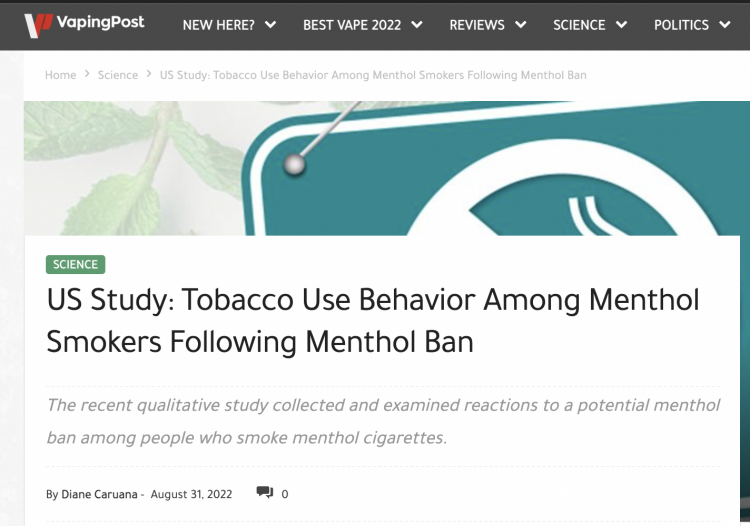
A recent qualitative study in the United States collected and examined the responses of individuals who smoke menthol cigarettes to the potential menthol ban. The study team conducted interviews with 35 menthol smokers, questioning them on their perception of menthol cigarette risks, their knowledge, attitudes, and perceptions of menthol cigarette regulations, and their expected behavior if menthol cigarettes were to be banned.
The collected answers indicate that many participants actually believe that menthol cigarettes pose greater health risks than non-menthol cigarettes. Some people believe that the FDA is attracted to young people and wants to ban them, while others believe that the ban would be a positive step forward for public health.
On the other hand, some participants are skeptical and argue that banning menthol while leaving regular cigarettes on the market would not have a significant impact. Others say that if menthol is banned, they would simply switch to other products such as e-cigarettes, while some believe the ban may even encourage them to quit smoking altogether.
Researchers at the University of Michigan have recently conducted another study which found that banning menthol-flavored cigarettes could reduce smoking rates by 15%. This is because it would lead many smokers to quit or switch to less harmful nicotine products.
A study published in the BMJ's "Tobacco Control" concluded that a ban on menthol cigarettes could prevent 16,250 tobacco-related deaths per year by 2060. Rafael Meza, epidemiology professor at the University of Michigan School of Public Health and one of the study's authors, stated that "our findings suggest that a menthol ban may offer significant health benefits and underscore the urgency of ultimately approving and implementing such a ban.
The investigation was based on data analysis and computational modeling infrastructure developed by the Tobacco Regulation Evaluation Center. The research team utilized smoking and e-cigarette models, which were previously developed for simulating the smoking and e-cigarette behavior of mint and non-mint tobacco products.
They found that by implementing a ban on menthol cigarettes, the smoking rates for both menthol and non-menthol cigarettes would decrease by 15% by 2026. It is estimated that the number of deaths caused by smoking and vaping would decrease by about 5%, resulting in an 8.8% increase in life expectancy - translating to a yearly avoidance of 16,250 deaths and an additional 11 million years of life over a 40-year period (nearly 300,000 people per year).
Disclaimer: 1. The content of this article is sourced from third-party information and is only intended for industry exchange and learning. 2. This article does not represent the views of 2FIRSTS and 2FIRSTS is unable to confirm the truthfulness and accuracy of the article's content. The compilation of this article is only intended for industry exchange and research. 3. Due to limited compilation capabilities, the compiled article may not express the same content as the original, please refer to the original article. 4. Regarding any domestic, Hong Kong, Macau, Taiwan, or foreign expressions and positions, 2FIRSTS fully aligns with the Chinese government. 5. The copyright of the compiled information belongs to the original media and author. If there is any infringement, please contact us for deletion.
Disclaimer
This article is provided solely for professional research, industry discussion, and informational purposes. Any references to brands, companies, products, technologies, or policies are made for factual reporting and analytical purposes only, and do not constitute endorsement, recommendation, promotion, or advertising by 2Firsts.
Nicotine-containing products, including but not limited to cigarettes, e-cigarettes, heated tobacco products, and nicotine pouches, carry significant health risks. Readers are responsible for complying with all applicable laws and regulations in their respective jurisdictions, including age restrictions and access limitations.
The information contained in this article should not be regarded as investment, legal, medical, regulatory, or commercial advice. While 2Firsts strives to ensure the accuracy and reliability of its content, it does not assume liability for any direct or indirect loss arising from errors, omissions, inaccuracies, or reliance on the information contained herein.
This article is not intended for individuals below the legal age for accessing tobacco or nicotine-related information in their jurisdiction.
Copyright Notice
This article is either original content produced by 2Firsts or content reproduced, translated, summarized, or adapted from third-party sources with attribution where applicable. The intellectual property rights of the original content remain with 2Firsts or the respective original rights holders.
No individual or organization may copy, reproduce, distribute, republish, modify, translate, or otherwise use this content without prior authorization. Any unauthorized use may result in legal action.
For copyright-related inquiries, corrections, or removal requests, please contact: info@2firsts.com.
AI-Assisted Translation and Editing Notice
Portions of this article may have been translated, edited, or reviewed with the assistance of artificial intelligence tools to improve efficiency and readability. Due to the limitations of AI-assisted translation and editing, discrepancies, omissions, or inaccuracies may exist when compared with the original source.
Where applicable, readers are advised to refer to the original source for the most complete and accurate information. If you identify any errors or believe that any content infringes upon your rights, please contact us at info@2firsts.com, and we will review and address the matter promptly.