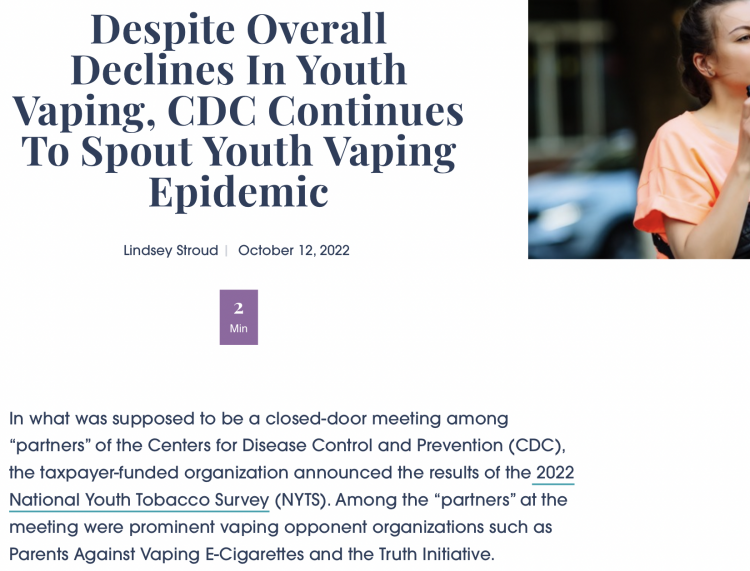
The results of the 2022 National Youth Tobacco Survey (NYTS), which is funded by taxpayers, were announced by the Centers for Disease Control and Prevention (CDC) and partners in a closed-door meeting in the United States. Among the partners at the meeting were well-known anti-smoking organizations such as the Parent Anti-Vaping E-Cigarette Organization and the Truth Initiative.
Opponents of marijuana use rejoice as a report from 2022 shows that there has been an increase in marijuana use among young people in the period 2021-2022. However, contrary to what is still being referred to as an "epidemic" by the Centers for Disease Control and Prevention, overall, marijuana use among young people has significantly decreased. Unfortunately, as the CDC and other national organizations continue to denounce the false notion of a so-called "teen vaping epidemic", this message is being ignored.
In 2022, 3.3% of middle school students and 14.1% of high school students reported using e-cigarettes in the past month, meaning they had used e-cigarettes at least once in the 30 days before the survey. Among middle school students, there was an increase of 17.9% in e-cigarette use in the past month, and for high school students, there was an increase of 24.8%.
Overall, in 2022, approximately 2.55 million American middle and high school students reported using electronic cigarette products in the previous month, according to a survey. This represents a slight increase from the previous month's figures of 1.72 million high school students and 320,000 middle school students in 2021. However, these numbers are significantly lower compared to 2019 when 5.3 million middle and high school students reported using electronic cigarette products in the 30 days prior to the survey, including 4.1 million high school students (27.5%) and 1.2 million middle school students (10.5%).
In fact, there are nearly 2.75 million fewer young people in 2022 compared to 2019. Between 2019 and 2022, the usage of steam products among high school students decreased by 48.7% last month and by 68.6% among middle school students.
Of course, as they did for 2021, the Centers for Disease Control and Prevention and their "partner" organizations quickly stated that the surveys for 2022 and 2021 cannot be compared to previous years due to the ongoing COVID-19 pandemic and changes in survey methodology.
In 2021, around 50.8% of student survey respondents were surveyed at school, while 49.2% were surveyed at home. According to data from the Centers for Disease Control and Prevention, in 2022, 99.3% of survey respondents were surveyed at school. If there are any differences, the results from 2019 and 2022 are more comparable than those from 2021 and 2022.
During a closed-door meeting, a participant questioned the appropriateness of using the term "youth e-cigarette epidemic". Dr. Linda Neff, Chief of Epidemiology at the Centers for Disease Control and Prevention, promptly responded that the organization has never stopped using the term "epidemic". It is clear that the agency refuses to acknowledge a decrease in smoking among young people and continues to conflate a nonexistent crisis.
The number of young smokers has decreased, and instead of continuing to demonize alternatives to cigarettes, the American public health system should address policies that could lead to this sharp decline while also not hindering adults from accessing products that reduce the harms of tobacco.
Please provide the text to translate.
Disclaimer
This article is provided solely for professional research, industry discussion, and informational purposes. Any references to brands, companies, products, technologies, or policies are made for factual reporting and analytical purposes only, and do not constitute endorsement, recommendation, promotion, or advertising by 2Firsts.
Nicotine-containing products, including but not limited to cigarettes, e-cigarettes, heated tobacco products, and nicotine pouches, carry significant health risks. Readers are responsible for complying with all applicable laws and regulations in their respective jurisdictions, including age restrictions and access limitations.
The information contained in this article should not be regarded as investment, legal, medical, regulatory, or commercial advice. While 2Firsts strives to ensure the accuracy and reliability of its content, it does not assume liability for any direct or indirect loss arising from errors, omissions, inaccuracies, or reliance on the information contained herein.
This article is not intended for individuals below the legal age for accessing tobacco or nicotine-related information in their jurisdiction.
Copyright Notice
This article is either original content produced by 2Firsts or content reproduced, translated, summarized, or adapted from third-party sources with attribution where applicable. The intellectual property rights of the original content remain with 2Firsts or the respective original rights holders.
No individual or organization may copy, reproduce, distribute, republish, modify, translate, or otherwise use this content without prior authorization. Any unauthorized use may result in legal action.
For copyright-related inquiries, corrections, or removal requests, please contact: info@2firsts.com.
AI-Assisted Translation and Editing Notice
Portions of this article may have been translated, edited, or reviewed with the assistance of artificial intelligence tools to improve efficiency and readability. Due to the limitations of AI-assisted translation and editing, discrepancies, omissions, or inaccuracies may exist when compared with the original source.
Where applicable, readers are advised to refer to the original source for the most complete and accurate information. If you identify any errors or believe that any content infringes upon your rights, please contact us at info@2firsts.com, and we will review and address the matter promptly.