Key Points
- PMI’s smoke-free business accounted for approximately 42% of total net revenues in Q2 2026; the company says it has invested more than $16 billion in smoke-free product development, scientific substantiation and commercialization since 2008.
- The inaugural TNFD report includes electronics supply chains, critical raw materials, and the use and end-of-life stages of smoke-free devices and consumables.
- The report says non-circular electronic products, particularly single-use items, can increase consumption of limited natural resources where reuse or recycling options are limited.
- PMI is piloting in-store cosmetic repairs for IQOS devices in Czechia and Slovakia; its 2040 circularity scenario tests a 50% reduction in waste-related costs, 10% raw-material savings and a 25% refurbished-product substitution rate.
- PMI’s responsible minerals policy covers 3TGs and cobalt, while a nature indicator is included in the VALUE Index linked to 30% of performance-based long-term equity awards.
- PMI has not yet disclosed the specific value of assets, revenue, expenses or investment exposed to or deployed against nature-related risks and opportunities.
2Firsts
September 23, 2026
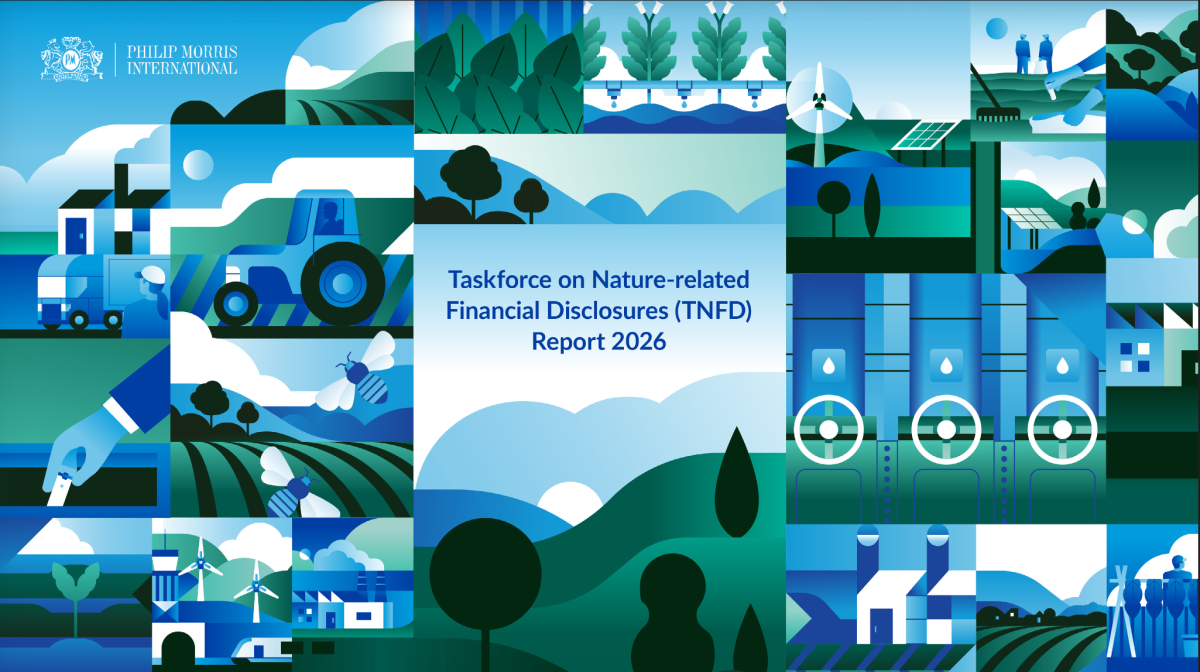
According to Philip Morris International’s inaugural report aligned with the Taskforce on Nature-related Financial Disclosures, released on September 22, the company has included its electronics supply chain and the use and end-of-life stages of smoke-free devices and consumables in its nature-related assessment. The report also shows that PMI’s smoke-free business accounted for about 42% of total net revenues in the second quarter of 2026.
PMI said it has invested more than $16 billion since 2008 in developing, scientifically substantiating and commercializing smoke-free products. Its smoke-free products were available in 109 markets as of June 30, 2026, while the company estimated that more than 43 million legal-age consumers used them worldwide at the end of 2025.
Smoke-Free Business at 42% of Q2 Net Revenue as Electronics Enter TNFD Assessment
PMI’s smoke-free portfolio includes heat-not-burn products, nicotine pouches and e-vapor products.
In its first TNFD report, the company assesses electronics alongside tobacco, agricultural commodities, pulp and paper and other upstream categories for nature-related dependencies.
The report says electronics production depends on critical raw materials, which are classified as abiotic natural assets under the TNFD framework.
PMI’s Responsible Sourcing of Minerals Policy covers 3TGs — tin, tantalum, tungsten and gold — as well as cobalt, and sets due-diligence expectations for related supply chains. The company also maintains a separate critical raw materials assessment covering sourcing, environmental and social risks associated with materials used in its products.
Downstream, PMI assesses the product-use and end-of-life stages of cigarettes, smoke-free devices, smoke-free consumables and packaging.
The company said limited visibility into where products are ultimately consumed and disposed of after the point of sale prevents a meaningful location-specific assessment of the biodiversity footprint of downstream activities.
Single-Use Electronics Enter Resource-Consumption Assessment as IQOS Repair Pilot Expands Device-Life Focus
The report says non-circular electronic products, particularly single-use items, can intensify consumption of limited natural resources where recycling or reuse options are unavailable.
PMI also includes critical raw materials used in electronics manufacturing, as well as solid waste, resource use and pollution at product end-of-life, among the relevant impact pathways.
For electronic smoke-free products, the company says its product-design approach covers material selection and sourcing, component production, manufacturing, use and end-of-life.
PMI disclosed that it is piloting in-store cosmetic repairs for IQOS devices in Czechia and Slovakia to extend device life and reduce waste.
For smoke-free consumables, PMI said differences in product composition, use and post-use consumer behavior require a different approach from cigarettes and that it plans further assessments of disposal practices across consumable categories.
2040 Circularity Scenario Tests 50% Waste-Cost Reduction and 10% Raw-Material Savings
PMI also conducted nature-related scenario analysis through 2040.
Under a scenario focused on reducing natural-resource dependency through circularity, the company modeled:
- a 50% reduction in product waste-related costs;
- 10% raw-material savings;
- a 25% substitution rate for refurbished products versus new products.
PMI described the potential financial benefit under the scenario as a “moderate” increase and said greater circularity could reduce risks associated with raw-material dependency, regulation, compliance and reputation. The report does not disclose a specific dollar value for those assumptions.
PMI said methodologies, datasets and assumptions for nature-impact valuation are not yet standardized and therefore presented financial implications in relative rather than precise monetary terms.
The company also identified 631 nature-related priority locations, including 31 manufacturing sites and approximately 600 sourcing locations across more than 70 countries, covering tobacco, electronics, pulp and paper supply chains. It did not disclose how many relate specifically to electronics or smoke-free products.
Financial Exposure Remains Unquantified as Nature Metric Enters Long-Term Incentives
PMI has not disclosed the value of assets, liabilities, revenue and expenses exposed to nature-related physical and transition risks, or the amount of capital expenditure, financing or investment deployed toward nature-related opportunities.
The report marks several of those TNFD financial metrics as “Not currently available.” PMI said assessment of potential financial implications remains in progress and that more detailed disclosure will be phased in during future reporting cycles.
On governance, PMI said its VALUE Index is linked to 30% of performance-based long-term equity awards. The index includes indicators aligned with the six strategic priorities in its Value Plan 2030+, including one dedicated to nature.
The report also covers tobacco agriculture, pulp and paper, water and forest-related supply chains. PMI said approximately two-thirds of the inherent nature-related impacts covered by its assessment are associated with the tobacco supply chain, while about one-third are linked to forest-based supply chains.
PMI said its assessment of the potential financial implications of nature-related risks and opportunities remains ongoing, with additional disclosures planned for future reporting cycles.
Follow 2Firsts for coverage of global next-generation product supply chains, corporate strategy and capital-market developments.
Cover Image: Philip Morris International
Disclaimer
This article is provided solely for professional research, industry discussion, and informational purposes. Any references to brands, companies, products, technologies, or policies are made for factual reporting and analytical purposes only, and do not constitute endorsement, recommendation, promotion, or advertising by 2Firsts.
Nicotine-containing products, including but not limited to cigarettes, e-cigarettes, heated tobacco products, and nicotine pouches, carry significant health risks. Readers are responsible for complying with all applicable laws and regulations in their respective jurisdictions, including age restrictions and access limitations.
The information contained in this article should not be regarded as investment, legal, medical, regulatory, or commercial advice. While 2Firsts strives to ensure the accuracy and reliability of its content, it does not assume liability for any direct or indirect loss arising from errors, omissions, inaccuracies, or reliance on the information contained herein.
This article is not intended for individuals below the legal age for accessing tobacco or nicotine-related information in their jurisdiction.
Copyright Notice
This article is either original content produced by 2Firsts or content reproduced, translated, summarized, or adapted from third-party sources with attribution where applicable. The intellectual property rights of the original content remain with 2Firsts or the respective original rights holders.
No individual or organization may copy, reproduce, distribute, republish, modify, translate, or otherwise use this content without prior authorization. Any unauthorized use may result in legal action.
For copyright-related inquiries, corrections, or removal requests, please contact: info@2firsts.com.
AI-Assisted Translation and Editing Notice
Portions of this article may have been translated, edited, or reviewed with the assistance of artificial intelligence tools to improve efficiency and readability. Due to the limitations of AI-assisted translation and editing, discrepancies, omissions, or inaccuracies may exist when compared with the original source.
Where applicable, readers are advised to refer to the original source for the most complete and accurate information. If you identify any errors or believe that any content infringes upon your rights, please contact us at info@2firsts.com, and we will review and address the matter promptly.