Key Points
- Detailed rules enter public consultation: The full draft of China’s mandatory national standard for heated cigarettes has been released, with comments due by September 26, 2026.
- Sticks and devices treated as one system: The draft includes both the tobacco stick and heating device in the product definition and requires stick packaging to state device compatibility information.
- Multiple technologies remain in scope: The proposal addresses heating elements located either in the device or inside the tobacco stick, without designating central, peripheral or induction heating as the preferred route.
- Safety requirements take priority: The draft focuses on device safety, temperature control, activation protection and nicotine yield, without setting detailed requirements for residue, ease of cleaning or the overall consumer experience.
- Flavour and patent questions remain open: The current text does not specify rules for characterising flavours or permitted additives, while respondents are asked to submit information on any known relevant patents.
2Firsts
SHENZHEN, July 29, 2026
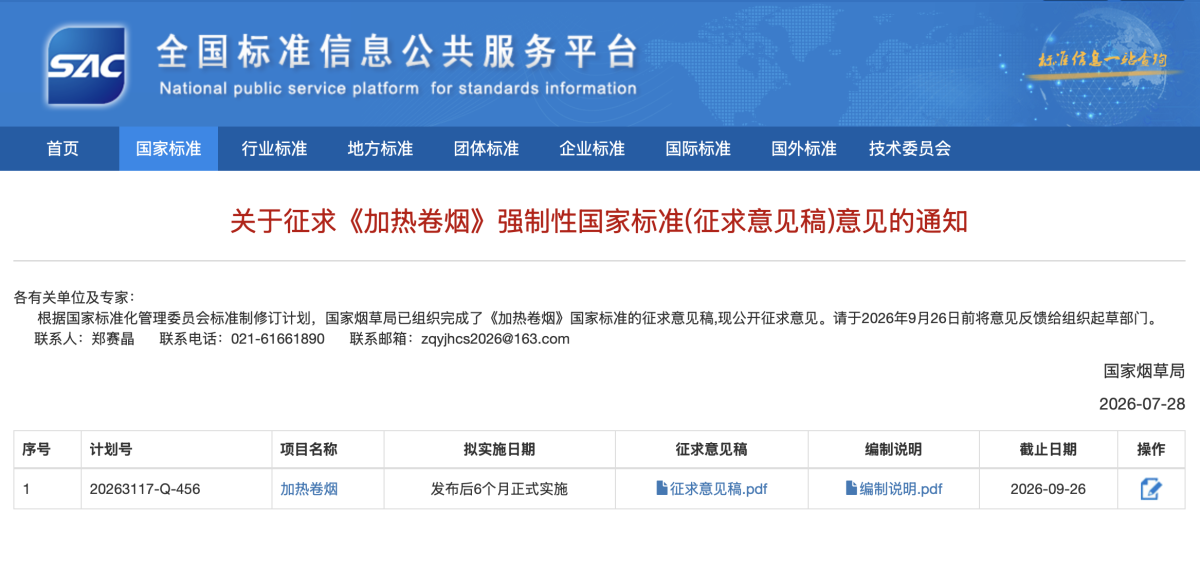
China’s tobacco regulator on July 28 opened a draft mandatory national standard for heated cigarettes for public comment.Submissions will be accepted until September 26.
The project, numbered 20263117-Q-456, was formally issued on June 27 with a 16-month development period. The national standards database says the final standard is intended to take effect six months after publication.
In April, 2Firsts reported that China had begun the project-approval process for mandatory standards covering heated cigarettes and nicotine pouches. Publication of the full heated cigarette draft moves the project from initiation into detailed rulemaking.
The Standard Covers Tobacco Sticks, Devices and Aerosols
The proposed standard applies specifically to heated cigarettes powered by electrical energy.
International technical terminology also recognises heated tobacco products using other heat sources, including smouldering carbon and heated aerosol. The explanatory note says electrically heated products are the dominant category currently on the market and are therefore the focus of the Chinese standard.
“Electrically heated” does not describe a single product design. Electricity can generate heat through a blade, pin, rod or peripheral heating chamber. It can also produce a magnetic field that heats an element embedded in the tobacco stick, as in induction-heating systems. PMI says IQOS ILUMA uses a metal heating element inside its TEREA stick that is heated through induction.
The draft defines a heated cigarette as a cigarette-and-device system that heats, rather than burns, a tobacco substrate to produce a nicotine-containing aerosol. Its main proposed requirements include:
● Tobacco sticks: The tobacco substrate must be made from tobacco leaf, redried tobacco leaf, reconstituted tobacco or cut tobacco. Sticks must be free from mould, have a water activity no higher than 0.70 and keep the lip-contact surface at or below 55°C.
● Heating devices: Batteries must not be user-replaceable. Devices must include child-resistant activation and accidental activation protection and meet requirements covering electrical and battery safety, water-resistance and drop testing, charging and pressure release. Heating-element surface temperature must not exceed 380°C.
● Aerosols: Average nicotine yield must not exceed 0.2 mg per puff.
● Packaging and traceability: Tobacco-stick packaging must state device compatibility requirements. Both stick and device packaging must carry product traceability information.
Tobacco Sticks and Devices Form One Product System
The draft treats the tobacco stick and heating device as parts of the same product system. The explanatory note describes them as inseparable components of an electrically heated cigarette.
Tobacco-stick packaging must identify the compatible heating device, making the specific combination of stick, device and operating conditions an important basis for compliance.
Changes to the stick formulation, physical structure or device settings may require the product’s compatibility to be reassessed. This would require closer coordination between Chinese tobacco manufacturers and device developers and may also affect compatibility between product generations.
The draft does not specify whether sticks and devices must be produced by the same company or set rules for cross-brand compatibility.
Multiple Heating Architectures Remain in Scope
The heating-element temperature test sets out separate procedures for products in which the heating element is located inside the device and those in which it is embedded in the tobacco stick.
The first configuration can include blades, pins, rods and peripheral heating chambers. The second accommodates stick-embedded heating elements, including bladeless induction systems similar in principle to IQOS ILUMA.
Central heating, peripheral heating and stick-embedded heating structures can therefore all be assessed under the proposed temperature and safety requirements. The draft does not identify a preferred technology for China’s domestic market.
The Draft Requires a Tobacco-Based Substrate, Excluding Herbal Nicotine Sticks
The draft defines not only how a heated cigarette is powered, but also what material may be heated. It requires the tobacco substrate to be processed from tobacco leaf, redried tobacco leaf, reconstituted tobacco or cut tobacco.
This requirement would place heated herbal sticks made primarily from tea or other non-tobacco plants, with nicotine added or applied to the material, outside the proposed heated cigarette standard. The same conclusion applies whether the herbal substrate is formed as sheets, strands or granules.
The restriction concerns the origin of the substrate rather than its physical form. Granules made from permitted tobacco materials are not expressly excluded. However, cigarette-style sticks filled with non-tobacco plant granules and added nicotine would not meet the proposed tobacco-substrate requirement. The draft therefore leaves room for different heating technologies and substrate formats while preserving a clear tobacco-based product boundary.
The Draft Sets a Safety Floor, Not the Final Product Experience
Device engineering safety occupies a substantial part of the proposal. Requirements cover electrical and battery safety, child-resistant and accidental activation protection, water-resistance and drop testing, high-voltage charging, pressure-release direction and heating-element temperature.
Requirements for tobacco sticks mainly address the tobacco substrate, appearance, water activity and lip-contact temperature.
The draft does not prescribe performance requirements for tobacco residue, device cleaning, aerosol consistency, draw resistance, preheating time or sensory consistency.
Apart from nicotine yield, it also sets no numerical limits for carbon monoxide, carbonyl compounds, tobacco-specific nitrosamines, volatile organic compounds or metals in the aerosol.
The current text therefore functions primarily as a mandatory safety and quality baseline rather than a complete product-performance specification. Different technologies can still differentiate themselves through heating uniformity, residue control, ease of use and consumer experience.
Flavour and Additive Rules Remain Unspecified
Project materials released in April indicated that the standard was expected to address principles for additive use and prohibited substances in tobacco sticks.
The current draft does not include a ban on characterising flavours or a positive or negative list covering flavourings, cooling agents or other additives.
It requires the tobacco substrate to be made from specified tobacco materials but defines the substrate as tobacco materials and “auxiliary substances” that generate aerosol when heated.
The rules governing which flavours and additives may be used in heated cigarettes for China’s domestic market have yet to be set out.
Patent Information Is Part of the Consultation
The draft asks respondents to submit information and supporting documents on any known relevant patents. Its foreword also states that parts of the standard may involve patents and that the issuing body is not responsible for identifying them.
The explanatory note, however, says the standard itself does not involve patent issues.
The drafting group has not identified a patent issue at this stage, while the consultation leaves room for further disclosures. For companies considering device-based or stick-based heating systems, patents covering heating structures, induction technology, device compatibility and temperature control remain relevant to technology selection.
China Places Greater Emphasis on Device Safety and System Management
The European Union, Russia and China have taken different regulatory approaches to heated tobacco products.
The EU mainly regulates the category through tobacco-product legislation covering product notification, ingredients, packaging and market presentation. In 2022, it withdrew certain exemptions for heated tobacco products, extending restrictions on characterising flavours and some labelling requirements to the category.
Russia’s GOST R 57458-2017 standard mainly covers heated tobacco intended exclusively for use with a dedicated heating device. It defines the product around the generation of tobacco aerosol without combustion or smouldering.
China’s proposal brings tobacco sticks, devices and aerosols into one mandatory national standard and sets concentrated requirements for batteries, electrical safety, activation protection, water-resistance and drop testing, charging, pressure release and heating temperature.
The EU has established a clear restriction on characterising flavours. Russia’s standard places greater emphasis on heated tobacco consumables and the absence of combustion or smouldering. China’s draft gives greater weight to device engineering and the stick-device system.
China Market Launch Unlikely Before Spring 2027
The consultation closes on September 26. The standard must then proceed through comment review, revision, technical examination, approval and publication.
The explanatory note recommends a six-month transition period between publication and implementation.
Based on the published timetable, a formal launch in China’s domestic market is unlikely before spring 2027. The eventual timing will also depend on product approval and market-entry arrangements, production planning, commercial distribution, taxation and packaging rules.
The draft provides the clearest outline to date of how China may regulate electrically heated cigarettes: tobacco sticks and devices are treated as one system, multiple heating architectures remain in scope, and the current standard concentrates on minimum safety and quality requirements. Flavour rules, additive controls and broader product-performance requirements have yet to be defined.
2Firsts will continue to monitor developments in China’s tobacco regulation.
Cover image: Screenshot from the National Public Service Platform for Standards Information.

Disclaimer
This article is provided solely for professional research, industry discussion, and informational purposes. Any references to brands, companies, products, technologies, or policies are made for factual reporting and analytical purposes only, and do not constitute endorsement, recommendation, promotion, or advertising by 2Firsts.
Nicotine-containing products, including but not limited to cigarettes, e-cigarettes, heated tobacco products, and nicotine pouches, carry significant health risks. Readers are responsible for complying with all applicable laws and regulations in their respective jurisdictions, including age restrictions and access limitations.
The information contained in this article should not be regarded as investment, legal, medical, regulatory, or commercial advice. While 2Firsts strives to ensure the accuracy and reliability of its content, it does not assume liability for any direct or indirect loss arising from errors, omissions, inaccuracies, or reliance on the information contained herein.
This article is not intended for individuals below the legal age for accessing tobacco or nicotine-related information in their jurisdiction.
Copyright Notice
This article is either original content produced by 2Firsts or content reproduced, translated, summarized, or adapted from third-party sources with attribution where applicable. The intellectual property rights of the original content remain with 2Firsts or the respective original rights holders.
No individual or organization may copy, reproduce, distribute, republish, modify, translate, or otherwise use this content without prior authorization. Any unauthorized use may result in legal action.
For copyright-related inquiries, corrections, or removal requests, please contact: info@2firsts.com.
AI-Assisted Translation and Editing Notice
Portions of this article may have been translated, edited, or reviewed with the assistance of artificial intelligence tools to improve efficiency and readability. Due to the limitations of AI-assisted translation and editing, discrepancies, omissions, or inaccuracies may exist when compared with the original source.
Where applicable, readers are advised to refer to the original source for the most complete and accurate information. If you identify any errors or believe that any content infringes upon your rights, please contact us at info@2firsts.com, and we will review and address the matter promptly.