Key Points
- Sweden's Public Health Agency found ZYN nicotine pouch ingredient labels noncompliant and ordered Swedish Match North Europe to revise them.
- The products reviewed listed 10 to 13 ingredients on their packaging, compared with 11 to 42 in regulatory submissions.
- Multiple flavoring ingredients were grouped under the generic term "aromer" rather than identified individually.
- Swedish Match was given 60 days to comply and faces a conditional penalty of SEK 2 million per month for noncompliance. Previously marketed products are not subject to recall under the order.
- The company cited trade-secret protection and legislative history in defending its labeling practices and said it intends to appeal.
2Firsts
October 22, 2026
Sweden's Public Health Agency (Folkhälsomyndigheten) has found ingredient labels on ZYN nicotine pouches produced by Philip Morris International (PMI) subsidiary Swedish Match to be noncompliant because multiple flavoring ingredients are grouped under the generic term "aromer" rather than listed individually, according to an October 21 report by Swedish financial newspaper Dagens industri. The agency has ordered corrective action, warning of a conditional penalty of SEK 2 million per month for noncompliance. Swedish Match disputes the decision and plans to appeal.
The agency found that the products' packaging listed 10 to 13 ingredients, while corresponding product notifications submitted to regulators identified between 11 and 42 ingredients.
ZYN Packaging Lists 10 to 13 Ingredients, Compared With 11 to 42 in Regulatory Submissions
According to Dagens industri, Sweden's Public Health Agency purchased five cans of ZYN nicotine pouches ahead of a visit to Swedish Match's factory in Gothenburg in May 2026 and examined the ingredient declarations on their packaging.
The agency found that the products reviewed listed 10 to 13 ingredients on their packaging, compared with 11 to 42 ingredients in the corresponding product notifications. Multiple flavoring components were grouped under the Swedish term "aromer," meaning flavorings, without being identified individually.
An ingredient declaration for ZYN Cold Mint shown in the report included nicotine salts, cellulose and sweetening agents, while the specific flavoring components were presented under the generic designation "aromer."
Under Section 4 of Sweden's Ordinance (2022:1263) on Tobacco-Free Nicotine Products, manufacturers must submit a list of all ingredients and their quantities, along with toxicological information, to regulators. Section 11 requires product packaging to list all ingredients in descending order by weight and provide information on nicotine content and nicotine per dose.
The Public Health Agency concluded that Swedish Match's use of a generic flavoring designation for multiple ingredients did not meet the statutory labeling requirements.
Swedish Match Cites Trade Secrets and Plans to Appeal
Swedish Match disputes the Public Health Agency's interpretation of the labeling rules.
According to Dagens industri, the company argued that grouping flavoring ingredients under "aromer" protects confidential product formulations and complies with its interpretation of Swedish law.
Swedish Match also referred to the legislative preparatory materials for Sweden's tobacco-free nicotine product law, noting that lawmakers did not ultimately include a specific prohibition against grouping ingredients under a common designation.
The company further argued that the limited space on nicotine pouch packaging makes extensive ingredient lists difficult to accommodate.
Under the Public Health Agency's HSLF-FS 2023:24 regulations, ingredient declarations must cover 20% of one of the largest surfaces of both unit and outer packaging. They must appear in Swedish, using bold black text on a white background, and may be applied using non-removable stickers.
The Public Health Agency based its decision on the statutory requirement to list all ingredients and maintained that the individual flavoring components must be disclosed.
Swedish Match communications director Robert Noord told Dagens industri in an emailed response that the company considered its existing labels compliant with Swedish law, disagreed with the agency's assessment and intended to appeal the decision.
SEK 2 Million Monthly Penalty Threatened; Existing ZYN Products Not Subject to Recall
The Swedish Public Health Agency issued its administrative decision on September 29, 2026, directing Swedish Match North Europe to revise the ingredient declarations on the relevant ZYN products.
According to Dagens industri, the company was given 60 days to comply. Failure to meet the requirements could trigger a conditional penalty of SEK 2 million for each month of continued noncompliance.
The order applies only to products manufactured after the decision becomes legally effective and does not require the recall of ZYN products already placed on the market.
The decision may be appealed within three weeks of notification. Dagens industri reported that no appeal had been received by the agency when the newspaper contacted officials. Swedish Match subsequently confirmed that it intended to challenge the ruling.
Follow 2Firsts for the latest news, regulatory developments and market trends across the global tobacco and nicotine industry.
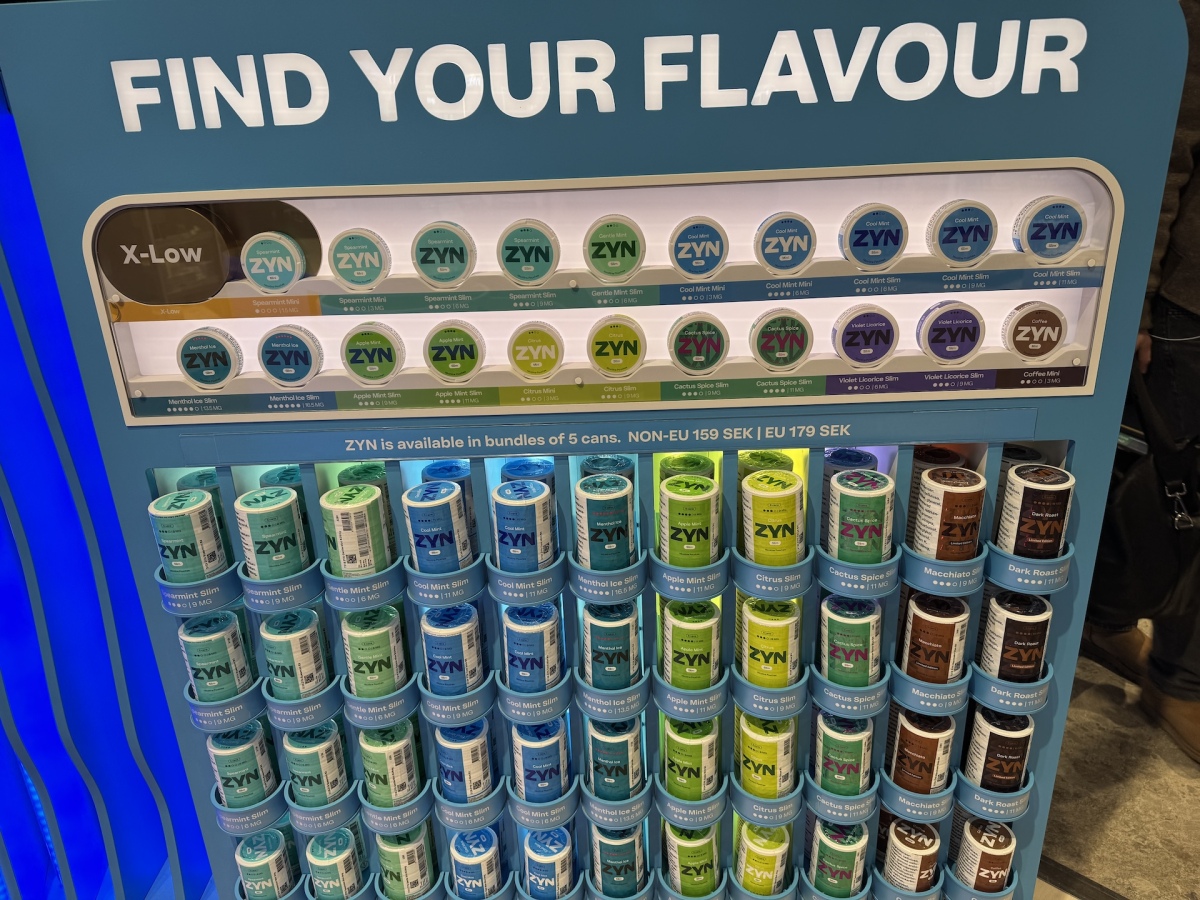
Cover image: ZYN products on display at a duty-free shop at Stockholm Airport, Sweden. Photo taken by 2Firsts in November 2025.
Reference
- Dagens industri — Böter hotar Swedish Match – mörkar Zyn-ingredienser, October 21, 2026
- Swedish Parliament — Ordinance (2022:1263) on Tobacco-Free Nicotine Products, Sections 4 and 11
- Swedish Parliament — Act (2022:1257) on Tobacco-Free Nicotine Products
- Swedish Public Health Agency — HSLF-FS 2023:24, Regulations on Tobacco-Free Nicotine Products
- Swedish Public Health Agency — Manufacturing and Importing Tobacco-Free Nicotine Products
Disclaimer
This article is provided solely for professional research, industry discussion, and informational purposes. Any references to brands, companies, products, technologies, or policies are made for factual reporting and analytical purposes only, and do not constitute endorsement, recommendation, promotion, or advertising by 2Firsts.
Nicotine-containing products, including but not limited to cigarettes, e-cigarettes, heated tobacco products, and nicotine pouches, carry significant health risks. Readers are responsible for complying with all applicable laws and regulations in their respective jurisdictions, including age restrictions and access limitations.
The information contained in this article should not be regarded as investment, legal, medical, regulatory, or commercial advice. While 2Firsts strives to ensure the accuracy and reliability of its content, it does not assume liability for any direct or indirect loss arising from errors, omissions, inaccuracies, or reliance on the information contained herein.
This article is not intended for individuals below the legal age for accessing tobacco or nicotine-related information in their jurisdiction.
Copyright Notice
This article is either original content produced by 2Firsts or content reproduced, translated, summarized, or adapted from third-party sources with attribution where applicable. The intellectual property rights of the original content remain with 2Firsts or the respective original rights holders.
No individual or organization may copy, reproduce, distribute, republish, modify, translate, or otherwise use this content without prior authorization. Any unauthorized use may result in legal action.
For copyright-related inquiries, corrections, or removal requests, please contact: info@2firsts.com.
AI-Assisted Translation and Editing Notice
Portions of this article may have been translated, edited, or reviewed with the assistance of artificial intelligence tools to improve efficiency and readability. Due to the limitations of AI-assisted translation and editing, discrepancies, omissions, or inaccuracies may exist when compared with the original source.
Where applicable, readers are advised to refer to the original source for the most complete and accurate information. If you identify any errors or believe that any content infringes upon your rights, please contact us at info@2firsts.com, and we will review and address the matter promptly.