Key Points
- The Tobacco and Vapes Bill enters report stage in the House of Lords beginning February 24, 2026.
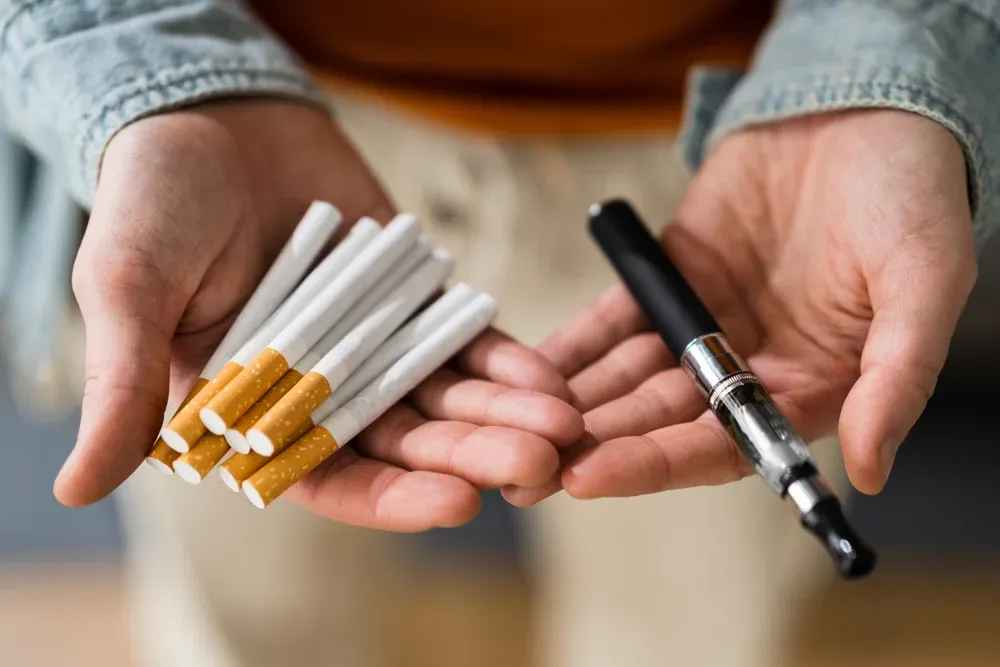
- The legislation aims to prevent individuals aged 15 and under in 2026 from ever legally purchasing tobacco.
- Proposed amendments include raising the legal sales age to 21 and enhancing age-verification requirements.
- The bill would enable new product and information regulations for tobacco and vape products.
2Firsts, February 22, 2026
According to UK Parliament, The UK House of Lords is set to begin report stage consideration of the Tobacco and Vapes Bill on Tuesday, February 24.
The bill aims to create what lawmakers describe as the first “smoke-free generation” by ensuring that children turning 15 in 2026 or younger will never be legally sold tobacco products.
In addition to tobacco restrictions, the legislation seeks to provide authority for product and information requirements relating to tobacco, vaping and other associated products.
Report stage allows members of the House of Lords to conduct detailed scrutiny of the bill and propose amendments. Three days have been scheduled so far for report stage debate: February 24, March 3 and March 5, although additional dates may be added.
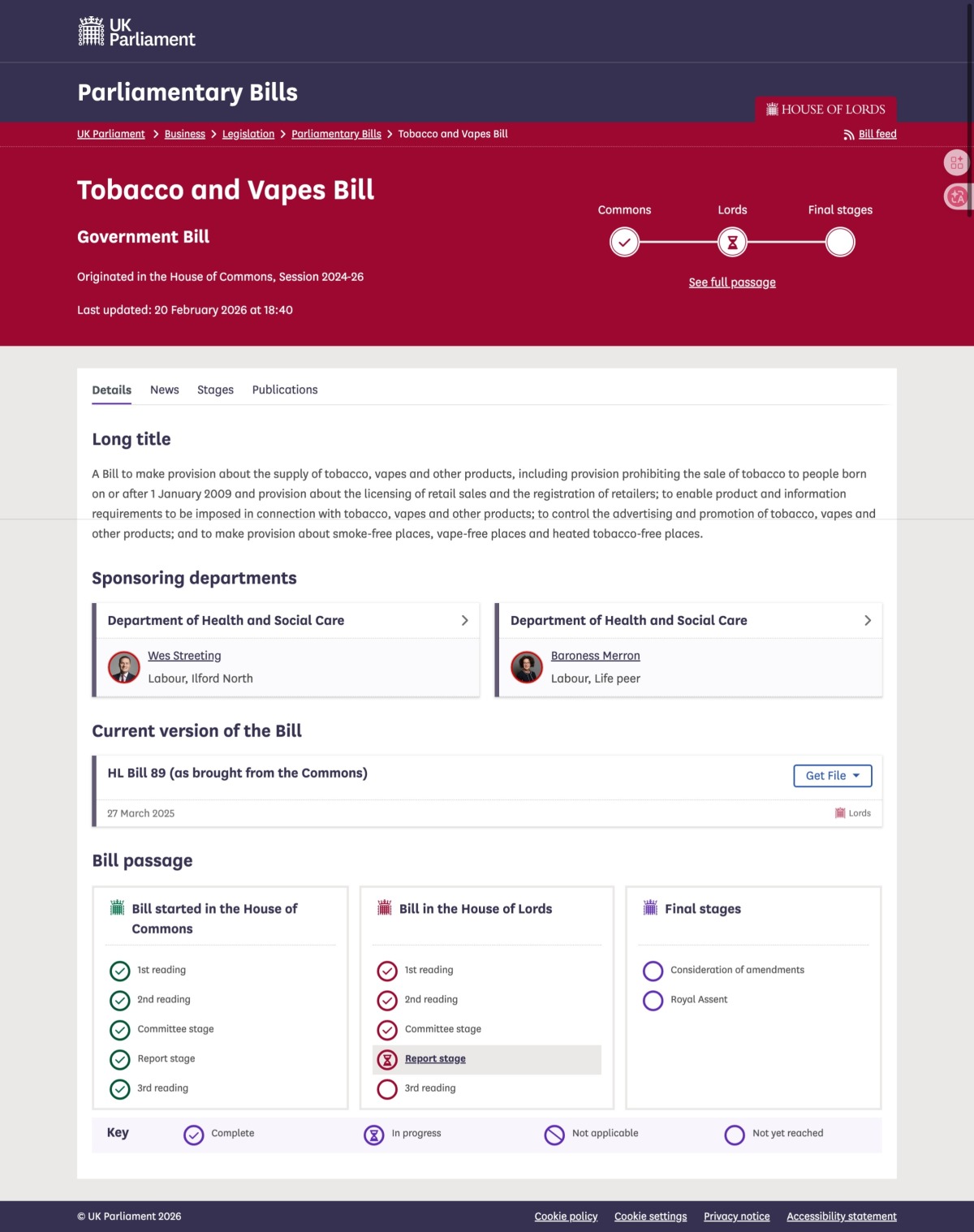
On the first day of report stage, members are expected to consider amendments addressing several issues, including raising the legal age for tobacco and vape sales to 21, specifying customer age-verification methods, granting powers to prohibit sales of certain products, improving transparency of tobacco sales data to support public health policy, and establishing a youth vaping and waste impacts taskforce.
The bill previously underwent line-by-line examination during committee stage between October 27 and November 26, 2025. A second reading debate on the bill’s key principles took place on April 23, 2025.
Further proceedings can be followed via Parliament TV and official Hansard transcripts.
Disclaimer
This article is provided solely for professional research, industry discussion, and informational purposes. Any references to brands, companies, products, technologies, or policies are made for factual reporting and analytical purposes only, and do not constitute endorsement, recommendation, promotion, or advertising by 2Firsts.
Nicotine-containing products, including but not limited to cigarettes, e-cigarettes, heated tobacco products, and nicotine pouches, carry significant health risks. Readers are responsible for complying with all applicable laws and regulations in their respective jurisdictions, including age restrictions and access limitations.
The information contained in this article should not be regarded as investment, legal, medical, regulatory, or commercial advice. While 2Firsts strives to ensure the accuracy and reliability of its content, it does not assume liability for any direct or indirect loss arising from errors, omissions, inaccuracies, or reliance on the information contained herein.
This article is not intended for individuals below the legal age for accessing tobacco or nicotine-related information in their jurisdiction.
Copyright Notice
This article is either original content produced by 2Firsts or content reproduced, translated, summarized, or adapted from third-party sources with attribution where applicable. The intellectual property rights of the original content remain with 2Firsts or the respective original rights holders.
No individual or organization may copy, reproduce, distribute, republish, modify, translate, or otherwise use this content without prior authorization. Any unauthorized use may result in legal action.
For copyright-related inquiries, corrections, or removal requests, please contact: info@2firsts.com.
AI-Assisted Translation and Editing Notice
Portions of this article may have been translated, edited, or reviewed with the assistance of artificial intelligence tools to improve efficiency and readability. Due to the limitations of AI-assisted translation and editing, discrepancies, omissions, or inaccuracies may exist when compared with the original source.
Where applicable, readers are advised to refer to the original source for the most complete and accurate information. If you identify any errors or believe that any content infringes upon your rights, please contact us at info@2firsts.com, and we will review and address the matter promptly.