Sponsored
Content provided by Mylor
The Vaper Expo UK will be held from May 8 to 10, 2026, at the National Exhibition Centre (The NEC) in Birmingham.
As a major offline platform for exchange in the UK vaping market, this year’s exhibition will showcase a wide range of vaping devices, e-liquids, new nicotine delivery systems, and CBD-related products, and will be open to both B2B trade visitors and general consumers.
Against this backdrop, Mylor (Booth E70) will present its solutions related to e-liquid experience design at the exhibition.
Focusing on key dimensions such as sweetness, cooling sensation, sourness, and nicotine experience, Mylor will showcase its systematic thinking on differentiated competition in e-liquid products.
In today’s e-liquid market, there’s a widespread but rarely discussed phenomenon: more and more products have "no obvious shortcomings, yet no real character."
In terms of basic performance, these products often tick all the boxes. They deliver distinct flavor profiles, well-balanced cooling, and proper throat hit or satisfaction.
However, in actual use cases, user feedback tends to converge: smooth but unremarkable, with little motivation to repurchase.
Behind this phenomenon lies not a single ingredient or formula issue, but rather a structural reason. The vaping experience itself has rarely been designed as a complete system.
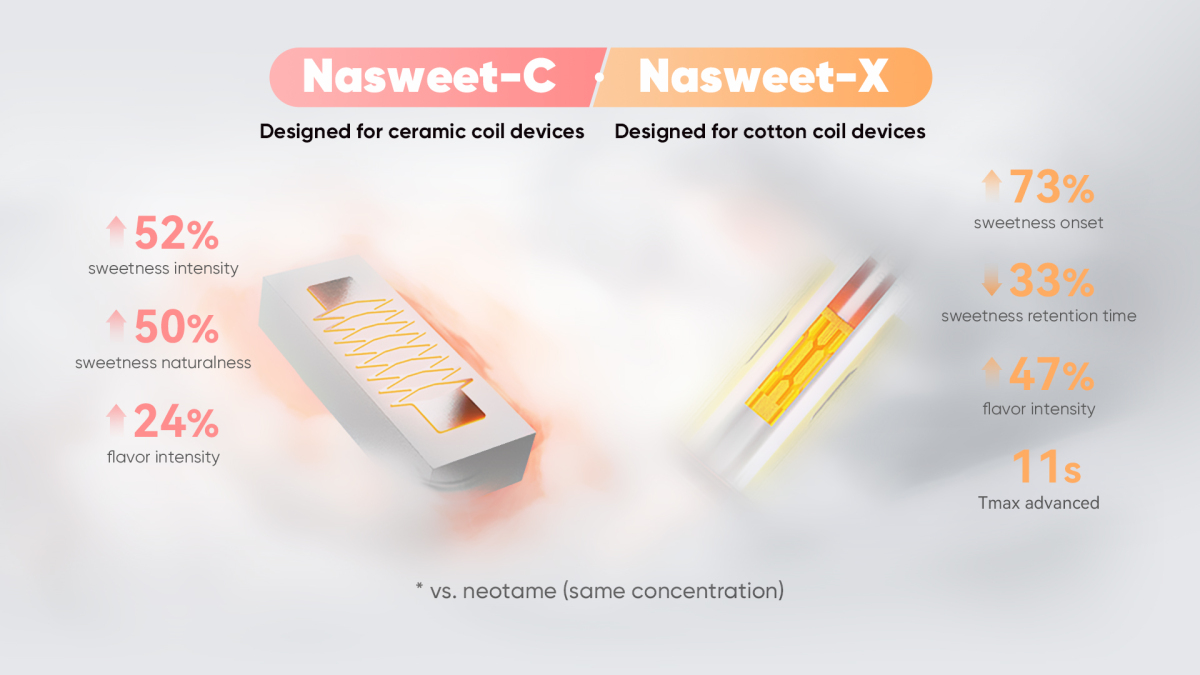
Take sweetness perception as an example. The industry often focuses on the sweetness intensity of sweeteners in e-liquids. But in actual applications, the perceived sweetness is heavily influenced by device structure.
Differences in aerosol particle size distribution between ceramic coil and cotton coil devices lead to noticeably different sensory perceptions, even when using the same sweetener formula.
Ceramic coils tend to produce a finer, weaker sweetness, while cotton coils deliver a stronger initial impact but may leave more residual sweetness.
Under these conditions, simply adjusting sweetener dosage or composition often fails to resolve issues like delayed onset or lingering aftertaste.
More and more research and development practices are beginning to shift to another approach—treating sweetness as an "equipment adaptation variable" rather than an independent formula parameter..
Based on this approach, Mylor developed device-adapted sweetener solutions—NaSweet-C for ceramic coils and NaSweet-X for cotton coils. It delivers a more balanced, natural sweetness with less impact on device stability.
A similar trend is also emerging in cooling sensation design.
For a long time, most formulations relied heavily on WS-23. But as user experience demands continue to evolve, the differences in a single cooling sensation are being rapidly leveled out. At the same time, excessive use can introduce unwanted harshness, reducing overall comfort.
In response, Mylor introduced a layered cooling system—the Coolant series.
Instead of focusing on "stronger cooling",this approach breaks down the cooling sensation into different stages: the immediate sensation at the mouth, the diffusion through the nasal cavity, and the lingering effect in the throat, delivering a more complete, progressive, and balanced cooling experience.
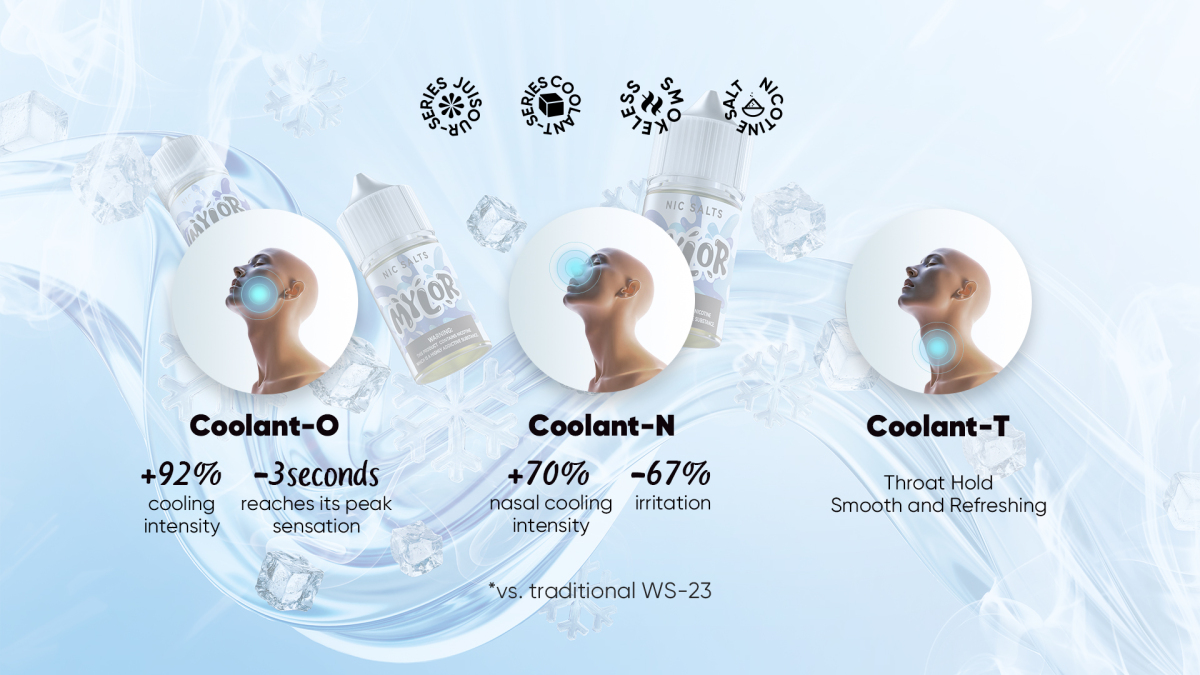
In other words, it’s not about being colder—it’s about creating a more structured cooling pathway.
On the flavor side, the importance of sourness is also being re-evaluated.
In the past, many fruit flavor profiles have trended toward sweetness dominance. but this has led to flavor homogenization, to the point where sweetness replaces the perception of real fruit.
Both research and practical experience have shown that sourness not only participates in taste balance but also affects aroma expression through retronasal olfaction. It is a key factor in determining how “real” a flavor feels.
Without a proper sourness structure, even well-developed aroma compounds can result in a flavor that feels artificial or flat.
Therefore,Mylor developed the JuiSour series, built around a “juicy sourness” concept. By optimizing the balance between sweetness, sourness, and aroma interaction, it introduces a “golden sour-sweet ratio” for different flavor categories—shifting the experience from simple sweetness to a more vibrant, juice-like profile.
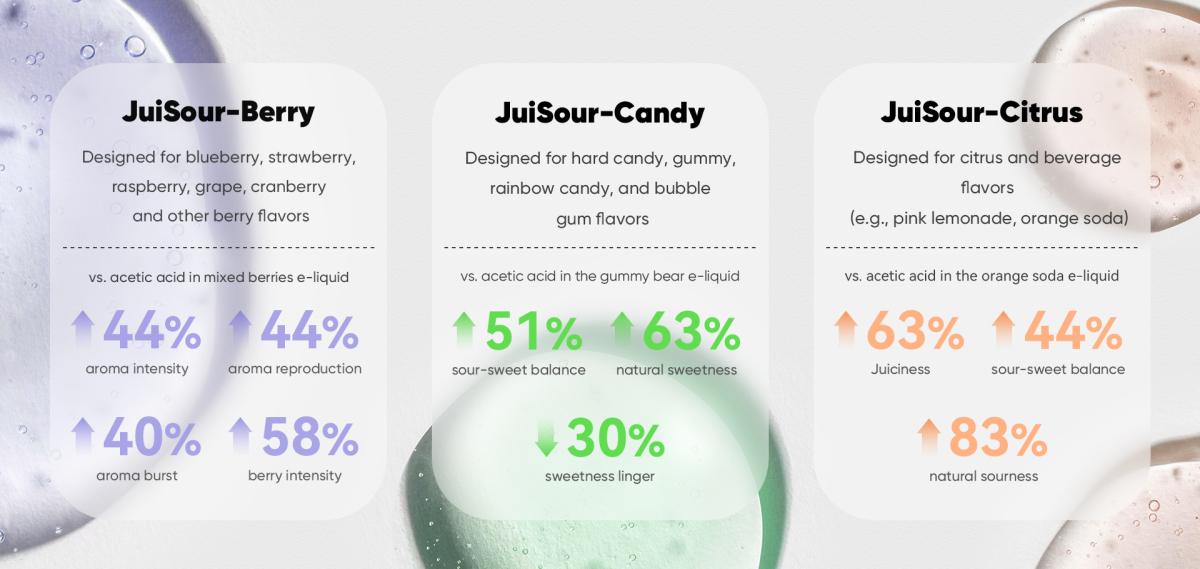
Compared to flavor, the nicotine experience has long been simplified to a single parameter: concentration.
In reality, user perception of nicotine is far more complex. It involves throat hit, harshness, onset speed, and even chest impact.
This also explains why products with the same nicotine strength can deliver completely different sensory feelings.
Based on this difference, Mylor has moved toward breaking down and designing the nicotine experience itself—allowing it to play different roles depending on the product.
This has led to the launch of the FUNC nicotine salt series, which achieve targeted delivery across the head, throat, and chest, meeting diverse demands for headrush, throat hit, and chest kick.
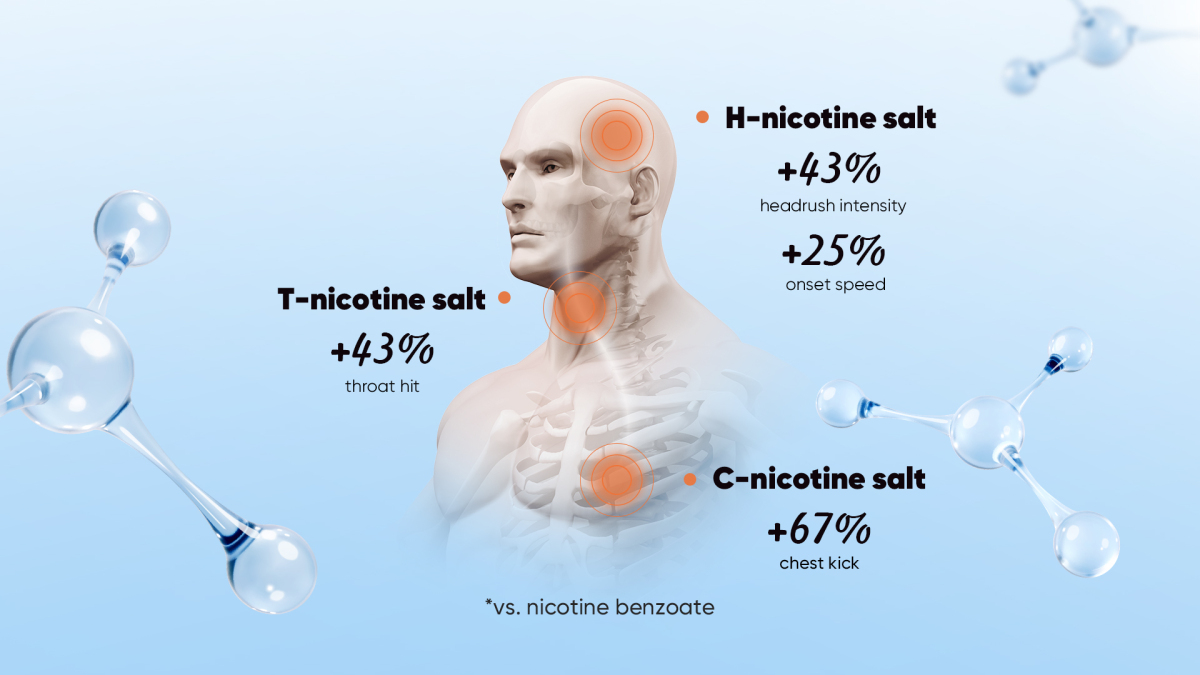
From all the above, the gap between products is no longer about whether certain elements are present but how well they work together.
Sweetness, cooling, sourness, and nicotine experience have become basic components of almost all products.. What truly differentiates a product is whether the overall experience is coherent and logical.
When each component is optimized individually without a unified design logic, the result tends to be "no obvious problems, but no memory points ."
Mylor’s approach focuses on integrating these variables into a unified experience pathway, helping brands create products with a more consistent and recognizable style.
From an industry perspective, this change reflects a deeper trend:
E-liquids are moving from “flavor formulation” to “experience design.”
At this stage, competition is no longer centered on the performance of individual components but on how different technologies match and how well the entire sensory journey is controlled.
For corporate brands, this evolution not only affects product performance, but will also directly influences users' long-term choices and repurchase behavior.
About Mylor Innovation Lab Co., Ltd.
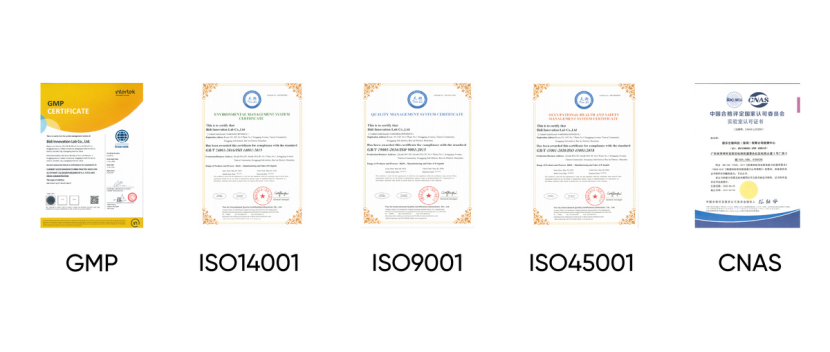
Mylor Innovation Lab Co., Ltd. is a global leader in e-liquid R&D and manufacturing. Since its founding in 2019, the company has rapidly become an industry benchmark thanks to advanced automated production and rigorous quality control. Mylor operates a 5,000 m² modern facility with automation rates up to 80%. Its laboratories are equipped with world-class instruments—including multiple GC, GC-MS, HPLC, and ICP-MS systems—and are accredited by CNAS, with testing capabilities aligned to international standards. Backed by a team of 10+ senior flavorists, Mylor has developed over 30,000 e-liquid formulas, supplying major markets across Europe, the Middle East, Southeast Asia, Russia, and North America.
For more technical information or collaboration inquiries, please contact: max@Mylorbio.com/+86 13714124978
Source: Mylor