Key Points:
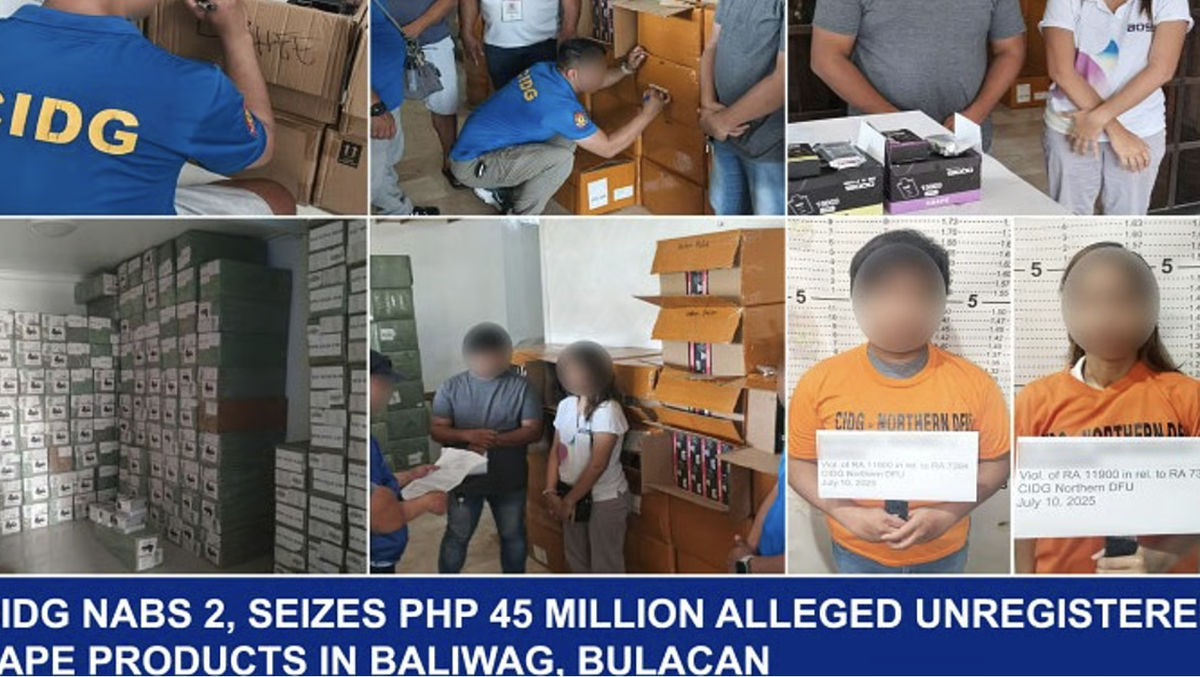
·Law enforcement operation: The Philippine Criminal Investigation and Detection Group (CIDG) and the Department of Trade and Industry (DTI) conducted a joint raid executing a search warrant at two commercial establishments in Bulacan, Philippines.
·Items seized include 140 boxes of e-cigarettes, 23 boxes of pods, and related accessories, with a total value of 45 million pesos (approximately $800,000).
·Two suspects, known as "Rhizmel" and "Anne", were arrested for allegedly selling unregistered e-cigarette products.
·The case is being prosecuted under Article 19 of Republic Act No. 11900, as the products were not registered with the DTI and the Bureau of Internal Revenue.
·CIDG emphasizes the government's commitment to regulating e-cigarette products in order to protect public health rights and interests.
【2Firsts News Flash】According to the Daily Tribune report on July 13, the Criminal Investigation and Detection Group (CIDG) in the Philippines seized e-cigarette products worth 45 million pesos (approximately $800,000) on July 10.
The Criminal Investigation and Detective Division stated that its North District field team, in collaboration with the Department of Trade and Industry (DTI), executed a search warrant, resulting in the arrest of two suspects and the seizure of multiple unregistered e-cigarette products.
According to a report submitted to Acting Director of the Criminal Investigation and Detection Group Romeo Macapaz, two suspects have been identified as business partners "Rhizmel" and "Anne." They are accused of illegally selling and distributing unregistered e-cigarette products without the necessary permits and authorization from the Department of Trade and Industry.
The items seized in this operation include 140 boxes of various e-cigarette products (including brands such as Spark Lighting, Elite 15000, Royal Purple, Oxva, Boss V00M-01, and Premium Boss Greek), 23 boxes of Spark Pods, 98 boxes of Spark Pod Juice, 104 boxes of Spark Pod Refills, several receipts and delivery orders, and a closed-circuit television monitoring device, with an estimated total value of 45 million pesos.
The suspect has been handed over to the national prosecutor's office for prosecution for failing to register the relevant products with the Ministry of Trade and Industry and the National Tax Bureau, in violation of Article 19 of Republic Act No. 11900, the "Vaporized Nicotine and Non-Nicotine Product Regulation Law.
Deputy Police Commissioner Markapaz emphasized that the government has a responsibility to protect and promote the health rights of the people, as well as to cultivate a nation-wide awareness of health. The government is committed to regulating the import, manufacture, sale, distribution, and use of vaping nicotine and non-nicotine products, related equipment, and e-cigarette products in order to create a healthy social environment.
Afterword:
Recently, multiple departments in the Philippines have cracked down on illegal e-cigarette products. 2Firsts had an in-depth conversation with Lucas, who has years of experience in the e-cigarette industry in the Philippines. Lucas believes that the Philippine market is currently in a "chaotic period," and until the regulatory system is solidified, it means high risks and uncertainties for all practitioners. The e-cigarette market in the Philippines is expected to continue moving forward in turmoil. (Related reading)
We welcome news tips, article submissions, interview requests, or comments on this piece.
Please contact us at info@2firsts.com, or reach out to Alan Zhao, CEO of 2Firsts, on LinkedIn
Notice
1. This article is intended solely for professional research purposes related to industry, technology, and policy. Any references to brands or products are made purely for objective description and do not constitute any form of endorsement, recommendation, or promotion by 2Firsts.
2. The use of nicotine-containing products — including, but not limited to, cigarettes, e-cigarettes, nicotine pouchand heated tobacco products — carries significant health risks. Users are responsible for complying with all applicable laws and regulations in their respective jurisdictions.
3. This article is not intended to serve as the basis for any investment decisions or financial advice. 2Firsts assumes no direct or indirect liability for any inaccuracies or errors in the content.
4. Access to this article is strictly prohibited for individuals below the legal age in their jurisdiction.
Copyright
This article is either an original work created by 2Firsts or a reproduction from third-party sources with proper attribution. All copyrights and usage rights belong to 2Firsts or the original content provider. Unauthorized reproduction, distribution, or any other form of unauthorized use by any individual or organization is strictly prohibited. Violators will be held legally accountable.
For copyright-related inquiries, please contact: info@2firsts.com
AI Assistance Disclaimer
This article may have been enhanced using AI tools to improve translation and editorial efficiency. However, due to technical limitations, inaccuracies may occur. Readers are encouraged to refer to the cited sources for the most accurate information.
We welcome any corrections or feedback. Please contact us at: info@2firsts.com