Key Points
● Listing: AIR Global began trading on Nasdaq under ticker AIIR after completing its business combination with Cantor Equity Partners III.
● Market reaction: AIR shares fell 18.6% on their first trading day, closing at $10.44.
● Category test: The listing gives the hookah industry a rare public-market reference point.
● Business model: AIR is trying to frame hookah as a scalable consumer platform, not only a fragmented tobacco trade.
● Uncertainty: Market acceptance, regulatory recognition and consumer adoption remain key tests.
2Firsts
May 19, 2026
AIR Global PLC fell 18.6% in its first day of Nasdaq trading on May 18, giving public investors an early look at a Dubai-based hookah company trying to bring a long-fragmented tobacco category into the listed-company market.
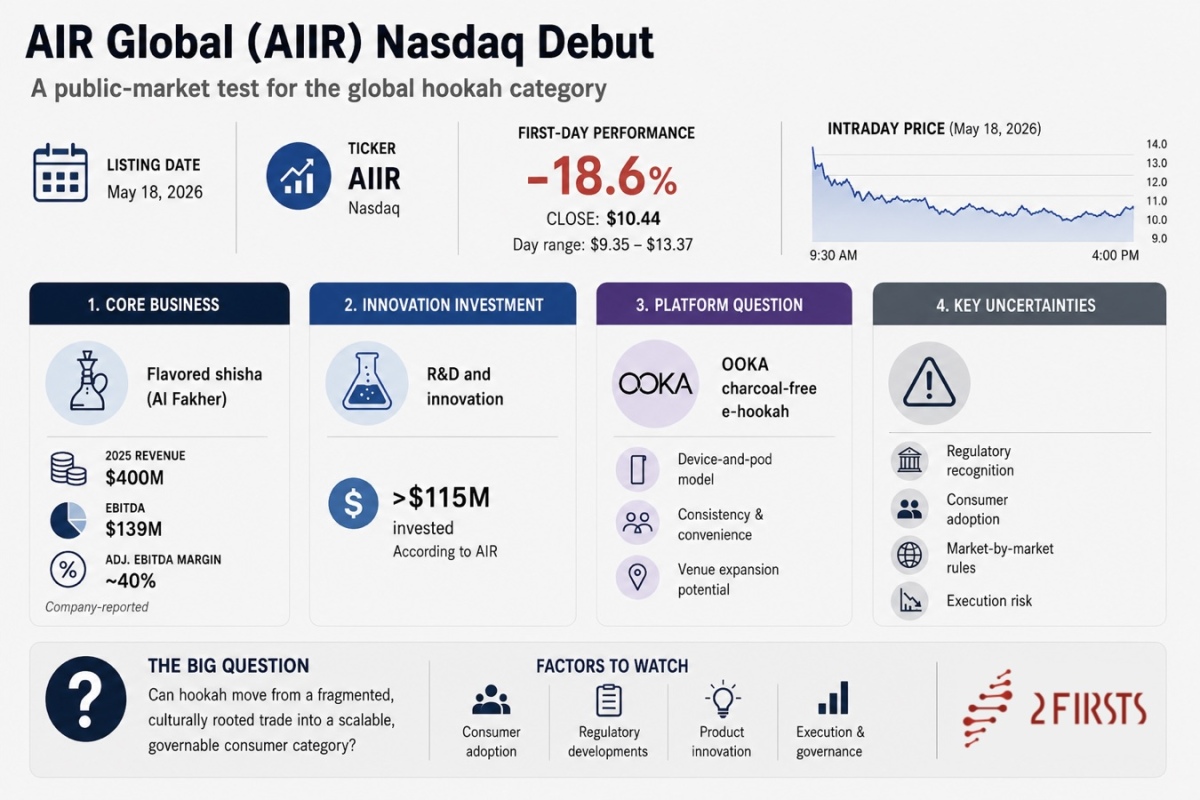
The company’s ordinary shares began trading under the ticker AIIR after AIR completed its business combination with Cantor Equity Partners III, a special purpose acquisition company. According to Yahoo Finance data reviewed by 2Firsts, AIR shares closed at $10.44, down 18.63%. Public market data showed the stock opened at $13.37 and traded between $9.35 and $13.37 during the session.
The first-day decline came as AIR positioned itself as a rare listed pure-play company in the global hookah sector. AIR owns Al Fakher, one of the best-known shisha brands, and describes itself as a global leader in flavored shisha molasses and advanced inhalation technologies. The company says it is the first pure-play hookah company to list in the United States.
AIR has also presented the listing as notable for a Middle Eastern company entering U.S. public markets during a period of heightened regional tensions linked to Iran. For the tobacco and nicotine industry, however, the more immediate question is whether hookah can be valued as a scalable consumer platform rather than as a fragmented trade built around lounges, regional distributors and traditional consumption rituals.
In a March 2026 interview with 2Firsts, AIR Chief Executive Stuart Brazier argued that hookah should be viewed as a more mature and governable category. With AIR now trading on Nasdaq, that argument has moved from corporate positioning to market test.
First-Day Trading Shows Early Repricing
AIR’s debut showed a sharp pullback after the shares opened above $13.
The stock closed at $10.44 after trading as low as $9.35. Yahoo Finance also showed AIIR at $9.88 in pre-market trading on May 19, down a further 5.36% from the previous close.
The move should be treated with caution. Newly listed companies coming through SPAC combinations often trade with limited liquidity and can see large price swings as investors assess valuation, available float and post-merger fundamentals. AIR’s first session does not, on its own, show whether investors accept or reject the hookah category.
Still, the listing gives the industry a public reference point it has largely lacked. Listed tobacco exposure has historically been concentrated in cigarettes, heated tobacco, vaping products, oral nicotine and diversified tobacco groups. Hookah has had commercial scale, but much of the market remains less visible to institutional investors because it is spread across local operators, lounges, distributors and traditional retail channels.

A Shisha Business Seeks a Listed-Company Valuation
AIR’s investor case starts with scale and profitability.
According to information provided by the company, the business combination initially valued AIR at about $1.749 billion. AIR said its 2025 revenue rose 6% to $400 million, while EBITDA increased 7% to $139 million. The company has also said its core business has historically generated adjusted EBITDA margins near 40%.
AIR also says the global consumer market for flavored shisha molasses is estimated at $15 billion to $20 billion, and that it held more than 60% market share in the United States in 2025.
Those figures form the financial basis of AIR’s public-market pitch. Investors will now test them against filings, quarterly results, cash generation, category data and the company’s ability to expand without weakening margins.
AIR is not presenting itself as a pre-revenue technology company. Its foundation is a profitable shisha business. The larger valuation question is whether that business can be paired with devices, pods, intellectual property and regulatory evidence to create a more defensible consumer platform.
Charcoal-Free E-Hookah Tests the Traditional Experience
AIR’s clearest attempt to change the structure of the hookah market is OOKA, its charcoal-free electronic hookah platform.
Traditional hookah depends on charcoal, preparation, service, cleanup and open-system consumables. Those features help define the category, but they also limit where hookah can be sold and used. OOKA is designed to move part of the experience into a closed device-and-pod system.
According to company materials and previous comments to 2Firsts, AIR has invested more than $115 million in innovation, including advanced inhalation platforms. The strategic aim is to shift part of hookah from an open consumables trade toward a more controlled hardware-and-consumables model.
If OOKA gains adoption, AIR could benefit from recurring pod sales, proprietary hardware, stronger product control and access to venues where charcoal-based waterpipe use is difficult or restricted. That would give the company a model investors may treat differently from traditional shisha supply.
The risk is consumer behavior. Hookah is not only a delivery format; it is also a social practice. Some users may welcome a cleaner and more convenient system. Others may regard charcoal, lounge service and traditional preparation as central to the experience. OOKA may expand consumption occasions, but it has not yet proved that it can reshape the category at scale.
Regulatory Recognition Remains Uncertain
AIR’s platform strategy also depends on how regulators view heated or charcoal-free hookah.
The company has argued that such products may eventually be treated differently from charcoal-based waterpipe formats. It has cited scientific work, including a peer-reviewed study published in December 2025, to support its argument that certain toxicants and pollutants can be reduced in controlled settings.
That is a regulatory argument, not a regulatory outcome.
Authorities may classify products based on tobacco content, nicotine delivery, device design, emissions, youth access risks or existing waterpipe rules. Different markets may reach different conclusions. AIR therefore has a differentiation thesis, but not broad regulatory recognition of that thesis.
If regulators eventually distinguish closed-system heated hookah from charcoal-based formats, AIR could gain a stronger compliance story and higher barriers to entry. If they do not, its position will depend more on brand strength, pricing, distribution, product execution and consumer uptake.
The Industry Now Has a Public Test Case
AIR’s Nasdaq debut does not prove that hookah has become an institutional category. Its first-day fall does not prove the opposite.
What has changed is visibility. Investors can now assess a hookah-focused company through share price, filings, earnings, margins and capital allocation. That may influence how competitors, distributors, regulators and investors view the category.
If AIR’s model gains traction, the hookah trade could see more attention on brand scale, proprietary systems, regulatory evidence and corporate governance. Companies with access to capital may be better placed to consolidate fragmented markets, develop closed-system products or acquire regional brands. AIR previously announced the acquisition of Germany’s NameLess, a premium flavored hookah brand, indicating that regional brand acquisitions may form part of its broader expansion strategy alongside closed-system products.
The constraints remain significant. Hookah markets are culturally rooted, regionally diverse, price-sensitive and exposed to tightening tobacco regulation. A listed-company structure does not remove those pressures. It makes them more visible.
For AIR, the market test has begun. For the wider hookah industry, the question is whether a category built around ritual, flavor and local trade can evolve into one that public markets view as scalable, governable and durable.
2Firsts will continue to follow AIR and the development of the global hookah market.
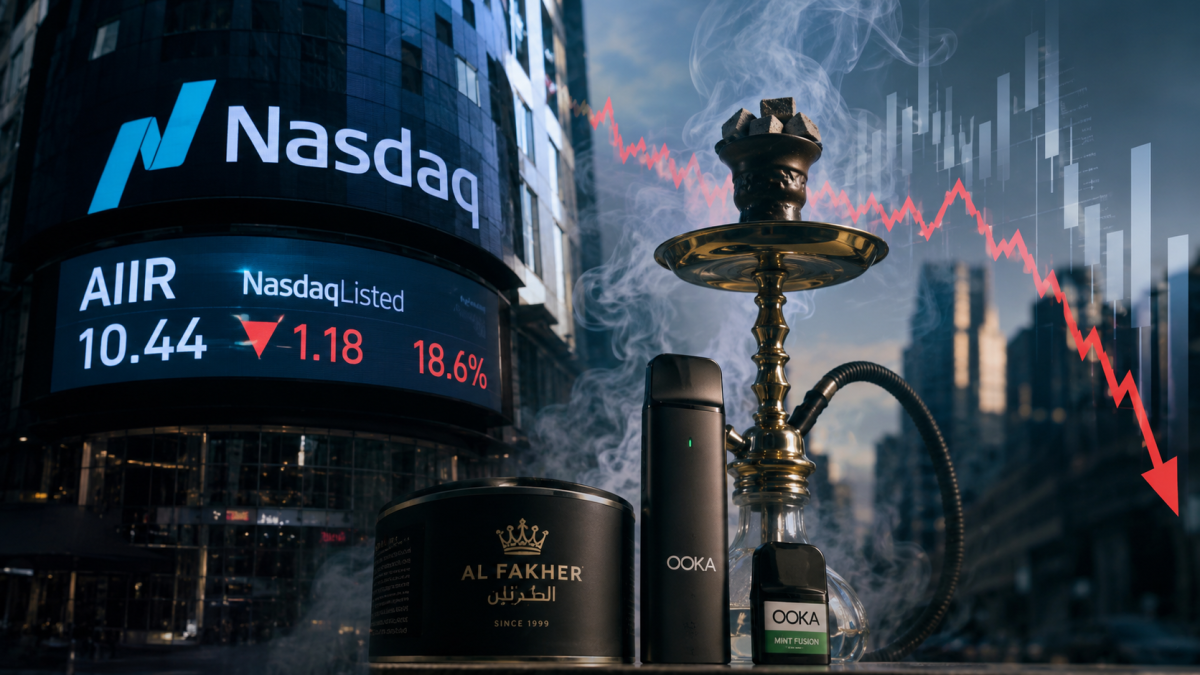
(Cover image generated by AI.)