Key Points
- Koplow will deliver a keynote and participate in a fireside chat at NATO's Sept. 29-30 conference in Washington.
- NATO has not disclosed the specific policy topics Koplow will address beyond saying he will discuss CTP regulatory developments.
- On May 7, Koplow outlined efforts to accelerate premarket tobacco product review, including efficiency improvements involving ENDS and nicotine pouch applications.
- On May 8, the FDA issued final guidance setting out enforcement priorities for certain unauthorized ENDS and oral nicotine pouch products with pending applications.
- FDA plans a public list identifying manufacturers and products it does not currently intend to prioritize for enforcement under the policy, but inclusion does not constitute marketing authorization.
- FDA currently says it has authorized 45 e-cigarette products and that these are the only e-cigarettes that may lawfully be sold in the United States.
- NATO says its current membership includes more than 66,000 retail stores and maintains a tracker covering FDA warning letters, civil money penalty complaints and import alerts involving vapor products.
2Firsts
August 14, 2026
Bret Koplow, acting director of the U.S. Food and Drug Administration's Center for Tobacco Products, will address a tobacco and nicotine retail industry conference in Washington in September, about four months after the agency moved to accelerate PMTA reviews and refine its enforcement priorities for certain unauthorized ENDS and nicotine pouch products.
According to an Aug. 14 report by Convenience Store News, Koplow will deliver a keynote at the National Association of Tobacco Outlets' 25th Anniversary Celebration and Legislative Conference on Sept. 29-30 and take part in a fireside chat afterward.
NATO's agenda also includes an FDA-focused session. Neither the association nor the FDA has announced a detailed topic for Koplow's keynote, and there is no confirmation that he will specifically address PMTA reviews, ENDS enforcement or nicotine pouch policy.
His appearance comes shortly after two closely timed FDA actions involving product review and enforcement.
FDA Moves to Speed PMTA Reviews, Then Refines Enforcement Priorities
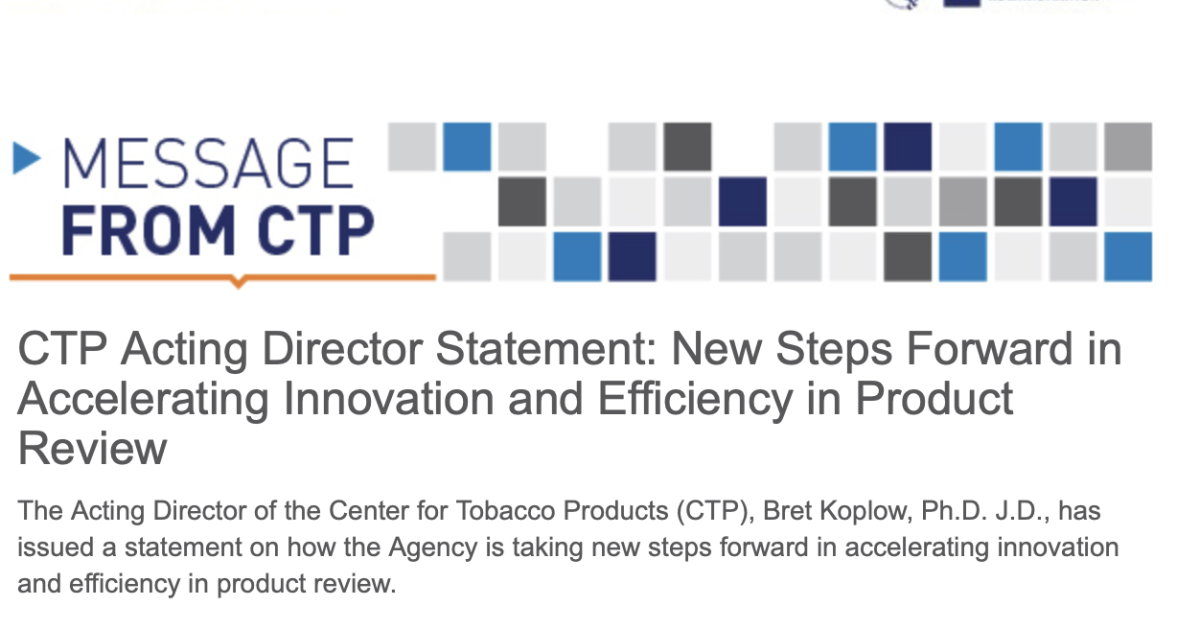
On May 7, Koplow issued a statement outlining new steps to improve the speed and efficiency of premarket tobacco product review.
He said CTP reduced its application backlog by roughly 70% during 2025 and had effectively eliminated the queue at the Acceptance Review stage. The center has also been working to improve Filing Review efficiency, including for electronic nicotine delivery systems, or ENDS, and nicotine pouch applications.
Koplow framed the changes as an effort to speed regulatory decisions without lowering scientific standards, saying more efficient review could allow products meeting the statutory public-health standard to reach adult tobacco users sooner.
New tobacco products must still meet the legal standard of being appropriate for the protection of the public health before receiving FDA marketing authorization.
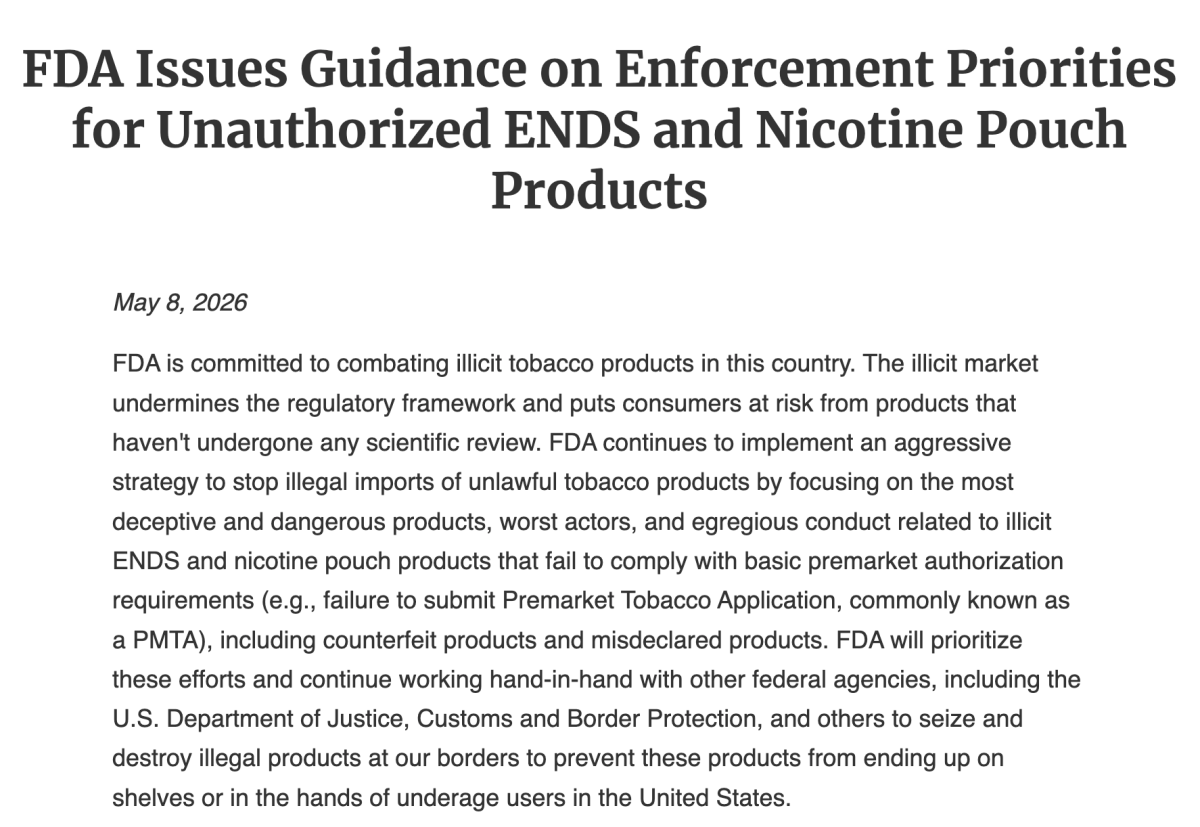
One day later, on May 8, the FDA issued final guidance titled Enforcement Priorities for Certain New Tobacco Products Marketed Without Premarket Authorization.
The guidance sets out circumstances in which the agency does not currently intend to prioritize enforcement against certain unauthorized ENDS and oral nicotine pouch products.
The policy may cover certain products with pending PMTAs that FDA has accepted and filed, as well as qualifying supplemental PMTAs, subject to additional conditions.
For non-tobacco-flavored ENDS, the FDA also requires the application to contain data sufficient for the agency to evaluate whether the product meets the appropriate-for-the-protection-of-the-public-health standard.
Lower Enforcement Priority Does Not Mean FDA Authorization
The May policy creates greater differentiation among unauthorized products from an enforcement perspective, but it does not change their legal status.
The FDA states that new tobacco products may not legally be marketed without premarket authorization. Products covered by the new enforcement policy therefore remain unauthorized even if the agency does not currently intend to prioritize enforcement against them.
The FDA has also said that falling within the policy has no bearing on whether a product will ultimately receive marketing authorization.
FDA currently says it has authorized 45 e-cigarette products and that these are the only e-cigarette products that may lawfully be sold in the United States.
From a retailer risk-management perspective, products can now be viewed in several practical regulatory and enforcement situations: products with FDA marketing authorization; unauthorized products that may currently fall outside the agency's enforcement priorities under the May guidance; and unauthorized products that are or may become enforcement priorities.
That is a practical description of the market, not a set of three formal legal categories created by the FDA.
FDA Plans Public List Under May Enforcement Policy
The FDA also said it will create and maintain a publicly available list identifying manufacturers and products that it does not currently intend to prioritize for enforcement under the May policy.
Manufacturers whose products meet the policy conditions and want to be included can contact the regulatory health project manager responsible for their pending application or use a CTP-designated channel.
For retailers, such a list could provide greater visibility into the agency's current enforcement posture toward individual products.
The FDA cautions, however, that inclusion would not constitute marketing authorization and would not guarantee that the agency would refrain from enforcement in every case.
The agency may still prioritize action against products with characteristics it considers particularly appealing to underage users, including cartoon-like fictional characters, products disguised as other consumer goods or devices resembling children's toys, phones or gaming platforms.
Other factors can include unusually high nicotine content, serious adverse experiences, lack of required child-resistant packaging or potential fire hazards.
NATO Says Membership Includes More Than 66,000 Retail Stores
NATO is a national trade association representing tobacco and nicotine retail interests.
The association says its current membership includes more than 66,000 retail stores, along with manufacturers, distributors and other industry participants.
It monitors federal, state and local tobacco and nicotine regulation and lists vapor regulatory issues and FDA engagement among its core policy areas.
FDA product status and enforcement decisions have direct commercial implications for retailers.
NATO maintains an enforcement tracker covering flavored disposable vapor brands cited in FDA warning letters, civil money penalty complaints and import alerts.
The association also cautions retailers that enforcement involving one brand does not necessarily establish the regulatory status of every SKU sold under that name and recommends checking individual products with suppliers.
Retailers Have Pushed for Faster Decisions and Clearer Product Status
Over the past one to two years, NATO and other U.S. retail groups have publicly called for faster FDA PMTA decisions while also supporting stronger enforcement against unauthorized disposable vaping products.
Retail groups have argued that long review timelines and unclear product status increase uncertainty around purchasing and inventory decisions.
NATO has also supported age-verification and retail-compliance measures aimed at preventing underage sales while opposing broad flavor bans and comprehensive local prohibitions on legal tobacco and nicotine retail sales.
The FDA has not said its May review and enforcement changes were adopted in response to NATO or other retail groups.
The policies nevertheless overlap with several issues those groups have raised, including faster regulatory decisions, greater visibility into product status and a stronger focus on products that have not met basic premarket application requirements or present additional public-health concerns.
Retailers Will Watch How FDA Explains the New Review and Enforcement Approach
Koplow's September appearance will come as the FDA pursues two related regulatory tracks: speeding decisions on tobacco product applications while applying more differentiated enforcement priorities to unauthorized ENDS and nicotine pouch products before final decisions are reached.
For manufacturers, the changes mean regulatory strategy involves not only whether a product ultimately receives marketing authorization, but also whether it falls within the FDA's current enforcement-priority policy while an application remains pending.
For distributors and retailers, the challenge is distinguishing between FDA-authorized products, unauthorized products that may not currently be prioritized for enforcement, and unauthorized products that remain or become enforcement targets.
NATO has not said Koplow will announce any new policy at the conference.
As the FDA begins implementing the public-list approach and other elements of the May guidance, retailers are likely to watch for greater clarity on how CTP draws those enforcement lines and how faster PMTA reviews interact with enforcement decisions in the U.S. vaping market.
Koplow's remarks will also offer a window into how the FDA intends to allocate regulatory resources between faster product review and continued enforcement against unauthorized products.
Follow 2Firsts for the latest updates on global tobacco and nicotine regulation, policy developments and industry trends.
Cover Image generated by AI
Disclaimer
This article is provided solely for professional research, industry discussion, and informational purposes. Any references to brands, companies, products, technologies, or policies are made for factual reporting and analytical purposes only, and do not constitute endorsement, recommendation, promotion, or advertising by 2Firsts.
Nicotine-containing products, including but not limited to cigarettes, e-cigarettes, heated tobacco products, and nicotine pouches, carry significant health risks. Readers are responsible for complying with all applicable laws and regulations in their respective jurisdictions, including age restrictions and access limitations.
The information contained in this article should not be regarded as investment, legal, medical, regulatory, or commercial advice. While 2Firsts strives to ensure the accuracy and reliability of its content, it does not assume liability for any direct or indirect loss arising from errors, omissions, inaccuracies, or reliance on the information contained herein.
This article is not intended for individuals below the legal age for accessing tobacco or nicotine-related information in their jurisdiction.
Copyright Notice
This article is either original content produced by 2Firsts or content reproduced, translated, summarized, or adapted from third-party sources with attribution where applicable. The intellectual property rights of the original content remain with 2Firsts or the respective original rights holders.
No individual or organization may copy, reproduce, distribute, republish, modify, translate, or otherwise use this content without prior authorization. Any unauthorized use may result in legal action.
For copyright-related inquiries, corrections, or removal requests, please contact: info@2firsts.com.
AI-Assisted Translation and Editing Notice
Portions of this article may have been translated, edited, or reviewed with the assistance of artificial intelligence tools to improve efficiency and readability. Due to the limitations of AI-assisted translation and editing, discrepancies, omissions, or inaccuracies may exist when compared with the original source.
Where applicable, readers are advised to refer to the original source for the most complete and accurate information. If you identify any errors or believe that any content infringes upon your rights, please contact us at info@2firsts.com, and we will review and address the matter promptly.