Key Points
- Vapor Technology Association and Southside Vape lost at the preliminary-injunction stage.
- The Alabama Supreme Court allowed the state’s 2025 ENDS law to remain in effect.
- The law creates a state product directory for ENDS and related products.
- Covered products generally must be U.S.-made or FDA-authorized.
- The court said the plaintiffs failed to show a reasonable likelihood of success on their constitutional claims.
2Firsts
July 10, 2026
Vapor Technology Association and vape retailer Southside Vape, LLC suffered an early legal setback in their challenge to Alabama’s 2025 vape law, according to VitalLaw and the Alabama Supreme Court’s decision.
The Alabama Supreme Court affirmed a lower court’s refusal to issue a preliminary injunction blocking enforcement of the state’s law regulating electronic nicotine delivery systems, or ENDS.
The case concerns Act No. 2025-403, Alabama’s law regulating ENDS and e-liquids. The court held that the plaintiffs had standing to challenge the law, but failed to demonstrate a reasonable likelihood of success on the merits of their constitutional claims at this stage.
Alabama Law Creates ENDS Product Directory
According to the court’s decision, Alabama’s Act No. 2025-403 took effect on June 1, 2025, and regulates electronic nicotine delivery systems and e-liquids, commonly referred to as e-cigarettes or vapes.
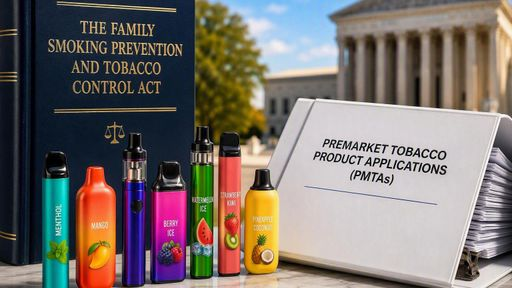
The law establishes an ENDS product directory and sets conditions for products to be included. Beginning Oct. 1, 2025, manufacturers of e-liquids and alternative nicotine products sold in Alabama must submit certifications to the Alabama Department of Revenue stating that their products comply with federal law.
The law also provides that e-liquids, ENDS and alternative nicotine products may be added to the state directory only if one of two conditions is met: the product and its components are made, packaged, labeled and manufactured in the United States, or the manufacturer has received an FDA marketing order or other authorization.
VTA and Vape Retailer Challenged the Law
The plaintiffs were Vapor Technology Association, an industry group for vapor products, and Southside Vape, LLC, which operates specialty vape shops in southern Alabama.
The plaintiffs filed suit in Montgomery Circuit Court, seeking a temporary restraining order and a preliminary injunction to stop enforcement of the Alabama law. The trial court initially issued a temporary restraining order, but later denied the motion for a preliminary injunction and extended the temporary restraining order during the appeal.
The plaintiffs argued that the Alabama law was preempted by federal law and violated the dormant Commerce Clause. They also said the law could cause lost profits, loss of employees and possible store closures.
Court Finds Standing but Says Injunction Standard Was Not Met
The Alabama Supreme Court found that the plaintiffs had standing because the alleged harms were not hypothetical and could flow directly from enforcement of the law.
However, the court said the plaintiffs failed to show a reasonable likelihood of success on the merits of their constitutional claims.
The court concluded that the Alabama law was not preempted by federal law. It also found that the law served legitimate state interests related to the health and safety of Alabama residents, including youth protection.
As a result, the court affirmed the lower court’s denial of the preliminary injunction. Procedurally, Alabama officials prevailed at this stage, while Vapor Technology Association and Southside Vape failed to stop the law from remaining in effect.
Court Discusses Restrictions on Foreign-Made Vapes
The decision also addressed Alabama’s restriction on foreign-made ENDS products.
The court acknowledged that the law clearly discriminates against foreign trade, but said the state had offered a compelling reason tied to health and safety.
The court cited legislative findings stating that, until the FDA effectively regulates vaping products in the United States, Alabama must restrict and prohibit the sale of foreign vaping products to protect residents’ health, safety and welfare.
This part of the decision makes the case particularly relevant to the vape supply chain. For products relying on overseas manufacturing or imports, Alabama’s law places FDA authorization and U.S. manufacturing requirements into the state-level market access framework.
Industry Impact and Outlook
The Alabama Supreme Court’s ruling shows that state-level ENDS directory laws continue to receive support in some courts.
In recent years, multiple U.S. states have moved to create ENDS product directories or PMTA registry systems, using FDA marketing authorization status, FDA review status and state certification requirements as market access tools. Alabama’s law goes further by adding U.S. manufacturing or FDA authorization requirements, giving it a more direct effect on imported vape products.
For vape manufacturers, importers and retailers, the case shows that state-level regulation is moving beyond age verification, taxation and retail licensing. It is increasingly extending into product origin, manufacturing location, FDA authorization status and directory eligibility.
The ruling remains a preliminary-injunction decision, not a final judgment on all underlying claims. The court’s core finding was that the plaintiffs had not shown a reasonable likelihood of success at this stage. Future litigation, rulings on similar state laws and differing federal court approaches to ENDS directory laws will continue to shape the U.S. regulatory landscape.
From an international supply-chain perspective, the Alabama case is important for Chinese and other overseas vape manufacturers. As state market access rules become more closely tied to FDA authorization, product directories and manufacturing-origin requirements, compliance barriers for exports to the U.S. may continue to rise.
Follow 2Firsts for the latest updates on global tobacco harm reduction, nicotine products and regulatory developments.
Cover Image source: VitalLaw
Disclaimer
This article is provided solely for professional research, industry discussion, and informational purposes. Any references to brands, companies, products, technologies, or policies are made for factual reporting and analytical purposes only, and do not constitute endorsement, recommendation, promotion, or advertising by 2Firsts.
Nicotine-containing products, including but not limited to cigarettes, e-cigarettes, heated tobacco products, and nicotine pouches, carry significant health risks. Readers are responsible for complying with all applicable laws and regulations in their respective jurisdictions, including age restrictions and access limitations.
The information contained in this article should not be regarded as investment, legal, medical, regulatory, or commercial advice. While 2Firsts strives to ensure the accuracy and reliability of its content, it does not assume liability for any direct or indirect loss arising from errors, omissions, inaccuracies, or reliance on the information contained herein.
This article is not intended for individuals below the legal age for accessing tobacco or nicotine-related information in their jurisdiction.
Copyright Notice
This article is either original content produced by 2Firsts or content reproduced, translated, summarized, or adapted from third-party sources with attribution where applicable. The intellectual property rights of the original content remain with 2Firsts or the respective original rights holders.
No individual or organization may copy, reproduce, distribute, republish, modify, translate, or otherwise use this content without prior authorization. Any unauthorized use may result in legal action.
For copyright-related inquiries, corrections, or removal requests, please contact: info@2firsts.com.
AI-Assisted Translation and Editing Notice
Portions of this article may have been translated, edited, or reviewed with the assistance of artificial intelligence tools to improve efficiency and readability. Due to the limitations of AI-assisted translation and editing, discrepancies, omissions, or inaccuracies may exist when compared with the original source.
Where applicable, readers are advised to refer to the original source for the most complete and accurate information. If you identify any errors or believe that any content infringes upon your rights, please contact us at info@2firsts.com, and we will review and address the matter promptly.