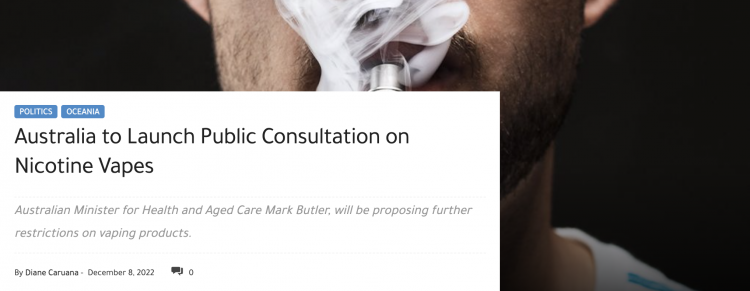
An event set to take place this week at the Parliament House in Canberra will include discussions on commemorating the 10-year anniversary of plain packaging laws. The process will focus on the Therapeutic Goods Administration's regulation of nicotine vapor products. "We need to understand the shortcomings of the current regulatory framework and what actions the government can take to change the status quo," said Australia's Minister for Health and Aged Care, Butler.
The minister criticized the previous government for delaying the implementation of stricter regulations on electronic cigarettes. "The former government made a mistake with the e-cigarette issue," Butler told The Guardian Australia. "Our children are paying the price for this division and delay.
National progress on smoking cessation has stalled.
Meanwhile, in contrast to Butler's argument, a recent study published in BMJ Open confirms that Australia's strict and outdated e-cigarette policies are hindering the country's efforts to quit smoking.
A new study titled "The Impact of E-cigarette Introductions on Smoking in Six Jurisdictions with Different E-cigarette Regulations: Interrupted Time Series Analysis" analyzed smoking rates and cigarette consumption in six jurisdictions with varying e-cigarette regulations, including Alberta, Ontario, Quebec, and British Columbia in Canada, as well as the United Kingdom and Australia.
Australia has the strictest regulations on electronic cigarettes among these nations, which also leads to the lowest usage rate of e-cigarettes. However, in terms of reducing smoking rates, it is also one of the countries with the slowest progress.
The availability of e-cigarettes is directly proportional to the decrease in smoking rates.
Dr. Colin Mendelsohn, an expert in tobacco treatment, stated in a blog post that this study demonstrates yet again that in Canada and the United Kingdom, following the widespread use of e-cigarettes, there has been a faster decline in the amount of smoking and smoking rates among young people.
However, in Australia, the rate of decline in cigarette consumption among adult smokers has slowed down, and since the popularity of e-cigarettes, the rate of decline in smoking among young people has also slowed down.
Australia has implemented the strictest electronic cigarette regulations in the Western world, based on misleading concerns that vaping could lead young non-smokers to take up the habit. However, this has ironically impeded access to life-saving alternatives for adults and led to more smoking-related deaths and illnesses, said Mendelsohn.
2FIRSTS will continue to report on this topic, and future updates will be available on the "2FIRSTSAPP." Scan the QR code below to download the app.
Disclaimer
This article is provided solely for professional research, industry discussion, and informational purposes. Any references to brands, companies, products, technologies, or policies are made for factual reporting and analytical purposes only, and do not constitute endorsement, recommendation, promotion, or advertising by 2Firsts.
Nicotine-containing products, including but not limited to cigarettes, e-cigarettes, heated tobacco products, and nicotine pouches, carry significant health risks. Readers are responsible for complying with all applicable laws and regulations in their respective jurisdictions, including age restrictions and access limitations.
The information contained in this article should not be regarded as investment, legal, medical, regulatory, or commercial advice. While 2Firsts strives to ensure the accuracy and reliability of its content, it does not assume liability for any direct or indirect loss arising from errors, omissions, inaccuracies, or reliance on the information contained herein.
This article is not intended for individuals below the legal age for accessing tobacco or nicotine-related information in their jurisdiction.
Copyright Notice
This article is either original content produced by 2Firsts or content reproduced, translated, summarized, or adapted from third-party sources with attribution where applicable. The intellectual property rights of the original content remain with 2Firsts or the respective original rights holders.
No individual or organization may copy, reproduce, distribute, republish, modify, translate, or otherwise use this content without prior authorization. Any unauthorized use may result in legal action.
For copyright-related inquiries, corrections, or removal requests, please contact: info@2firsts.com.
AI-Assisted Translation and Editing Notice
Portions of this article may have been translated, edited, or reviewed with the assistance of artificial intelligence tools to improve efficiency and readability. Due to the limitations of AI-assisted translation and editing, discrepancies, omissions, or inaccuracies may exist when compared with the original source.
Where applicable, readers are advised to refer to the original source for the most complete and accurate information. If you identify any errors or believe that any content infringes upon your rights, please contact us at info@2firsts.com, and we will review and address the matter promptly.