
Key Points
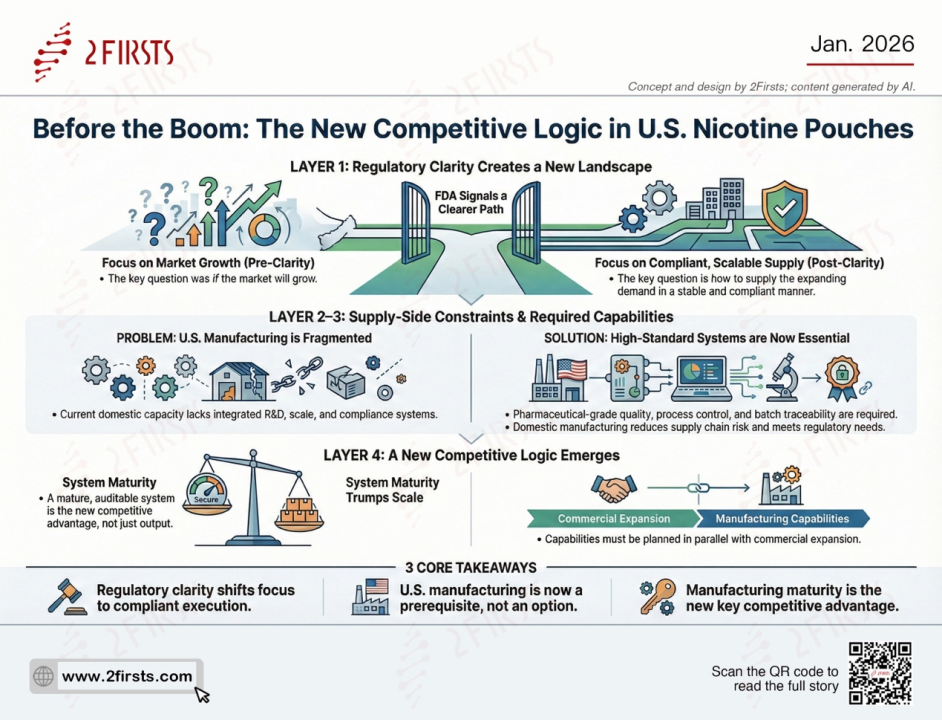
- As the FDA continues to grant Marketing Granted Orders (MGOs) to nicotine pouch products through the PMTA pathway, the U.S. nicotine pouch market is entering a phase of greater regulatory clarity, shifting industry focus from whether the category will grow to how expanding demand can be supplied in a stable and compliant manner.
- Unlike the early development path of e-cigarettes—where market expansion preceded the build-out of manufacturing capabilities—competition in nicotine pouches is increasingly centered at an earlier stage on manufacturing systems, quality control, and compliance execution.
- U.S. domestic nicotine pouch manufacturing remains highly fragmented, with relatively limited local capacity capable of combining systematic R&D, stable large-scale production, and regulatory compliance, making structural constraints on the supply side increasingly visible.
- For brands seeking to enter or expand in the U.S. market, manufacturing and compliance are no longer back-end considerations, but prerequisites that must be planned and validated in parallel with commercial expansion.
- Rena World has chosen to establish high-standard U.S.-based manufacturing ahead of full market takeoff, aiming to compete in the next phase of the U.S. nicotine pouch market through manufacturing system maturity rather than capacity scale alone.
2Firsts, January 19, 2026
On December 19, 2025, the U.S. Food and Drug Administration (FDA) officially authorized six on! PLUS nicotine pouch products for sale in the U.S. market through the PMTA pathway, issuing Marketing Granted Orders (MGOs). The decision is widely regarded within the industry as a pivotal milestone in the regulatory trajectory of nicotine pouches in the United States, signaling the category’s transition from an early stage of uncertainty to a clearer and more operational regulatory framework.
As regulatory pathways become increasingly defined, market demand has already been validated. Over the past several years, nicotine pouches have continued to gain penetration within the U.S. nicotine consumption landscape, emerging as one of the fastest-growing product segments.
Strong sales performance and sustained investment by leading brands have shifted the industry’s focus from whether nicotine pouches will grow to how expanding demand can be supplied in a stable and scalable manner. Previously, media reports indicated that Philip Morris International’s U.S. subsidiary (PMI US) announced plans to invest approximately USD 600 million to build a new ZYN nicotine pouch manufacturing facility in the United States.
A new question is now emerging: unlike the early trajectory of e-cigarettes—where market expansion preceded the build-out of manufacturing and compliance capabilities—are nicotine pouches forming a different competitive logic? Specifically, before the market reaches full-scale expansion, have manufacturing capacity, quality systems, and regulatory execution already become essential prerequisites that must be established in advance?
At the same time, 2Firsts has observed the emergence of a new group of entrants focused on building domestic manufacturing operations in the United States. Rena World is one of them. According to information published on its official website, Rena World was founded in 2023 and focuses on U.S.-based nicotine pouch manufacturing. In November 2025, Reuters reported that Rena World had completed a Pre-A funding round, which will be used to build a high-standard, automated nicotine pouch manufacturing facility in Texas.
Against this backdrop, 2Firsts engaged in discussions with Rena World to explore the future competitive logic and trends of the U.S. nicotine pouch market from a manufacturing-oriented perspective.
Rena World Is Betting on Timing, Not Hype
Rena World did not enter the nicotine pouch sector at the height of market enthusiasm. According to the company, its decision can be traced back to 2024, when a U.S. nicotine pouch brand approached the team seeking to advance its business through domestic manufacturing. Its U.S.-based R&D and manufacturing platform, Rena Labs & Manufacturing, was built and brought into operation gradually based on this strategic assessment.
The brand’s requirements were straightforward but difficult to meet: it was looking for a manufacturing partner capable of stable U.S.-based production while meeting stringent quality and compliance standards. At the time, such capabilities were scarce in the U.S. market. After multiple discussions, the brand ultimately turned to Rena World.
That engagement prompted Rena World’s team to reassess the development potential of nicotine pouch manufacturing in the United States. Unlike many later entrants, Rena World’s two founders were already experienced in manufacturing regulated products. The team had long worked in pharmaceutical-grade manufacturing environments, with systematic experience in high-standard production systems, quality control, and compliance requirements. This background allowed them to recognize early on that nicotine pouches were not a category suited to rapid expansion through low-threshold capacity alone.
Following a broader market assessment, Rena World reached a conclusion: as regulatory pathways became clearer and brand demand increasingly concentrated around compliance and scale, U.S. demand for high-standard nicotine pouch manufacturing would likely materialize ahead of a full market breakout. Waiting to build manufacturing capacity until demand peaks, the team believed, would significantly amplify execution and compliance risks.
Based on that assessment, Rena World decided to formally enter the U.S. nicotine pouch manufacturing sector, committing resources to the development of compliant domestic production capacity. For the company, this was not a short-term, opportunity-driven move, but a forward-looking deployment of its existing manufacturing experience in anticipation of market timing and execution windows.
Manufacturing Constraints Are Becoming More Visible as the Market Scales
What is the current state of nicotine pouch manufacturing in the United States, and what structural challenges does it face? Rena World’s team said that despite sustained demand growth and increasingly clear regulatory pathways, manufacturing capabilities have not undergone a corresponding structural upgrade. This mismatch, they said, is becoming an unavoidable reality for the industry.
From a supply-side perspective, Rena World noted that U.S. nicotine pouch manufacturing remains highly fragmented. A significant portion of products still relies on overseas contract manufacturing or cross-border supply chains, while the number of domestic operators capable of combining systematic R&D with scalable manufacturing remains limited. In the market’s early stages, such arrangements were sufficient to support product launches. As brands move into mainstream retail channels and regulatory expectations tighten, however, their limitations—particularly in stability, responsiveness, and compliance risk management—are becoming more pronounced.
Technical challenges at the manufacturing level have also become more apparent as production scales up. Rena World’s team emphasized that nicotine pouches are not simple fill-and-pack products: formulation structure, particle morphology, and moisture content all directly affect release profiles and user experience. In practice, issues such as uneven particle distribution, insufficient mixing consistency, and moisture control failures may not be evident in small-batch production, but once manufacturing shifts to continuous, large-scale operations, these factors can materially affect product consistency and compliance performance.
Quality and compliance challenges are likewise concentrated within the manufacturing system itself. Rena World believes that under a more stringent regulatory environment, quality is no longer confined to final inspection. Instead, it encompasses batch traceability, process parameter control, and long-term stability validation. Issues that may have been treated as “process imperfections” at an earlier stage—such as visual inconsistencies, inadequate sealing, or changes in product form—can become material risk factors once production is scaled and subject to compliance scrutiny.
Manufacturing Systems Must Support Both Compliance and Scale
As these structural issues become more visible, the question shifts to how manufacturing systems themselves must evolve to support compliance requirements while enabling scalable operations. On this point, Rena World told 2Firsts that its entry into nicotine pouch manufacturing was not driven by capacity or efficiency alone, but by long-standing experience within pharmaceutical-grade manufacturing systems.
Rena World said its core team has spent years working in regulated product environments and, with experience supported by the technical systems and supply chain resources of a large, public-listed pharmaceutical group, has participated in the development and production of multiple pharmaceutical products. This background shaped the company’s approach to nicotine pouches. Rather than treating them as a consumer product category that could start with lower standards and be upgraded over time, Rena World applied pharmaceutical-grade manufacturing and quality control logic from the outset.
In building its manufacturing system, Rena World emphasized that its focus was not on individual pieces of equipment or isolated process steps, but on whether the system as a whole could be replicated and audited. According to information disclosed in its presentation materials, Rena World operates a former FDA cGMP facility and is developing it into a GMP-ready manufacturing facility, equipped with cleanrooms & QC lab infrastructure. Within its U.S. manufacturing footprint, Rena World has incorporated mature pharmaceutical quality systems, process controls, and data management practices into nicotine pouch production, allowing operations to run on a regulatory-ready infrastructure.
From a quality and compliance perspective, Rena World believes that it does not view compliance as an external constraint, but as an integral component of the manufacturing system itself. Quality control, data recording, and traceability are not designed to satisfy a single regulatory review, but to support stable, long-term production. Under this framework, quality is not merely the outcome of final inspection, but something embedded into the manufacturing process through system design.
Overall, Rena World believes that ahead of the U.S. nicotine pouch market’s next phase, the ability of manufacturing systems to support both compliant operations and scalable expansion will be a decisive factor in determining which companies can remain competitive. This, the company said, is the core rationale behind its decision to systematically apply pharmaceutical-grade manufacturing experience and standards to the nicotine pouch sector.
Capacity Expansion Must Keep Pace with System Maturity
As Rena World’s manufacturing system has taken shape, another unavoidable question has emerged: is that system capable of supporting the next phase of market demand? Addressing this issue, Rena World outlined its phased capacity planning in the United States.
Rena World said its current manufacturing footprint corresponds to a first-phase capacity of over 50 million cans per year. Rather than maximizing scale at the outset, this initial phase is designed to support stable supply for compliant brands while validating the manufacturing system’s performance under continuous operation—specifically its stability, reproducibility, and ability to carry compliance processes at scale.
Building on the operation of the first phase, Rena World has planned a second-stage capacity expansion. According to the company, total annual capacity in the second phase is expected to increase to over 150 million cans in 2026. Rena World emphasized that this expansion is not a simple increase in output, but a systematic extension of manufacturing capability built on the condition that existing quality systems and process controls are already operating in a stable and reliable manner.
Rena World said this phased approach to capacity planning serves two purposes. On the one hand, it enables the company to meet the delivery requirements of large-scale customers and mainstream retail channels. On the other, it allows customers to benefit from more predictable supply cycles and cost structures as production scales.
In Rena World’s view, capacity itself is not the end point of a manufacturing system, but a reflection of its maturity. Only when capacity expansion advances in step with quality, compliance, and execution capabilities can manufacturing truly serve as the foundation for brands competing in the next phase of the U.S. nicotine pouch market.
U.S. Manufacturing Is Becoming the Standard, Not an Option
As regulatory pathways become clearer and market size continues to expand, the U.S. nicotine pouch market is entering a new stage of development. According to the company, its focus extends beyond market growth alone to the structural shifts taking place between regulation, demand, and manufacturing deployment.
According to Rena World, domestic U.S. manufacturing is transitioning from an optional strategy to a baseline requirement for the nicotine pouch sector. As the market scales, reliance on cross-border supply chains or ad hoc manufacturing arrangements is increasingly exposing limitations in compliance stability, supply responsiveness, and the management of policy and trade-related risks. By contrast, U.S.-based manufacturing offers greater control in meeting regulatory requirements, reducing tariff and supply-chain uncertainty, and aligning with the long-standing preference among mainstream retail channels and consumers for products made in the United States.
This shift is imposing more practical requirements on brands seeking to enter or expand in the U.S. market. Rena World noted that unlike the early growth trajectory of e-cigarettes—where expansion was driven by broad distribution across smaller outlets—nicotine pouch growth is more heavily dependent on mainstream retail systems and large channel networks. As a result, brands must establish the ability to serve major channels with stable supply and compliant operations from the outset, rather than attempting to retrofit these capabilities after scaling.
In this environment, compliance is no longer a task confined to a single stage of development. Instead, it has become a system-wide requirement spanning manufacturing, logistics, and sales. Rena World believe that if brands fail to address manufacturing and compliance in parallel at an early stage, these issues tend to be magnified as volumes grow, ultimately constraining channel expansion and market performance.
Conclusion
Overall, the U.S. nicotine pouch market is moving beyond its exploratory phase toward a new stage defined by compliance, scale, and execution capability. As regulatory pathways become clearer and demand continues to be released, manufacturing is no longer a back-end support function, but a core infrastructure determining whether companies can remain competitive over the long term.
In this context, U.S. manufacturing represents more than production alone. It brings together high-standard manufacturing, advanced R&D capabilities, systematic compliance execution, and a deep understanding of local markets and distribution channels into a single, integrated advantage. As this transition continues, developments within the U.S. nicotine pouch manufacturing landscape are likely to play an increasingly central role in shaping industry competition. Rena World represents one possible response to these structural shifts, but similar dynamics are likely to shape the broader U.S. nicotine pouch manufacturing landscape.
2Firsts will continue to follow and report on further developments in U.S. nicotine pouch manufacturing and related industries.