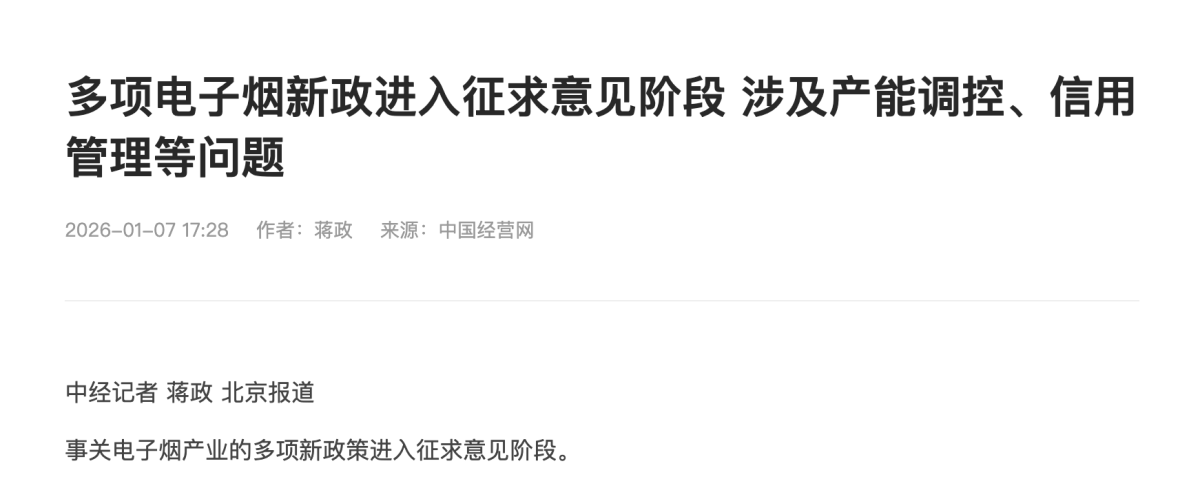
2Firsts Reposted from China Business Journal; Click to Read Original.
By Jiang Zheng, CBJ Reporter, Beijing
Multiple new policies concerning the e-cigarette industry have entered the public consultation phase.
Reporters from China Business Journal noted that on January 5, 2026, the State Tobacco Monopoly Administration (STMA) issued a notice seeking public comment on the "Detailed Rules for Credit Management of E-cigarette Production and Wholesale Enterprises (Trial) (Draft for Comment)" (hereinafter referred to as the "Draft for Comment"). This move aims to strengthen the credit management of e-cigarette business entities, protect their legal rights, and promote the legalized and standardized governance of the industry.
Earlier, on December 25, 2025, the STMA released the "Notice on Implementing E-cigarette Industrial Policies to Further Promote Dynamic Balance Between Supply and Demand (Draft for Comment)" (hereinafter referred to as the "Notice"), which addresses issues such as capacity regulation, supply-demand balance, and compliance upgrades.
Even earlier, on November 26, 2025, the Secretariat of the National Technical Committee on E-Cigarette Standardization publicly called for project applications for the 2026 National E-Cigarette Standards. This covers foundational standards, general technical requirements, manufacturing, storage and distribution, and testing/evaluation methods.
Alan Zhao, co-founder of 2Firsts, a leading global nicotine industry media and advisory platform, told reporters that these new regulations are crucial for the healthy growth of the e-cigarette industry. Since the start of state regulation in 2021, the fundamental principle has been clear: "referencing cigarettes." This means learning from tobacco regulations while maintaining distinctions. The recent flurry of activity does not exceed the framework set in 2021; rather, it is an optimization of that system.
Reporters noted that the "Draft for Comment" released on January 5 systematically regulates measures such as credit data collection, determination of dishonesty, credit rating, information disclosure, penalties, and credit repair. Regarding information collection, "dishonesty information" is categorized into three levels based on severity: Minor, General, and Serious, each with different disclosure periods. Based on this data, enterprises are assigned one of four credit grades: A, B, C, or D (from highest to lowest).
According to the draft, enterprises rated C or D will face strict scrutiny regarding applications for fixed-asset investment, increased approved production capacity, or expansion of production scale during the disclosure period. Furthermore, certain enterprises rated D will have their applications for new, renewed, or modified Tobacco Monopoly Production Enterprise Licenses denied.
In the past year, several e-cigarette companies have been listed as "discredited judgment debtors."
In September 2025, a "Legal Statement of Work Suspension and Closure" from Dongguan Aer Technology Co., Ltd. circulated online. As an e-cigarette manufacturer, the company cited intensified competition, rising costs, and shrinking orders for its decision to dissolve. Records from Tianyancha show the company was listed as a "judgment debtor" multiple times in late 2025.
"A highlight of the credit system is public disclosure," Alan Zhao said. "On one hand, it constrains manufacturers to operate compliantly. On the other, it provides an authoritative source of credit evaluation for upstream/downstream partners and global clients, aiding the overall compliance of the supply chain."
The "Notice" released on December 25, 2025, explicitly defines capacity limits.
The document states that "investment in new construction projects is prohibited"—meaning relocated or restored construction projects must not increase capacity, and technical upgrades at existing sites (including equipment purchases) generally must not result in capacity increases.
Strict requirements are set for any necessary capacity expansion: it must align with industrial and regulatory policies, demonstrate real market demand, meet safety and environmental technical conditions, and trend toward "intelligent, high-end, and green" manufacturing. Export-oriented enterprises must prove that their new capacity complies with the laws and regulations of the destination country.
Jin Jia Group, whose business includes "New Tobacco Products," reported revenues of 236 million yuan in that sector for the first half of 2025 (a 157.67% year-on-year increase). A staff member from their securities department noted that the industry has always had total volume controls and that the regulatory stance has been strict for nearly four years. Since most of their business is overseas, they expect the policy adjustments to have a limited impact.
Similarly, a representative from Yinghe Technology noted that their e-cigarette business is handled by a specialized team and has remained stable, primarily serving overseas markets.
Alan Zhao told reporters that while some leading companies currently face capacity shortages, they may expand in the future through industry acquisitions and integration, though specific supporting policies are still needed. These measures aim to optimize industrial structure and increase concentration. Market competition is already driving supply chain consolidation; combined with policy pressure, this will push the industry toward a high-level upgrade.
An anonymous industry insider noted that as regulations tighten, professionals are becoming increasingly cautious when discussing industry trends.
On December 18, 2025, the General Office of the State Council issued "Opinions on Cracking Down on Tobacco-Related Illegal Activities Across the Entire Chain." This document mandates high-pressure crackdowns on illegal manufacturing, storage, transportation, and mailing of tobacco products, as well as the sale of illegal e-cigarettes.
"Global competition has led to 'involution' (destructive competition), where some companies see increased sales volume but falling revenue. This leads to non-compliant behavior," Alan Zhao stated. "Regulatory constraints can reduce this unhealthy competition model."
We welcome news tips, article submissions, interview requests, or comments on this piece.
Please contact us at info@2firsts.com, or reach out to Alan Zhao, CEO of 2Firsts, on LinkedIn
Notice
1. This article is intended solely for professional research purposes related to industry, technology, and policy. Any references to brands or products are made purely for objective description and do not constitute any form of endorsement, recommendation, or promotion by 2Firsts.
2. The use of nicotine-containing products — including, but not limited to, cigarettes, e-cigarettes, nicotine pouchand heated tobacco products — carries significant health risks. Users are responsible for complying with all applicable laws and regulations in their respective jurisdictions.
3. This article is not intended to serve as the basis for any investment decisions or financial advice. 2Firsts assumes no direct or indirect liability for any inaccuracies or errors in the content.
4. Access to this article is strictly prohibited for individuals below the legal age in their jurisdiction.
Copyright
This article is either an original work created by 2Firsts or a reproduction from third-party sources with proper attribution. All copyrights and usage rights belong to 2Firsts or the original content provider. Unauthorized reproduction, distribution, or any other form of unauthorized use by any individual or organization is strictly prohibited. Violators will be held legally accountable.
For copyright-related inquiries, please contact: info@2firsts.com
AI Assistance Disclaimer
This article may have been enhanced using AI tools to improve translation and editorial efficiency. However, due to technical limitations, inaccuracies may occur. Readers are encouraged to refer to the cited sources for the most accurate information.
We welcome any corrections or feedback. Please contact us at: info@2firsts.com