Canada: British Columbia Adds Sales Tax to Cigarettes

Industry InsightBusiness
Jul.11.2022
Going into effect this week, British Columbia’s (BC) tobacco sales tax rules mean that online marketplaces, like Amazon and eBay, will now be responsible for collecting provincial sales taxes.

As of the 1st of January, a 13% tax hike on vaping products has gone into effect, increasing the tax from 7 to 20%. The tax increase is applicable to all vaping products and electronic cigarettes, as well as their refills, whether they contain nicotine or cannabis products. The Ministry of Finance had highlighted that BC was the first Canadian province to introduce such a tax.
Canada: British Columbia Adds Sales Tax to Cigarettes

Subsequently effective July 1st, the province has added a tax on other products, including cigarettes, cigars and chewing tobacco. After the tax, a $15.99 cigarette pack will cost an additional 7% or $1.12 extra a pack. “We are moving in line with other provinces to make sure we collect PST on tobacco products,” said Selina Robinson, B.C.’s finance minister.


Teen cannabis vaping


Meanwhile, a recent study published in JAMA Pediatrics, reported that between 2013 and 2020 the prevalence of cannabis vaping amongst teens has doubled, with approximately 1 in 3 grade 12 students vaping the substance in 2018 alone.


The review analyzed 17 studies from the United States and Canada published between 2015 and 2021, incorporating of a total of 198,845 surveyed adolescents. Titled, “Prevalence of Adolescent Cannabis Vaping. A Systematic Review and Meta-analysis of US and Canadian Studies,” the analysis found that the lifetime prevalence of cannabis vaping expanded from 6.1% in 2013, to 13.6% in 2020. Moreover, the prevalence of cannabis vaping doubled between  2017 to 2020, from 7.2% to 13.2%. Additionally, 30-day prevalence increased 7-fold from 2013 to 2020 (1.6% to 8.4%).


“A possible explanation for the upward trajectory in the prevalence of cannabis vaping observed in our study timeframe is the increasing uptake of vaping products generally used among youth and young adults, widening access to cannabis vaping products through legalization of cannabis, and the decrease in perceived risk of harm toward cannabis in the last decade,” said the authors.


Dwindling smoking rates


On the otherhand, the Canadian Tobacco and Nicotine Survey has recently revealed that between 2019 and 2020, there was a 40% drop in smoking rates in this specific age group, from 13.3% to 8%. This figure is encouraging for Health Canada’s smoking prevalence target of 5% for 2035. Moreover the target has already been achieved among those aged 15-19, as the smoking rate is currently no more than 5%.

JAMA Issues First U.S. Clinical Guidance on Vaping for Smoking Cessation, Urging Complete Switch From Cigarettes
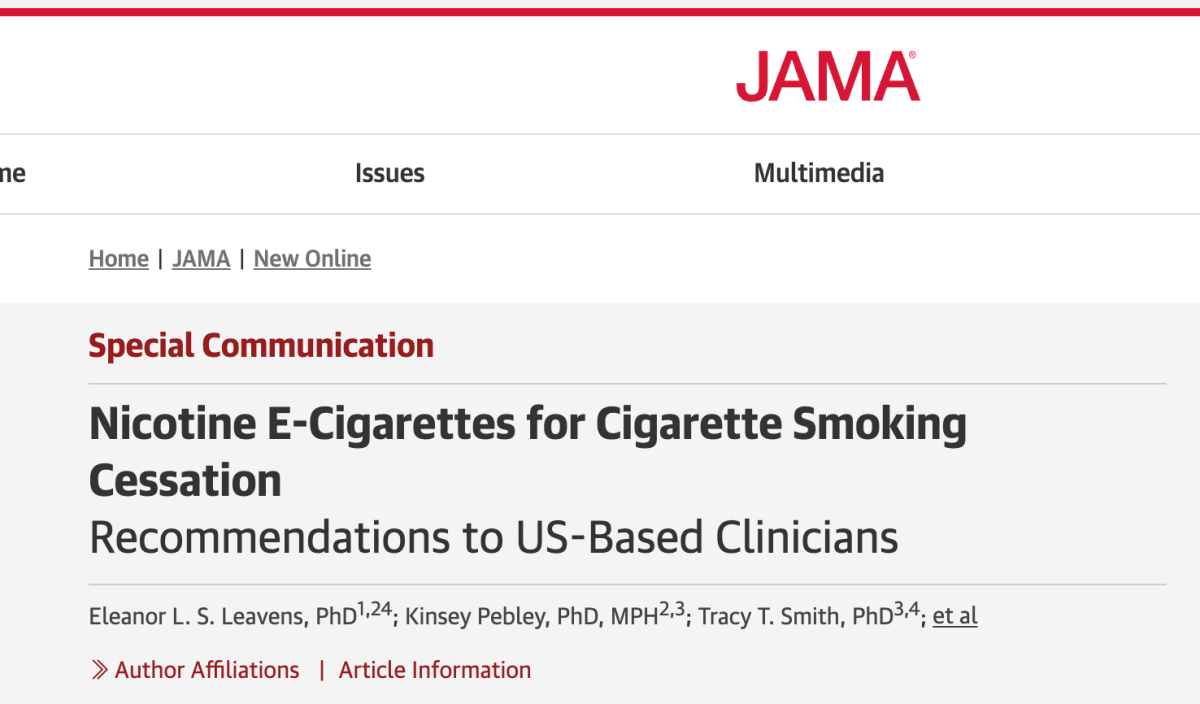
JAMA has published a Special Communication offering systematic recommendations for U.S.-based clinicians on the use of nicotine e-cigarettes in adult smoking cessation. Developed by the Harm Reduction Workgroup of the Society for Research on Nicotine and Tobacco’s Treatment Research Network, the paper recommends including e-cigarettes alongside FDA-approved cessation medications in risk-benefit discussions. It cites high-certainty evidence that nicotine e-cigarettes achieve higher quit rates than nicotine replacement therapy and evidence suggesting efficacy comparable to highly effective medications such as varenicline and cytisine. For adults who choose vaping to quit, the authors recommend FDA-authorized products, sufficient nicotine delivery and a rapid, complete transition away from cigarettes rather than prolonged dual use.
Aug.13
Russia’s Vape Device Labeling Regime Enters Force: Registration Starts in September, Mandatory Coding in December
Russia's digital labeling regime for reusable e-cigarettes and similar personal vaping devices entered its first mandatory phase in September 2026. From September 1, manufacturers, importers and other market participants must register with the national Chestny ZNAK tracking system. From December 1, newly manufactured and imported covered devices will be required to carry digital identification codes and be reported as entering circulation. Russia has also issued new operational guidance for imports, marking the transition from a voluntary pilot to phased mandatory implementation.
Sep.15
Philippines Weighs Unified Vape Tax as Lawmakers Back Risk-Based Rates and Government Seeks to Fill ₱66 Billion Revenue Gap
Philippine lawmakers are considering an overhaul of the country's vape excise-tax regime to eliminate the wide gap between taxes on nicotine salt and freebase nicotine liquids and reduce incentives for misdeclaration. House Bill 5364, filed by Rep. Rufus Rodriguez and Rep. Maximo Rodriguez Jr., would impose a unified ₱10-per-milliliter tax on vapor products, with 5% annual increases beginning in 2027. Rodriguez says the proposal could generate an average ₱6 billion in annual collections from 2027 through 2030. The debate comes as the Philippine government considers tobacco, vape and other health-tax reforms to help offset around ₱66 billion in revenue expected to be forgone under a proposed tax-relief package.
Aug.18
2Firsts Hosts China Market Forum at InterTabac as Global Industry Attention to China’s Tobacco Sector Deepens
On September 16, 2Firsts hosted a China-focused industry forum during InterTabac in Dortmund, bringing together more than 30 participants from North America, Europe, India, South Korea and other markets. The session covered traditional tobacco, next-generation products, exports, technology, regulation and supply chains, while examining how China’s tobacco sector operates, where its transformation may be heading, and why its growing role matters increasingly to companies across the global tobacco and nicotine industry.
Sep.21
Product | PMJ Adds Bold Ruby to IQOS ILUMA i Lineup in Japan, Convenience-Store Rollout Starts Sept. 29
Philip Morris Japan (PMJ) launched Bold Ruby as a new regular color for the IQOS ILUMA i and IQOS ILUMA i ONE in Japan on September 16, 2026, priced at JPY 6,980 and JPY 3,980, respectively. Initial sales began through IQOS online and physical channels, with convenience stores and selected tobacco retailers set to follow from September 29. Bold Ruby is a regular rather than limited-edition colorway and is available for the ILUMA i and ILUMA i ONE, but not the ILUMA i PRIME. The release does not involve changes to the devices' core hardware or functions.
Sep.22
Australia Tobacco Tax Debate Spreads Within Labor as NSW Premier Minns Reaffirms Support for a Cut
Australia’s tobacco excise debate is increasingly exposing differences within the governing Labor Party. New South Wales Labor Premier Chris Minns reaffirmed on September 8 that he supports reducing tobacco excise, arguing that current tax settings are pushing consumers toward cheaper black-market cigarettes. Federal Health Minister Mark Butler continues to oppose an excise cut, while Treasurer Jim Chalmers and Assistant Treasurer Daniel Mulino have recently stopped short of ruling out future changes. The divergence follows the opposition Coalition’s proposal to cut tobacco excise by 80%.
Sep.08