Key Points
- Consumer education: U.S. premium cigar consumers are seeking clearer knowledge of origin, craftsmanship, blends and flavor, not just brand recognition.
- Boutique brands: Better-informed consumers are showing more interest in smaller boutique cigar brands beyond legacy names.
- Women consumers: Women are becoming more active in cigar culture, while the industry should avoid assuming they only want flavored cigars.
- Cuban cigars: In the U.S., Cuban cigars remain symbolic, but consumer attitudes are increasingly mixed and complex.
- Emerging markets: For markets such as China, consumer education may help turn curiosity into sustained premium cigar participation.
2Firsts
July 6, 2026
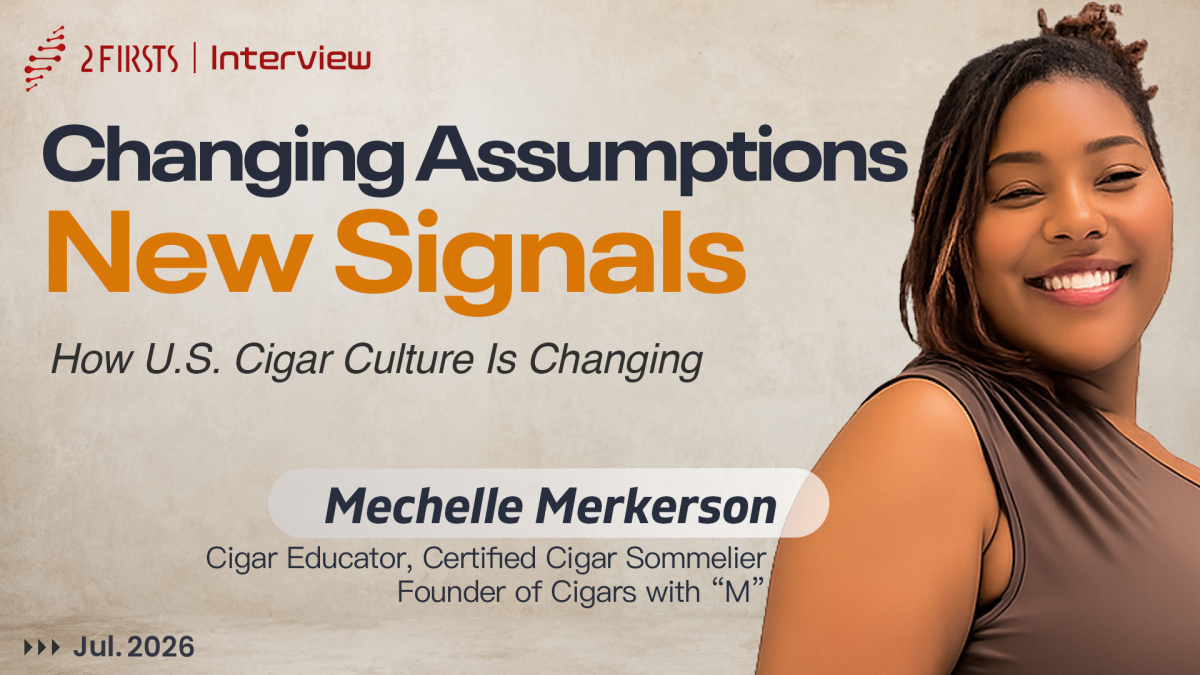
U.S. premium cigar culture is showing signs of change as consumers ask more questions, look beyond legacy brands and seek clearer information about what they smoke, cigar educator Mechelle Merkerson told 2Firsts.
The shift, as Merkerson describes it, is not a break from cigar tradition. It is a change in how consumers enter that tradition: through education, product discovery, digital content and more inclusive social spaces.
Merkerson is the founder of Cigars with “M,” an educational platform focused on making premium cigars more approachable through live experiences, digital storytelling and consumer education. A Certified Cigar Sommelier, she also serves as Co-Chair of Membership for Women of the Premium Cigar Association, or PCA, a major U.S.-based trade organization for the premium cigar and pipe tobacco sector.
According to biographical information she provided, Cigars with “M” has produced more than 208 cigar education episodes since launching in 2022, and Merkerson has educated consumers through more than 33 cigar education classes in the United States and internationally.
Consumers want “sound information”
For Merkerson, the clearest change in the U.S. cigar market is the rising demand for education.
“Consumers are desiring to be more educated,” she said.
That demand became more visible to her around the fourth quarter of 2024. In January 2025, she began curating cigar education experiences specifically for consumers, working with manufacturers to help explain cigars in a more accessible and structured way.
“The most important trend is being able to have sound information,” she said.
Premium cigars are rarely evaluated like standardized nicotine products. Consumers often consider origin, tobacco type, construction, aging, draw, burn and flavor development. For newcomers, that complexity can make the category difficult to navigate. For more experienced smokers, it creates a desire to understand why one cigar differs from another.
Merkerson said consumers increasingly want information they can compare with other sources and use in real purchasing or smoking situations. In her view, education can help manufacturers and retailers explain craftsmanship, tobacco origin, blending and smoking experience more effectively than lifestyle imagery alone.
Consumers, she said, are “wanting and hungrier for the educational piece.”

More cautious purchasing: U.S. consumers are smoking through existing inventory
Beyond the rising demand for cigar knowledge, Merkerson has also observed a shift toward more cautious purchasing among some U.S. consumers.
She said some consumers are buying fewer new cigars and instead smoking through cigars they already have stored in their humidors. These cigars may have originally been saved for a future occasion, but consumers are now actually taking them out and smoking them.
“I think now the trend is people are actually smoking what they have,” she said.
In Merkerson’s view, this change may be linked to tighter consumer budgets, or simply to the fact that some cigars have been stored for too long and consumers are beginning to recognize that they should enjoy what they already own rather than continually adding new purchases.
Education pushes consumers beyond legacy brands
The search for knowledge is also widening the consumer’s field of discovery.
In retail settings, Merkerson said, some buyers are asking for “something different, something new,” rather than only cigars from the established names that have long anchored humidor shelves.
That does not mean legacy brands are losing their importance. In premium cigars, heritage still matters: brand history, consistency, reputation and distribution remain powerful forces. But education can give consumers more confidence to explore smaller or independent labels.
In the cigar industry, these are often described as boutique brands — smaller cigar companies or independent labels that may have more limited production, distinctive blending stories or narrower distribution than major manufacturers.
Merkerson said she tries to balance larger manufacturers and smaller brands in her education events so consumers can compare different parts of the market. She cited Supreme Tobacco, a boutique brand, as one example. After trying the cigar in one of her classes, she said, some students later asked retailers to carry it.
Such cases do not suggest that boutique brands are replacing legacy names. They show how education can turn curiosity into retail interest for smaller labels, especially when consumers understand the story, blend and experience behind the product.
For brands and retailers, the signal is practical: the modern premium cigar consumer may still respect heritage, but discovery and personal connection are becoming more important parts of the purchase journey.
Women consumers are changing the room
A more education-led cigar culture is also changing who feels able to participate.
Merkerson said women are becoming more visible in premium cigar spaces, and she views that as a real growth trend rather than only a visibility shift. Organizations such as Women of PCA, she said, are helping create more accessible pathways into the industry through mentorship, panel discussions, professional support and practical information.
In her own classes, Merkerson has noticed that women often ask questions before assuming they already know how to approach a cigar. Some male consumers, by contrast, may assume they know the process because they have smoked cigars before, even when their habits may not be correct.
The industry’s mistake, in her view, is not only underestimating women’s interest. It is narrowing their choices before they have had the chance to explore.
One stereotype she wants the industry to avoid is the assumption that women entering cigar culture want flavored cigars.
“It doesn’t have to be flavored in order for her to enjoy it,” she said.
Flavored cigars, which include added flavor profiles such as sweet, vanilla or fruit-like notes, sit apart from traditional premium cigars in both product positioning and consumer perception. Merkerson said women should not automatically be directed toward them simply because they are women or new consumers. A mild traditional cigar may be a better introduction for some consumers, depending on their palate and level of interest.
The point is larger than one product category. If premium cigar culture wants to be more accessible, it also needs to avoid old assumptions about who the consumer is and what that consumer wants.
Cuban cigars remain iconic, but U.S. views are mixed
Cuban cigars occupy a different place in the United States than they do in many other markets.
Globally, Cuban cigars continue to carry strong cultural and luxury status, built on Cuba’s long history of tobacco growing and cigar production. In the United States, decades of trade restrictions have added another layer of mystique, making Cuban cigars both culturally iconic and legally complicated.
Asked how U.S. consumers view Cuban cigars today, Merkerson described the response as mixed. Some consumers still see them as highly desirable. Others have tried them and decided they are not their personal preference.
Given current restrictions, she said Cuban cigars often function in the U.S. more as a symbolic reference point than as an everyday consumption category for many consumers.
“I would say it’s more of a symbolic benchmark,” she said.
If U.S.-Cuba relations were normalized in the future, Merkerson expects the market response would be more complex than a simple surge in demand. Some consumers might want Cuban cigars because they were previously difficult to obtain. Others may continue to prefer non-Cuban cigars they already know and enjoy.
Her comments underline a broader change in cigar culture: reputation still matters, but consumers increasingly make choices through personal experience, education and access to information, rather than relying only on inherited prestige.
Education becomes market infrastructure
For Merkerson, the lesson for global cigar brands, retailers and market participants is direct: education should not be left to one group.
Whether it is a retailer, a cigar brand or another market participant, Merkerson said, everyone in the category should help provide cigar education.
Consumers follow different people and different platforms, she said, so education needs to reach them through multiple channels. When brands provide useful education, they can become a stronger voice in the market.
A signal for emerging cigar markets
Merkerson expects the global premium cigar market to keep changing. Boutique brands may continue to rise. Consumers may become more education-driven in how they choose and experience cigars. More women may enter the market. Larger companies may also acquire smaller brands as part of broader portfolios.
She cited events such as ProCigar in the Dominican Republic and Puro Sabor in Nicaragua as examples of how consumers can deepen their understanding through direct exposure to cigar-producing regions. Such events connect consumers, brands and industry participants with factories, tobacco fields, rolling techniques and regional cigar culture.
During the interview, 2Firsts also shared its observations on China’s developing cigar market, where consumer awareness of premium cigars is rising and the need for education is growing. Merkerson said she was interested in the market and would be open to bringing cigar education to China, though no specific plan was discussed.
That model matters beyond the United States. In emerging cigar markets in Asia and elsewhere, education may be the bridge between curiosity and sustained consumption. Consumers may first recognize famous names, but long-term category development depends on whether they understand origin, craftsmanship, flavor and personal preference.
The broader implication is clear: premium cigars, despite their long association with tradition, are not outside the wider changes affecting tobacco consumers. Consumers are asking more questions, seeking more choice and looking for deeper connections with the people, regions and craftsmanship behind the product.
For global cigar manufacturers and retailers, education is no longer only a marketing accessory. It is becoming part of the infrastructure of modern premium cigar culture.
2Firsts will continue to monitor the evolution of global premium cigar culture, particularly in consumer education, brand development and emerging market participation. Cigar industry professionals, brands, retailers, educators and researchers are welcome to share perspectives, submit contributions or contact 2Firsts for interviews at alan@2firsts.com.
Related Information
Mechelle Merkerson will also take part in the Masterclasses program at InterTabac 2026, where she is expected to host or participate in several sessions focused on the modern cigar consumer.
The session “The Digital Humidor: Where Social Media Meets the Modern Consumer” will explore how digital platforms and social media are reshaping the way consumers discover, engage with and develop loyalty toward premium cigar brands. It will examine how online communities, content creation and digital influence are redefining brand visibility and consumer behavior within the industry.
Another session, “She Is the Consumer,” will highlight the growing influence of women in the premium cigar industry, not only as consumers but also as educators, leaders and contributors to community growth.
A third session, “The Story Behind the Smoke: Why Narrative Shapes the Modern Consumer,” will examine how storytelling influences brand identity, consumer trust and emotional connection, as well as how narrative shapes purchasing decisions and long-term engagement within the premium cigar space.
For more information, please visit Merkerson’s Instagram, YouTube and LinkedIn.

Disclaimer
This article is provided solely for professional research, industry discussion, and informational purposes. Any references to brands, companies, products, technologies, or policies are made for factual reporting and analytical purposes only, and do not constitute endorsement, recommendation, promotion, or advertising by 2Firsts.
Nicotine-containing products, including but not limited to cigarettes, e-cigarettes, heated tobacco products, and nicotine pouches, carry significant health risks. Readers are responsible for complying with all applicable laws and regulations in their respective jurisdictions, including age restrictions and access limitations.
The information contained in this article should not be regarded as investment, legal, medical, regulatory, or commercial advice. While 2Firsts strives to ensure the accuracy and reliability of its content, it does not assume liability for any direct or indirect loss arising from errors, omissions, inaccuracies, or reliance on the information contained herein.
This article is not intended for individuals below the legal age for accessing tobacco or nicotine-related information in their jurisdiction.
Copyright Notice
This article is either original content produced by 2Firsts or content reproduced, translated, summarized, or adapted from third-party sources with attribution where applicable. The intellectual property rights of the original content remain with 2Firsts or the respective original rights holders.
No individual or organization may copy, reproduce, distribute, republish, modify, translate, or otherwise use this content without prior authorization. Any unauthorized use may result in legal action.
For copyright-related inquiries, corrections, or removal requests, please contact: info@2firsts.com.
AI-Assisted Translation and Editing Notice
Portions of this article may have been translated, edited, or reviewed with the assistance of artificial intelligence tools to improve efficiency and readability. Due to the limitations of AI-assisted translation and editing, discrepancies, omissions, or inaccuracies may exist when compared with the original source.
Where applicable, readers are advised to refer to the original source for the most complete and accurate information. If you identify any errors or believe that any content infringes upon your rights, please contact us at info@2firsts.com, and we will review and address the matter promptly.