ECCC and IEVA successfully held an online exchange meeting

2Firsts Events by 2FIRSTS
Jun.14.2022
The China Electronic Chamber of Commerce Electronic Cigarette Professional Committee and the Independent European Vape Alliance (IEVA) held a successful online international situation exchange meeting on June 8th, 2022.

The China Electronic Chamber of Commerce Electronic Cigarette Professional Committee and the Independent European Vape Alliance (IEVA) held a successful online international situation exchange meeting on June 8th, 2022. This is the first online meeting of the E-cigarette Special Committee since renovation of the office. Ao Weinuo, Secretary-General of the E-cigarette Committee, Guo Xiaoyu, COO and co-founder of 2FIRSTS , Jason Tian, International Public Relations Manager, Mr. Cipri Boboi, co-founder of IEVA, and Ms. Sonya Herrmann, communications delegate of IEVA, attended the meeting.


ECCC and IEVA successfully held an online exchange meeting


The meeting began on 9:00 a.m. Britain Time (4:00 p.m. Beijing time) and lasted approximately one and a half hours. At the start of the conference, Secretary-General Ao displayed a handwritten letter sent from overseas by the president of the IEVA Association, Mr. Dahlman. He expressed his appreciation for the E-Cigarette Committee's contribution to the worldwide e-cigarette business in the letter.


ECCC and IEVA successfully held an online exchange meeting

 
Later, Secretary-General Ao briefed the two IEVA representatives on the special committee's recent work focus, which included improving the office, expanding the live broadcast communication center, establishing an international organization, and encouraging trades and exchanges. According to Secretary-General Ao, the recently announced "E-Cigarette Management Measures" are expected to fundamentally fix a number of issues, including the disorderly development of China's e-cigarette business. The publication of the new policy will aid in the standardization, legalization, and integrity development of China's e-cigarette sector. The two delegates agreed and expressed their understanding. Secretary-General Ao answered the two delegates' comprehensive inquiries, which increased trust and communication between the two sides.

 
Following the most recent e-cigarette industry exchange in China, Mr. Cipri Boboi and Ms. Sonya Herrmann discussed the evolution of the e-cigarette sector in Europe. At the moment, the disposable e-cigarette market in Europe is expanding significantly, with stable growth in the first half of this year. The growth rate in the second half of this year is likely to outpace that in the first half. At the moment, European e-cigarette policy is focused on environmental protection. While the EU is designing the e-cigarette industry's tax policy, it is hoped that future e-cigarette goods would pay attention to environmental preservation in terms of raw materials and consumption, such as the introduction of recyclable e-cigarette products. According to Secretary-General Ao, Chinese e-cigarette companies will be brave in shouldering social duties, researching and creating more environmentally friendly products, protecting minors, and offering safer and more compliant products to consumers worldwide.


ECCC and IEVA successfully held an online exchange meeting


Through a live internet broadcast, the two sides also discussed the necessary preparations and procedures for visiting China's e-cigarette facility. IEVA has indicated strong interest and set a date for a recent visit. Shenzhen is the worldwide e-cigarette industry hub, accounting for more than 90% of global e-cigarette supply. Domestic electronic cigarettes exports reached 138.3 billion yuan in 2021. Although the global epidemic has made international travel more difficult, it cannot stymie China's e-cigarette exports or international cooperation. The Committee encourages more direct and efficient communication between Chinese supplier firms and overseas brands and distributors, as well as more direct and efficient communication between Chinese and foreign enterprises.

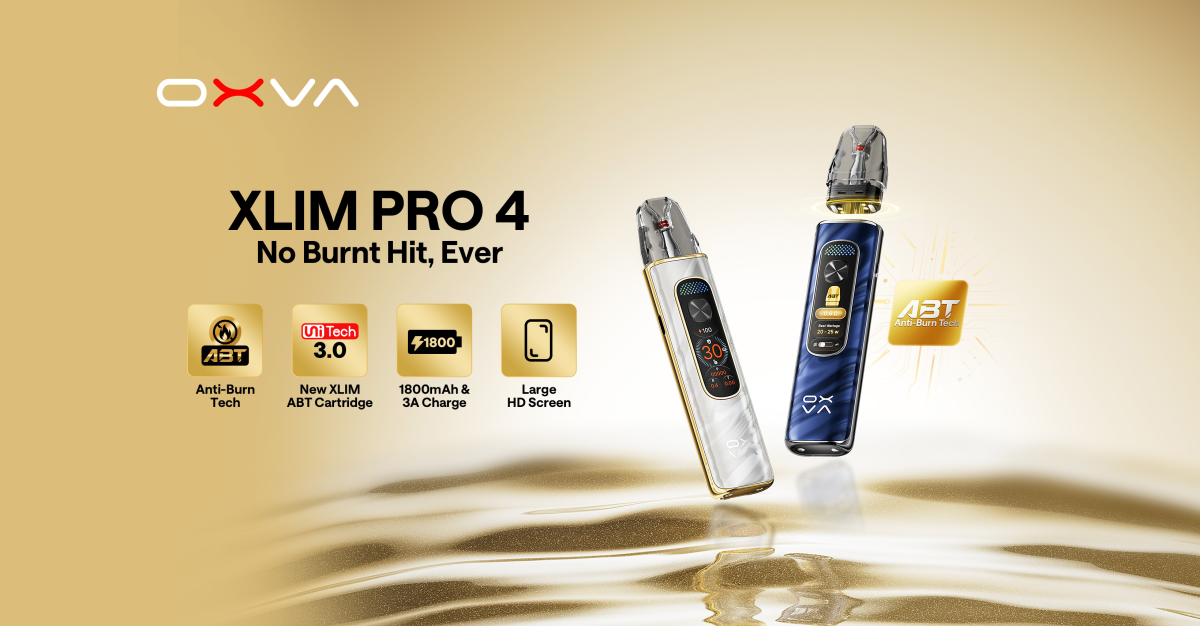
 

Product | OXVA Introduces XLIM PRO 4 With Liquid-Level Anti-Burn Technology and Dedicated Pods
Vaping brand OXVA introduced the XLIM PRO 4 refillable pod system in October 2026, featuring Anti-Burn Tech (ABT) based on smart e-liquid-level detection. The system can issue refill alerts and stop power output when e-liquid levels become too low. ABT requires the XLIM PRO 4 device and a dedicated XLIM ABT cartridge. Standard XLIM pods remain compatible but do not support ABT protection. OXVA previously introduced temperature-based anti-burn technology in the XLIM Pro 2 DNA, developed with Evolv. The new device features a 1,800mAh battery, 5–30W output and a 0.98-inch HD color screen. OXVA's official store lists the device at $37.90 and dedicated ABT replacement cartridges at $12.99. Independent testing confirmed the low-liquid protection response but recorded varying cartridge lifespans.
product
Oct.30
PMI Pushes Smoke-Free Business in Latin America as Argentina Lifts Heated Tobacco Ban, Mexico City Share Tops 7%
Philip Morris International (PMI) showcased IQOS heated tobacco systems and nicotine pouch products at Technovation 2026 in Buenos Aires on October 7–8, presenting research on consumer attitudes, regulatory developments and illicit cigarette trade across Latin America. PMI Chief Global Growth Officer Stefano Volpetti said smoke-free products accounted for more than 7% of the Mexico City market. Argentina repealed its heated tobacco ban in May 2026 and introduced registration requirements for tobacco and nicotine products, while local media reported nicotine pouch sales in Mendoza. A PMI-commissioned survey found that only 8% of respondents across four Latin American countries were familiar with nicotine pouches. A separate KPMG study estimated illicit cigarette consumption at 77 billion sticks across 11 markets in Latin America and Canada in 2025.
PMI
Oct.13
South Korea Extends Vape Rules to Unmanned Stores After Bringing Synthetic Nicotine Under Tobacco Law
South Korea's Ministry of Gender Equality and Family said on September 14 that it plans to designate unmanned e-cigarette stores as businesses where minors are prohibited from entering or working. Operators would be required to verify customers' ages and display notices restricting access by minors. The proposal is open for public comment through October 6. The move follows an April expansion of South Korea's statutory tobacco definition that brought products made with natural or synthetic nicotine under the Tobacco Business Act. Nicotine-free liquids and products using nicotine analogues such as 6-methylnicotine, however, remain an emerging regulatory issue.
Sep.21
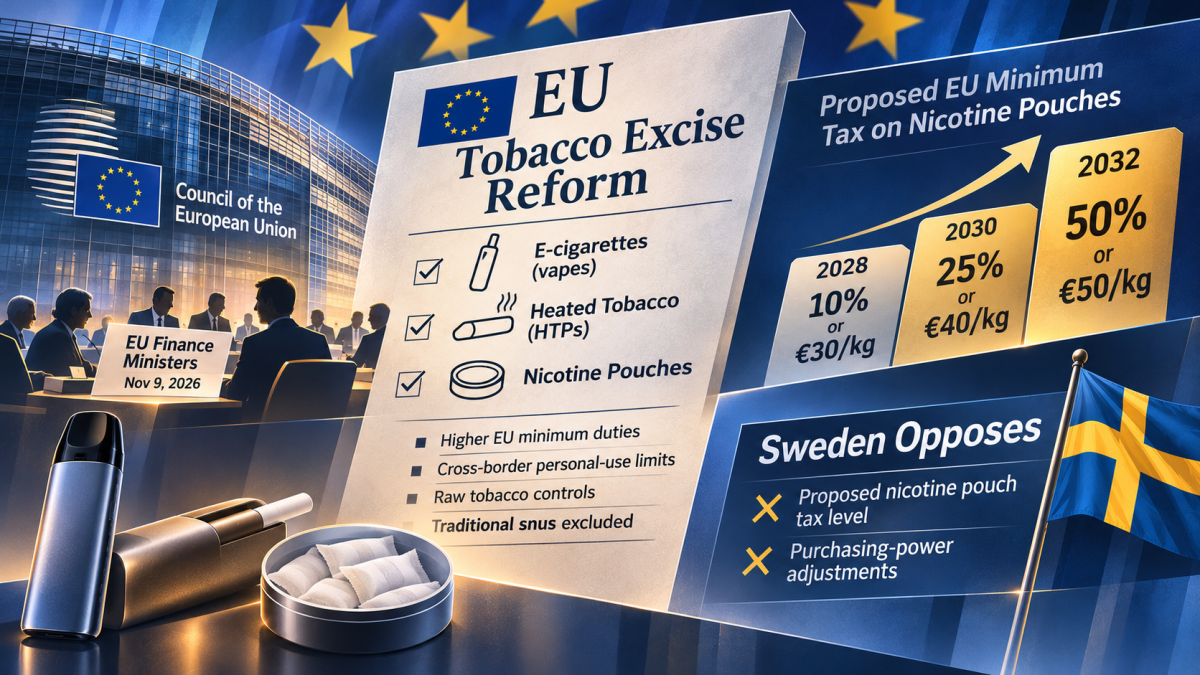
EU Vape, Heated Tobacco and Nicotine Pouch Tax Reform Reaches Ministerial Talks: Sweden Opposes Proposed 2032 Minimum of 50% of Retail Price or €50/kg for Nicotine Pouches
EU finance ministers are scheduled to discuss tobacco excise reform on November 9, 2026, seeking agreement on higher minimum duties for conventional tobacco and a common EU minimum tax framework covering e-cigarettes, heated tobacco and nicotine pouches. A November 5 Council document identifies nicotine pouch taxation as the main outstanding issue. The Irish Council presidency proposes phased increases, reaching 50% of retail selling price or €50 per kilogram in 2032. Sweden has formally said it cannot support the current compromise, objecting to both the proposed nicotine pouch tax burden and the adjustment of minimum rates based on national purchasing power. The package also addresses cross-border personal-use reference quantities, raw tobacco controls and the continued exclusion of traditional tobacco snus.
Regulations
Nov.10
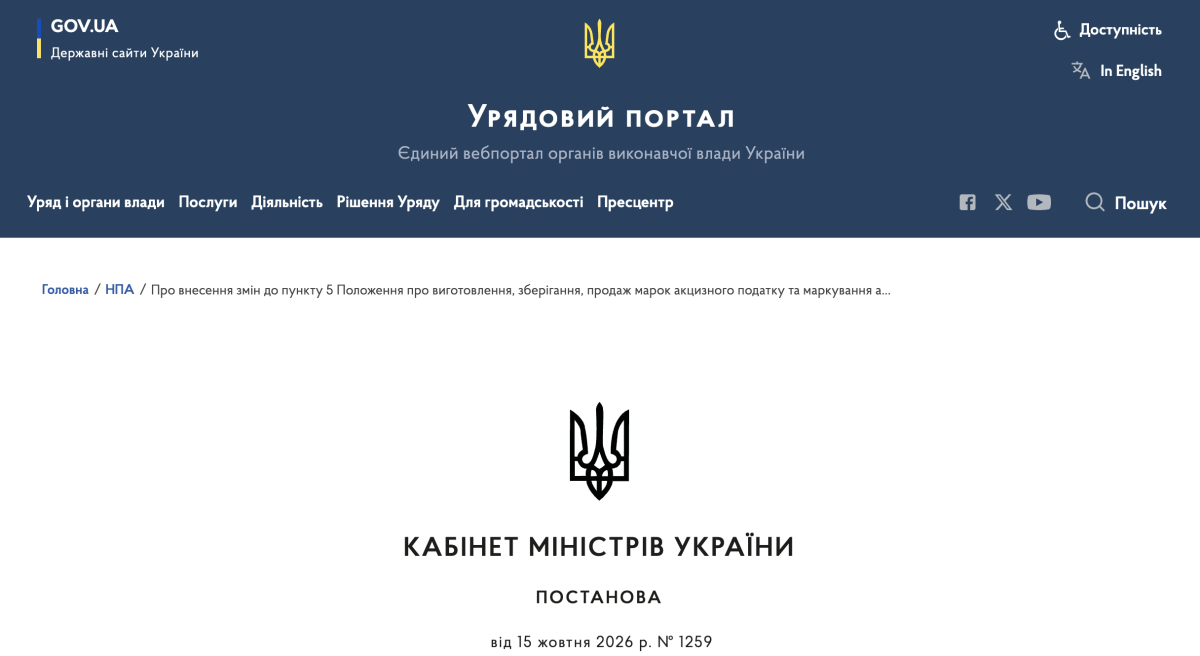
Ukraine Raises Excise Stamp Fees for Tobacco, Heated Tobacco and Vape Liquids by 30.5% as Parliament Backs E-Excise Delay to 2027
Ukraine's Cabinet of Ministers adopted Resolution No. 1259 on October 15, 2026, increasing excise stamp production fees for tobacco products and e-cigarette liquids by approximately 30.5%, from UAH 0.1643 to UAH 0.2144 per stamp. Fees for alcoholic beverages rose by about 30.2%. Separately, Ukraine's parliament passed Bill No. 15532 on October 13, proposing to postpone the full implementation of electronic excise stamps and traceability for alcohol, tobacco and e-cigarette liquids from November 1, 2026, to July 1, 2027. Parliament cited additional testing, configuration and integration requirements. The bill was sent to the president for signature on October 19.
Regulations
Oct.21
2Firsts First Look|China to End VAT Export Rebates on Vape Devices and Nicotine in April 2027, Following Earlier Removal for HTP Devices and Nicotine Vapes
China's Ministry of Finance and State Taxation Administration announced on October 12, 2026, that value-added tax (VAT) export rebates for vape devices, nicotine and its salts, and certain non-combustible inhalation products will be eliminated from April 1, 2027. The measure adds four tobacco- and nicotine-related customs codes, including 8543400010, which covers vape devices and qualifying empty pods. China previously eliminated rebates for nicotine-containing vaping products and devices under code 8543400090 in April 2026. According to industry classification information held by 2Firsts, the latter currently corresponds to heated tobacco devices. Export excise tax refund and exemption arrangements will remain unchanged.
Special Report
Oct.12