Key Points
- Author is former DHS spokesperson;
- Focus on illegal Chinese vapes;
- CBP seized $175 million in products;
- Calls for FDA-CBP coordination.
2Firsts
May 25, 2026
The Washington Examiner recently published an opinion article written by Tricia McLaughlin, who previously served as Assistant Secretary for Public Affairs and spokesperson at the U.S. Department of Homeland Security (DHS), overseeing communications related to border security, immigration enforcement, and homeland security policy.
The article argued that U.S. border security should not be limited to migration enforcement, but should also include efforts to intercept illicit goods and unauthorized next-generation nicotine products.
McLaughlin said the Trump administration is using a “whole-of-government” approach to strengthen border enforcement and market regulation against illegal vaping products.
Citing retail market data, the article claimed that approximately 86.3% of U.S. e-cigarette sales involve products that have not received FDA authorization.
The commentary said many of these products originate from China and enter the United States through mislabeling or concealment within legitimate cargo shipments.
According to the article, these products bypass the FDA’s legally required Premarket Tobacco Product Application (PMTA) review process.
McLaughlin said some shipments were deliberately mislabeled or hidden to evade inspection by U.S. Customs and Border Protection (CBP).
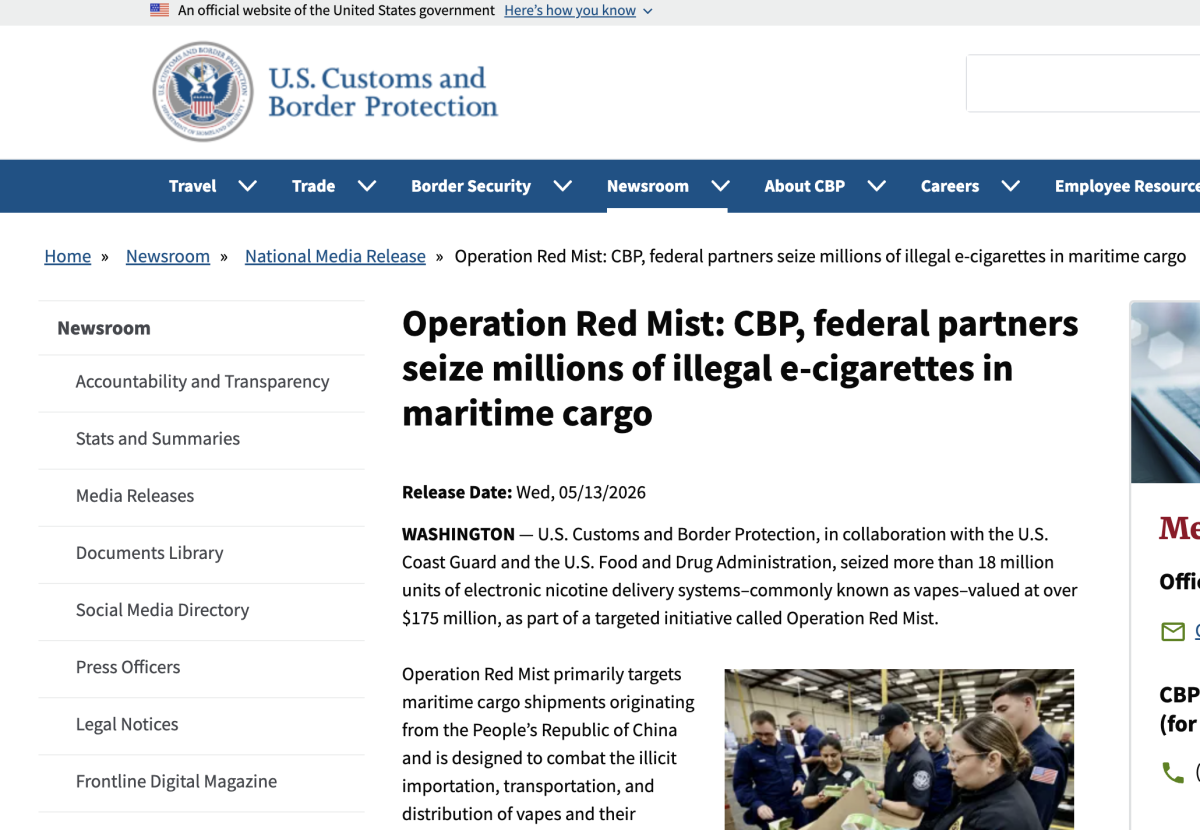
The article cited recent Trump administration enforcement actions, including “Operation Red Mist,” which reportedly seized more than 18 million unauthorized vaping products valued at over $175 million.
One individual seizure reportedly involved 3 million vape products worth approximately $76 million, representing about 4% of China’s monthly e-cigarette exports to the United States.
The commentary also referenced “Operation Vape Trail,” which reportedly seized more than 2.3 million vape devices and cartridges, along with more than 100 weapons, within a single week.
McLaughlin supported the FDA’s recent enforcement guidance targeting unauthorized Electronic Nicotine Delivery Systems (ENDS).
She argued that the policy marks an important step toward stronger public health protection and border enforcement, but said it is not enough to fully disrupt the illicit market.
The article urged FDA to expand enforcement efforts, including increased cargo seizures, permanent injunctions against repeat offenders, higher civil penalties, and daily intelligence-sharing coordination with DHS and CBP.
The commentary described U.S. ports of entry as the “first line of defense” against illegal vaping supply chains.
It also noted that Congress allocated $200 million to FDA last year to strengthen enforcement against illegal Chinese vape imports.
McLaughlin argued that FDA should establish a long-term joint enforcement structure with DHS and CBP, rather than relying mainly on retail-level enforcement.
The article concluded that the Trump administration’s “Make America Healthy Again” (MAHA) agenda should prioritize enforcement of existing law and suppression of illicit vape supply chains.
The piece is an opinion article reflecting the author’s views and related political perspective, not an official U.S. government policy document.
(Cover image: Former DHS Assistant Secretary for Public Affairs and spokesperson Tricia McLaughlin | Source: U.S. Department of Homeland Security)
Disclaimer
This article is provided solely for professional research, industry discussion, and informational purposes. Any references to brands, companies, products, technologies, or policies are made for factual reporting and analytical purposes only, and do not constitute endorsement, recommendation, promotion, or advertising by 2Firsts.
Nicotine-containing products, including but not limited to cigarettes, e-cigarettes, heated tobacco products, and nicotine pouches, carry significant health risks. Readers are responsible for complying with all applicable laws and regulations in their respective jurisdictions, including age restrictions and access limitations.
The information contained in this article should not be regarded as investment, legal, medical, regulatory, or commercial advice. While 2Firsts strives to ensure the accuracy and reliability of its content, it does not assume liability for any direct or indirect loss arising from errors, omissions, inaccuracies, or reliance on the information contained herein.
This article is not intended for individuals below the legal age for accessing tobacco or nicotine-related information in their jurisdiction.
Copyright Notice
This article is either original content produced by 2Firsts or content reproduced, translated, summarized, or adapted from third-party sources with attribution where applicable. The intellectual property rights of the original content remain with 2Firsts or the respective original rights holders.
No individual or organization may copy, reproduce, distribute, republish, modify, translate, or otherwise use this content without prior authorization. Any unauthorized use may result in legal action.
For copyright-related inquiries, corrections, or removal requests, please contact: info@2firsts.com.
AI-Assisted Translation and Editing Notice
Portions of this article may have been translated, edited, or reviewed with the assistance of artificial intelligence tools to improve efficiency and readability. Due to the limitations of AI-assisted translation and editing, discrepancies, omissions, or inaccuracies may exist when compared with the original source.
Where applicable, readers are advised to refer to the original source for the most complete and accurate information. If you identify any errors or believe that any content infringes upon your rights, please contact us at info@2firsts.com, and we will review and address the matter promptly.