Key Points
- Maine advances vape recycling bill;
- Lithium battery risks cited;
- Producers fund stewardship programs;
- Retailers join collection network;
- Disposal rules tightened.
2Firsts
June 12, 2026
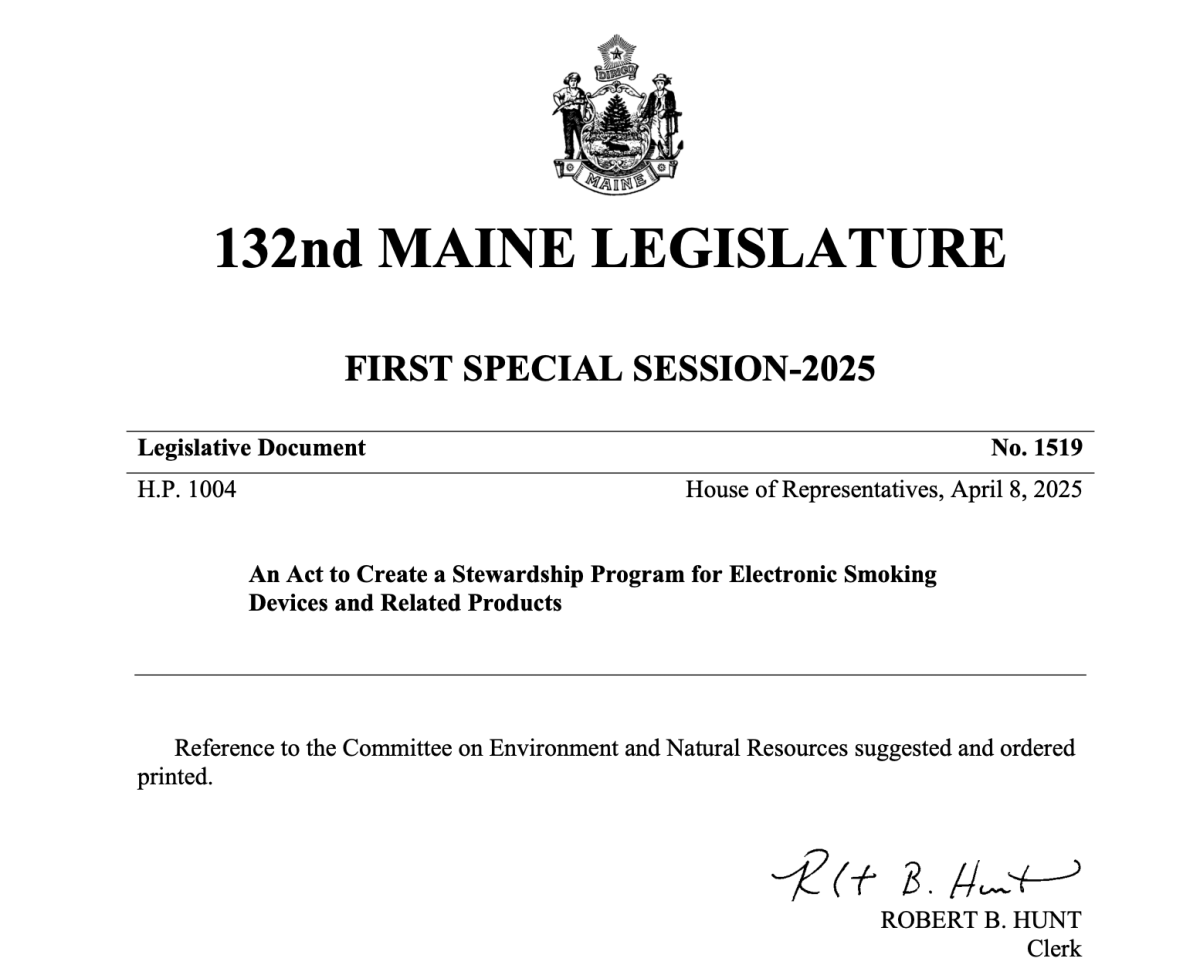
The Maine House of Representatives has passed LD 1519, titled An Act to Create a Stewardship Program for Electronic Smoking Devices and Related Products, establishing a producer-responsibility framework for electronic smoking devices.
The legislation primarily targets disposable vape products containing lithium-ion batteries and would require manufacturers and importers to take responsibility for managing products at the end of their life cycle.
Under the bill, producers would be required to individually or collectively establish and fund stewardship programs covering the collection, transportation, reuse, recycling and disposal of unwanted products.
The legislation applies to e-cigarettes, vape pens and related components.
Producers would be required to submit detailed stewardship plans to the Maine Department of Environmental Protection for approval.
These plans must outline collection methods, recycling and reuse processes, public education and outreach programs, and financial management arrangements.
The bill requires the creation of convenient collection networks to allow consumers to return unwanted products.
Once an approved stewardship plan is in operation, consumers would be prohibited from disposing of covered products through ordinary waste streams.
Instead, products must be returned through the stewardship program or transferred to licensed hazardous-waste transporters.
The legislation also requires retailers to participate as collection locations within three years of a stewardship plan receiving approval.
One of the primary motivations behind the bill is concern over fire risks associated with lithium-ion batteries used in disposable vape products.
The legislation notes that improperly discarded devices have caused fires in garbage trucks, recycling facilities and landfills.
In addition, the combination of plastics, metals, batteries and nicotine-containing materials increases waste-management complexity and costs.
Supporters argue that an Extended Producer Responsibility (EPR) approach can shift part of the disposal burden to manufacturers while reducing pressure on local governments and waste-management systems.
Several U.S. states have already implemented similar stewardship programs covering electronics, batteries, packaging materials and other consumer products.
By extending the concept to electronic smoking devices, Maine is highlighting growing concerns over the environmental and safety impacts of disposable vapes.
Industry observers said that as the disposable vape market continues to expand, battery recycling, safe disposal and environmental accountability are becoming increasingly important regulatory issues.
Unlike many vape regulations that focus on youth access, product sales or flavor restrictions, Maine’s proposal centers on product life-cycle management and environmental protection.
If fully implemented, the legislation could provide a model for other U.S. states seeking to address disposable vape waste and battery-related risks.
Cover image:Maine Legislature(LD 1519)
Disclaimer
This article is provided solely for professional research, industry discussion, and informational purposes. Any references to brands, companies, products, technologies, or policies are made for factual reporting and analytical purposes only, and do not constitute endorsement, recommendation, promotion, or advertising by 2Firsts.
Nicotine-containing products, including but not limited to cigarettes, e-cigarettes, heated tobacco products, and nicotine pouches, carry significant health risks. Readers are responsible for complying with all applicable laws and regulations in their respective jurisdictions, including age restrictions and access limitations.
The information contained in this article should not be regarded as investment, legal, medical, regulatory, or commercial advice. While 2Firsts strives to ensure the accuracy and reliability of its content, it does not assume liability for any direct or indirect loss arising from errors, omissions, inaccuracies, or reliance on the information contained herein.
This article is not intended for individuals below the legal age for accessing tobacco or nicotine-related information in their jurisdiction.
Copyright Notice
This article is either original content produced by 2Firsts or content reproduced, translated, summarized, or adapted from third-party sources with attribution where applicable. The intellectual property rights of the original content remain with 2Firsts or the respective original rights holders.
No individual or organization may copy, reproduce, distribute, republish, modify, translate, or otherwise use this content without prior authorization. Any unauthorized use may result in legal action.
For copyright-related inquiries, corrections, or removal requests, please contact: info@2firsts.com.
AI-Assisted Translation and Editing Notice
Portions of this article may have been translated, edited, or reviewed with the assistance of artificial intelligence tools to improve efficiency and readability. Due to the limitations of AI-assisted translation and editing, discrepancies, omissions, or inaccuracies may exist when compared with the original source.
Where applicable, readers are advised to refer to the original source for the most complete and accurate information. If you identify any errors or believe that any content infringes upon your rights, please contact us at info@2firsts.com, and we will review and address the matter promptly.