Key Points
- FDA received 26.66 million tobacco product applications from 2018 through 2025; 131,915 remained unresolved at the end of 2025, with an average wait of 1,266 days.
- Overall reviews averaged 507 days, while PMTA screening times have declined sharply in recent years. FDA still cannot systematically measure whether the 180-day scientific-review timeline is being met.
- FDA's nicotine pouch pilot involved four manufacturers and 158 applications. In April 2026, the agency incorporated lessons from the program into internal guidance for e-cigarette PMTA reviewers.
- FDA's 2026 enforcement policy gives greater practical significance to whether an unauthorized ENDS or nicotine pouch application has been accepted and filed.
2Firsts
October 3, 2026
According to a September 30 report from the U.S. Government Accountability Office, 131,915 tobacco product applications submitted to the Food and Drug Administration since 2018 remained without a final review as of December 31, 2025. Those pending applications had been waiting an average of 1,266 days, with most filed before 2023.
GAO also found that FDA's existing systems do not fully capture when scientific reviews begin or certain periods when the review clock may stop, preventing the agency from systematically determining whether PMTAs and other tobacco applications are meeting established scientific-review timelines.
The Department of Health and Human Services agreed with GAO's recommendation and said FDA will upgrade its systems to track substantive scientific-review milestones across all three premarket pathways.
The audit comes as FDA is reshaping parts of its premarket system. In April 2026, the agency issued internal guidance incorporating lessons from its nicotine pouch pilot into e-cigarette PMTA reviews.
After a 26 Million-Application Surge, Nearly 132,000 Still Await Final Decisions
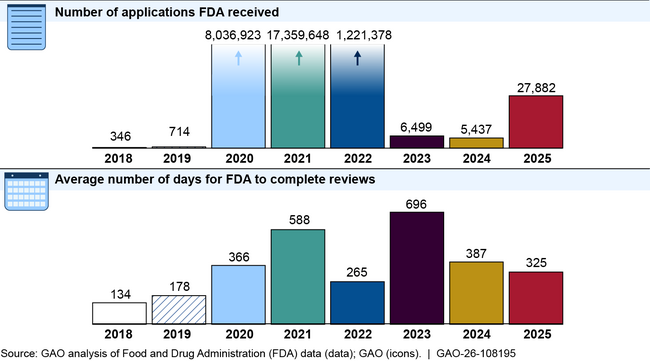
GAO analyzed applications received in calendar years 2018 through 2025.
FDA received 26,658,777 tobacco product applications over that period, including 25,396,571 in 2020 and 2021. By comparison, the agency received just 1,060 applications combined in 2018 and 2019.
FDA officials said most of the more than 26 million product applications received since the agency's 2016 deeming rule involved e-cigarettes.
By the end of 2025, FDA had completed reviews for 26,526,862 applications, leaving 131,915 without a final decision.
The raw application count does not translate into the same number of separate scientific reviews. Beginning in 2020, FDA grouped similar submissions from manufacturers for joint review. That bundling system reduced 26.66 million individual applications to 18,197 bundled applications.
The challenge facing FDA has therefore shifted from absorbing the initial submission surge toward resolving the remaining long-running applications.
PMTA Screening Has Accelerated, but FDA Still Cannot Fully Track the Scientific-Review Clock
Across all tobacco product pathways, FDA took an average of 507 days to complete application reviews from 2018 through 2025.
Review times have declined since 2023.
For PMTAs, historical screening times substantially exceeded FDA's internal targets:
| PMTA Step | FDA Goal | 2018-2025 Average |
|---|---|---|
| Accepted | 7 days | 236 days |
| Refused to Accept | 21 days | 542 days |
| Filed | 7 days | 141 days |
| Refused to File | 23 days | 116 days |
Recent performance has improved. The average time to file a PMTA fell from 845 days in 2022 to 156 days in 2025. The average time to refuse acceptance of a Substantial Equivalence application dropped from 596 days in 2023 to 170 days in 2025.
GAO's 507-day figure covers the full application process. FDA applies the statutory 180-day timeframe to the scientific-review phase of a filed PMTA.
GAO found that FDA does not consistently record when scientific review actually begins or all periods during which the review clock may be stopped while an applicant supplies additional information.
As a result, FDA cannot systematically determine whether it is meeting the 180-day PMTA scientific-review timeframe or the corresponding 73-day and 48-day targets for the other two pathways.
A 2023 HHS Inspector General review cited by GAO found that a small sample of PMTA scientific reviews took 483 to 633 days.
HHS Agrees to Formalize Tracking of Scientific-Review Timelines
GAO made one formal recommendation: FDA should collect the data needed to measure scientific-review timelines across all tobacco product pathways and monitor whether it meets those targets.
HHS agreed.
In its September 11 response, the department said FDA needs a more formal and automated method for tracking substantive scientific-review metrics and milestones and will upgrade its systems across all three premarket pathways.
HHS also said application review times have declined and that FDA is continuing to pursue greater efficiency, predictability and transparency while maintaining scientific rigor.
For manufacturers, a more systematic tracking system could make bottlenecks and review performance more visible and give Congress and industry a clearer measure of whether recent PMTA reforms are delivering faster decisions.
Nicotine Pouch Pilot Reshapes FDA-Applicant Interaction and Moves Into ENDS Reviews
FDA launched its nicotine pouch PMTA pilot in September 2025 with four manufacturers and 158 product applications.
The program increased informal interaction between FDA project managers and applicants, allowing issues to be addressed during review rather than relying only on formal correspondence.
One participating manufacturer said FDA worked directly with applicants to modify submissions to meet requirements rather than requiring them to withdraw and resubmit.
Six products had received marketing authorization by December 2025. As of May 11, 2026, the other 152 applications remained in scientific review, with no denials issued through the pilot at that point.
The model has already moved beyond nicotine pouches.
In April 2026, FDA issued internal guidance directing reviewers to incorporate lessons from the pilot into e-cigarette PMTA reviews.
FDA also began allowing reviewers to contact PMTA applicants before scientific review starts to ask whether new information is available that could facilitate the review, particularly relevant for applications that have been pending for years.
Nicotine Pouch and ENDS Marketing Orders Accelerate in 2026
FDA has issued a series of marketing orders alongside those process changes.
On August 4, FDA authorized four on! nicotine pouch products reviewed through the pilot. Additional Helix marketing orders followed on August 19, and FDA authorized 11 ZYN ULTRA products from Swedish Match USA on August 21.
FDA's current public list contains 43 authorized nicotine pouch products.
For ENDS, FDA issued new marketing orders for Glas products in May and authorized the JUUL2 device and tobacco- and menthol-flavored pods on August 28.
For applicants with mature regulatory teams and stronger scientific packages, faster review can shorten the path to a final marketing decision. For weaker applications, the same acceleration can mean reaching a denial sooner.
Pending PMTA Status Is Becoming More Important to Enforcement and Distribution Risk
FDA's May 2026 enforcement policy gave additional commercial significance to the specific stage of a pending application.
For certain unauthorized ENDS and nicotine pouch products whose applications have been accepted and filed, FDA said it generally does not intend to prioritize enforcement when other conditions in the guidance are met. Non-tobacco-flavored ENDS applications must also contain sufficient data for FDA to evaluate whether the product meets the appropriate-for-the-protection-of-public-health standard.
FDA continues to prioritize products that did not submit required applications, counterfeit or misdeclared products and products with certain youth-appealing characteristics.
That makes "PMTA pending" increasingly insufficient as a commercial description.
For manufacturers, importers, distributors and retailers, whether an application has merely been submitted, accepted, filed, entered scientific review or reached a final marketing decision increasingly carries different regulatory and commercial implications.
GAO similarly concluded that completing more reviews will help FDA clarify which products are lawfully marketed and support enforcement against unauthorized products.
Faster review can therefore expand the pool of authorized products while narrowing the space for products that have remained on the market for years on the basis of unresolved applications.
FDA Reworks the Application Gateway as eSubmitter Heads for Retirement
FDA is also reducing friction at the front end of the application process.
GAO found that the agency upgraded its electronic portal in fall 2025 to automatically validate certain required information and formatting that staff previously checked manually during acceptance review.
FDA expanded CTP Portal NextGen again in July 2026, adding folder uploads, direct document labeling and reusable contact information for PMTA and SE submissions.
After November 14, 2026, eSubmitter will no longer be available for PMTA and SE submissions, with FDA directing applicants toward web-based forms in CTP Portal NextGen.
For applicants, the changes are intended to reduce data-entry and formatting errors. For FDA, greater automation can shift staff time away from basic screening and toward substantive review.
Application Reviews Take CTP's Largest Share of Resources, While Vape and Pouch Makers Pay No Direct Tobacco User Fee
GAO's funding and staffing analysis covers fiscal years 2018 through 2025.
FDA's tobacco program is funded entirely through industry user fees. Since fiscal 2019, the agency has been authorized to collect $712 million annually.
Current law allows FDA to assess those fees on categories including cigarettes, cigars, snuff, chewing tobacco, pipe tobacco and roll-your-own tobacco. FDA is not authorized to directly assess the same tobacco user fees on e-cigarette or nicotine pouch manufacturers.
Application review has nevertheless remained CTP's largest resource commitment.
From fiscal 2018 through fiscal 2025, FDA obligated an average of about:
- $292 million a year to product application reviews;
- $150 million to public education and communications;
- $131 million to compliance and enforcement;
- $156 million to management, administration and overhead.
Staff in the Office of Science, which leads application review, increased from 338 in fiscal 2018 to 586 in fiscal 2025, accounting for an average 49% of CTP staff over the eight-year period.
Overall CTP staffing peaked at 1,195 in fiscal 2024 before falling to 1,090 in fiscal 2025.
FDA also carried $374 million in tobacco user fees from fiscal 2025 into fiscal 2026, above the $221 million to nearly $280 million carried into each of the previous six fiscal years. FDA said it planned to increase spending on application reviews and compliance and enforcement in fiscal 2026.
The figures put PMTA and other premarket reviews at the center of CTP's resource allocation even as e-cigarettes and nicotine pouches account for substantial review workloads without directly contributing to the current tobacco user-fee base.
Faster Reviews Could Redraw the U.S. Market for New Nicotine Products
GAO said more predictable review timelines and a larger number of completed decisions would help FDA determine which products can lawfully remain on the market and strengthen enforcement against unauthorized products.
For brands, PMTA quality, scientific evidence and the ability to respond to FDA are becoming more important to the speed of a final decision. For importers and retailers, the stage of an application is becoming a more relevant measure of commercial risk. For suppliers, the regulatory status of U.S. customers and individual SKUs can increasingly affect order continuity.
FDA is now moving on several fronts at once: accelerating reviews, increasing applicant interaction, automating submissions, differentiating enforcement by application status and issuing more final marketing decisions.
The result is a PMTA system that increasingly determines not just how long a product waits for review, but which products can enter and remain in the lawful U.S. nicotine market.
Follow 2Firsts for timely updates on global tobacco and nicotine regulations, market developments and industry trends.
Cover Image: U.S. Government Accountability Office

Disclaimer
This article is provided solely for professional research, industry discussion, and informational purposes. Any references to brands, companies, products, technologies, or policies are made for factual reporting and analytical purposes only, and do not constitute endorsement, recommendation, promotion, or advertising by 2Firsts.
Nicotine-containing products, including but not limited to cigarettes, e-cigarettes, heated tobacco products, and nicotine pouches, carry significant health risks. Readers are responsible for complying with all applicable laws and regulations in their respective jurisdictions, including age restrictions and access limitations.
The information contained in this article should not be regarded as investment, legal, medical, regulatory, or commercial advice. While 2Firsts strives to ensure the accuracy and reliability of its content, it does not assume liability for any direct or indirect loss arising from errors, omissions, inaccuracies, or reliance on the information contained herein.
This article is not intended for individuals below the legal age for accessing tobacco or nicotine-related information in their jurisdiction.
Copyright Notice
This article is either original content produced by 2Firsts or content reproduced, translated, summarized, or adapted from third-party sources with attribution where applicable. The intellectual property rights of the original content remain with 2Firsts or the respective original rights holders.
No individual or organization may copy, reproduce, distribute, republish, modify, translate, or otherwise use this content without prior authorization. Any unauthorized use may result in legal action.
For copyright-related inquiries, corrections, or removal requests, please contact: info@2firsts.com.
AI-Assisted Translation and Editing Notice
Portions of this article may have been translated, edited, or reviewed with the assistance of artificial intelligence tools to improve efficiency and readability. Due to the limitations of AI-assisted translation and editing, discrepancies, omissions, or inaccuracies may exist when compared with the original source.
Where applicable, readers are advised to refer to the original source for the most complete and accurate information. If you identify any errors or believe that any content infringes upon your rights, please contact us at info@2firsts.com, and we will review and address the matter promptly.