Key Points
- Retailers selling covered tobacco and nicotine products must hold a separate Retail Tobacco Permit for each business location from October 1.
- The rules cover electronic smoking devices, liquid nicotine, nicotine vapor products and substances used in vaping devices whether or not they contain nicotine.
- More than 3,000 businesses applied in September; qualifying pending applicants may operate under a Letter of Authorization through December 1.
- The retail permit operates alongside Virginia's vape product directory, with civil fines starting at $5,000 for certain unlisted liquid nicotine and nicotine vapor products.
2Firsts
October 3, 2026
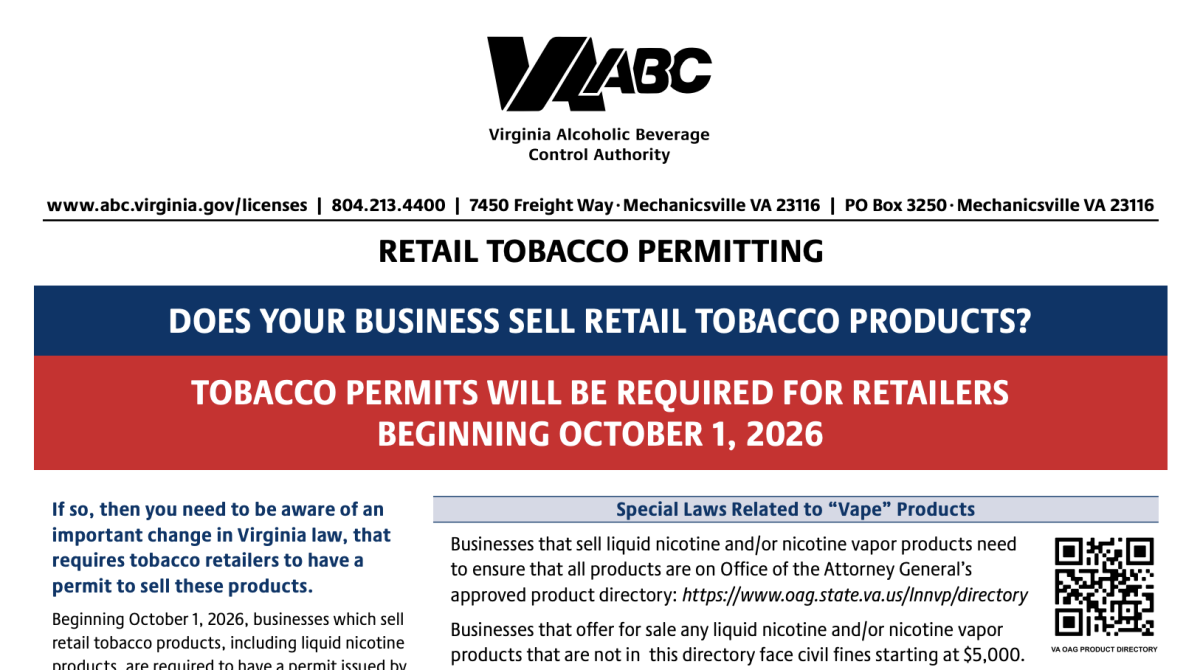
According to WDBJ, Virginia's new retail tobacco permit system took effect October 1, requiring businesses selling covered tobacco and nicotine products to obtain a Retail Tobacco Permit from the Virginia Alcoholic Beverage Control Authority.
The framework explicitly covers vape retail. Virginia law includes tobacco- or nicotine-containing products intended for human consumption, electronic smoking devices, and substances that may be aerosolized or vaporized through those devices whether or not they contain nicotine. Components, parts and accessories, including blunt or hemp wraps and glass pipes, are also included in the statutory definition.
Vape Retailers Move Into a Store-by-Store Permit System With $300-$400 Application Fees and Background Checks
A separate Retail Tobacco Permit is required for each business location. The permit must be displayed conspicuously at the premises and cannot be transferred between retailers or locations.
The rules apply to businesses including tobacco and vape shops, convenience stores, grocery stores, gasoline service stations, bars and restaurants that sell covered products to consumers.
Businesses selling only cigars or pipe tobacco are exempt from the permit requirement. Businesses engaged only in manufacturing or wholesale distribution also do not need this retail permit, although other Virginia licenses or permits may apply.
Retailers with an existing Virginia ABC alcohol license pay a $300 application fee. Other retailers pay $400. The initial 12-month permit is included in that fee, while the annual renewal fee has not yet been determined.
The application process also includes background checks. Virginia ABC requires criminal background checks for individuals with a 10% or greater ownership interest. Existing ABC license holders that have not completed a background check within the previous 24 months must undergo a new one.
Virginia residents also pay a $15 Virginia State Police background-check fee, while nonresidents must obtain a criminal background report from their state of residence.
Virginia ABC says online applications are normally expected to take 20 to 30 days to process, while paper applications may take longer.
More Than 3,000 September Applications Trigger Authorization Letters Through December 1
Virginia ABC began accepting Retail Tobacco Permit applications in July and notified affected businesses through email, social media, its website and direct staff outreach.
The regulator said more than 3,000 businesses applied in September alone.
Because applications require business documents and background checks, many of the submissions received close to the October 1 effective date had not completed all required steps, creating a processing backlog.
For applications received before October 1 and initially reviewed by Virginia ABC, the regulator began issuing Letters of Authorization from October 1.
Qualifying businesses may continue operating while their permit applications are completed, but all outstanding documents must be submitted by October 21. The authorization letters expire on December 1.
The letters are a transition mechanism rather than formal Retail Tobacco Permits. Businesses covered by the arrangement will need a completed permit after the authorization period ends.
Unpermitted Sales Are a Class 1 Misdemeanor as Training and Age Verification Tighten
Under Virginia law, a person who sells covered retail tobacco products without a Retail Tobacco Permit, outside specified statutory exceptions, is guilty of a Class 1 misdemeanor.
Permit holders may also be held responsible for violations committed by employees or agents in connection with retail tobacco sales.
Applicants must attest that employees have received training on identification checks, required signage, prohibited conduct and applicable penalties. Virginia ABC has launched the free Virginia Education for Retailers of Tobacco program to provide the required training elements.
Age-verification requirements are also part of the new compliance framework. Retailers must verify that purchasers meet Virginia's minimum age of 21. When a customer appears to be under 30, sellers must inspect government-issued photo identification or use approved identity-authentication or scanning technology to verify age.
Retail Permit Sits Alongside Virginia's Vape Directory, With Fines Starting at $5,000 for Unlisted Products
The Retail Tobacco Permit does not replace Virginia's existing vape product directory requirements.
Businesses selling liquid nicotine or nicotine vapor products must also ensure that the products appear on the approved product directory maintained by the Virginia Office of the Attorney General.
Businesses offering covered products that are not listed on the directory face civil fines starting at $5,000.
Vape retailers therefore face two separate compliance layers: the store itself must hold a Retail Tobacco Permit, while individual liquid nicotine and nicotine vapor products must also meet the state's directory requirements.
For multi-location operators, permit compliance must be managed separately for each store. For specialist vape retailers, product-level SKU compliance and store-level licensing now operate in parallel.
Virginia Expands Vape Compliance From Individual SKUs to Retail Operators
The new permit extends Virginia's tobacco and nicotine oversight further into the retail business itself.
The state's product directory regulates which liquid nicotine and nicotine vapor products may be offered through the retail channel. Beginning October 1, retailers must also meet requirements covering store permits, ownership and background checks, employee training, age verification and continuing permit compliance.
The business cost therefore extends beyond the $300 or $400 application fee. Owners with qualifying interests may need background checks, multi-store chains need permits for each location, permits require renewal, and covered vape products must still comply with the state product directory.
The more than 3,000 applications filed in September show the scale of businesses moving into the new licensing system. Virginia ABC's authorization letters provide a temporary bridge for qualifying applicants caught in the processing backlog, but that arrangement ends December 1.
With store licensing and product-directory requirements now operating together, vape retailers in Virginia face a dual compliance structure covering both the products they sell and the businesses that sell them.
Follow 2Firsts for timely updates on global tobacco and nicotine regulations, market developments and industry trends.
Cover Image: Virginia ABC
Disclaimer
This article is provided solely for professional research, industry discussion, and informational purposes. Any references to brands, companies, products, technologies, or policies are made for factual reporting and analytical purposes only, and do not constitute endorsement, recommendation, promotion, or advertising by 2Firsts.
Nicotine-containing products, including but not limited to cigarettes, e-cigarettes, heated tobacco products, and nicotine pouches, carry significant health risks. Readers are responsible for complying with all applicable laws and regulations in their respective jurisdictions, including age restrictions and access limitations.
The information contained in this article should not be regarded as investment, legal, medical, regulatory, or commercial advice. While 2Firsts strives to ensure the accuracy and reliability of its content, it does not assume liability for any direct or indirect loss arising from errors, omissions, inaccuracies, or reliance on the information contained herein.
This article is not intended for individuals below the legal age for accessing tobacco or nicotine-related information in their jurisdiction.
Copyright Notice
This article is either original content produced by 2Firsts or content reproduced, translated, summarized, or adapted from third-party sources with attribution where applicable. The intellectual property rights of the original content remain with 2Firsts or the respective original rights holders.
No individual or organization may copy, reproduce, distribute, republish, modify, translate, or otherwise use this content without prior authorization. Any unauthorized use may result in legal action.
For copyright-related inquiries, corrections, or removal requests, please contact: info@2firsts.com.
AI-Assisted Translation and Editing Notice
Portions of this article may have been translated, edited, or reviewed with the assistance of artificial intelligence tools to improve efficiency and readability. Due to the limitations of AI-assisted translation and editing, discrepancies, omissions, or inaccuracies may exist when compared with the original source.
Where applicable, readers are advised to refer to the original source for the most complete and accurate information. If you identify any errors or believe that any content infringes upon your rights, please contact us at info@2firsts.com, and we will review and address the matter promptly.