Key Points
- CBP is considering cross-checking foreign export records against U.S. import filings, potentially exposing differences in declared value, classification and product identity.
- For vapes without FDA marketing authorization, accurate customs declarations would mean more than higher duties: paying the correct tax would not make the products lawful for sale in the U.S.
- Industry sources said U.S.-bound logistics for leading unauthorized vape products is concentrated among fewer than 10 core Chinese freight forwarders, which price seizure and compensation risks into their rates.
- M said that if gray-market customs channels give way to costlier illicit transport, some Chinese vape exports could lose their economic viability in the U.S.
- China’s U.S.-bound vape and related-product exports still rose 8.4% to $1.98 billion in the first seven months of 2026, suggesting that existing supply chains have so far absorbed episodic enforcement shocks.
2Firsts | Shenzhen
September 7, 2026
A U.S. Customs and Border Protection proposal to collect records filed with foreign customs authorities could deal a “devastating” blow to parts of China’s vape export business, a veteran Chinese logistics professional told 2Firsts.
The source, who has extensive experience in cross-border vape shipping, is identified only as M because of the commercial and enforcement sensitivity of the subject.
M said the impact would not fall evenly across Chinese manufacturers. The greatest exposure lies with unauthorized products shipped through opaque, all-inclusive services that may involve undervaluation, inaccurate product descriptions or tariff classifications, and importers of record whose roles are unclear.
The risk goes beyond unpaid duties. If export records show a shipment’s true description and classification, U.S. authorities may be better able to identify it as containing e-cigarettes. Paying the correct duty would not resolve the separate question of whether the products have marketing authorization from the U.S. Food and Drug Administration.
The proposal affects China’s largest vape export market. China exported about $1.98 billion of vape and related products to the U.S. in the first seven months of 2026, up 8.4% from a year earlier, according to China Customs data analyzed by 2Firsts. July shipments jumped 53.5% to $404.2 million.
The figures cover vaping devices, nicotine-containing non-combustible products and other nicotine-substitute products. They measure declared exports and do not distinguish between FDA-authorized and unauthorized products.
CBP Seeks Export-Side Records
CBP published an advance notice of proposed rulemaking on September 2 to implement Executive Order 14411, signed by President Donald Trump on June 3 to strengthen customs enforcement.
The agency is considering collecting records submitted to foreign customs authorities before goods are exported to the United States. Its examples include export declarations, commercial invoices, packing lists, certificates of origin, export permits, bills of lading and air waybills.
Those records could show the value, classification and quantity declared when goods left the exporting country. CBP said it could use them to reconcile foreign export records with U.S. entry filings and detect discrepancies that may indicate trade violations, including dual invoicing.
The agency is seeking comments on whether the requirement should apply to all imports, whether the documents should be filed at entry or retained for later inspection, and how importers should explain differences in value, quantity or classification. Comments are due by December 1, 2026. No final rule or implementation date has been set.
Public data already show a wide gap between the two sides of the trade. China recorded more than 26 billion yuan, or about $3.6 billion, of vape exports to the U.S. in 2024, while U.S. customs data recorded only $333 million of Chinese vape imports that year, according to a Reuters analysis.
Two customs-data specialists told Reuters that discrepancies between trading partners were common, but a gap of about 90% was unusual. Reuters also found that one customs broker near Chicago O’Hare handled 60% of China-to-U.S. vape and vape-parts shipments registered by the FDA in 2024. Six of the 10 largest U.S. recipients were little-known businesses established in 2023 or 2024, some at residential addresses.
The gap is not, by itself, proof of undervaluation or smuggling. Differences in tariff classifications, valuation, shipping dates, transit trade and statistical coverage can all affect bilateral data. But its scale illustrates the information gap CBP is seeking to narrow.
How Customs Risk Gets Priced
Chinese freight forwarders commonly sell an all-in service known as shuangqing baoshui, literally “double customs clearance with duties and taxes included.” A single per-kilogram or per-shipment quote may cover export clearance in China, international freight, U.S. import clearance, duties and domestic delivery. Some providers also promise to compensate exporters at product cost if cargo is seized.
The service resembles Delivered Duty Paid, or DDP, shipping, but the terms are not interchangeable. DDP is a legitimate Incoterms arrangement under which the seller handles import clearance and pays the applicable duties. The compliance issue arises when an all-in service relies on undervaluation, inaccurate descriptions or classifications, or an opaque importer of record.
M said those practices are widespread in the unauthorized vape shipments he encounters, although no public data show how much of China’s U.S.-bound vape trade uses them.
He put recent all-in rates at about 40–50 yuan ($5.60–$7.00) per kilogram by sea and 95–98 yuan by air. The air rate reflects both transportation costs and the level of seizure risk perceived by the provider.
Another veteran Chinese industry source, identified as S, said many vape freight forwarders use their own internal “algorithms” to adjust prices as seizure risks and expected compensation claims change.
These are not standardized formulas or regulated insurance models. S said forwarders draw on their own cargo losses, the recent performance of clearance channels, information from peers and expected payouts. When seizures rise, they build the projected claims into future rates. When the perceived risk falls, quotes decline.
Customs risk is therefore built into the freight price.
M said that model would come under pressure if CBP began comparing foreign export documents with U.S. import filings. The value and description declared when a shipment left China could be checked against what was reported when it entered the U.S.
For unauthorized vapes, the same records could also reveal that the cargo contains FDA-regulated products without marketing authorization.
O’Hare Losses Reveal Hidden Liabilities
Dedicated cargo charters carrying vaping products are a regular part of the industry’s air-freight business between China and the United States.
M said that around May 2026, vape cargo on several such flights was seized in full at Chicago O’Hare, involving more than 200 metric tons of goods. He said the total was based on information about specific flights and cargo obtained through his industry network, rather than an estimate derived from an assumed seizure rate.
2Firsts could not independently confirm the flights or total weight through CBP announcements, court filings or other public records.
Some logistics operators described their perceived seizure rate for relevant O’Hare air cargo during the period as 70%–80%. The estimate was based on their own losses, peer reports and market quotes. It was not a statistical measure of all vape cargo entering through the airport.
Several Shenzhen-based vape supply-chain professionals interviewed separately by 2Firsts in June nevertheless gave broadly consistent accounts: the risk of vape air cargo being seized at O’Hare had risen sharply.
Some exporters continued to use air freight because it could reach U.S. channels in roughly three to seven days, compared with around two weeks or longer by sea. Supply-chain sources said Foger was replenishing U.S. inventories at the time, while Geek Bar and other leading unauthorized disposable products were also under pressure to restock.
2Firsts could not identify the brands carried on the seized flights or establish that the reported shortages were caused by those seizures.
A third Chinese logistics source, identified as F, said one forwarder involved in the May incident faced cargo-loss claims worth tens of millions of yuan and possibly close to 100 million yuan, based on exporters’ product costs.
Unable to pay the full amount in cash, the forwarder negotiated with some exporters to issue credits against future freight charges, F said. The exporters would continue using the company, with later shipping fees deducted from the outstanding compensation.
F said a large seizure would not necessarily force a forwarder out of business. When clearance was smooth and volumes were high, such companies could earn substantial profits. Over time, they sought to absorb seizure losses through earlier earnings, higher rates and future freight revenue.
Supply-chain sources said fewer than 10 core Chinese freight forwarders have long handled U.S.-bound shipments for leading unauthorized vape products. The concentration allows risk to be spread across cargo, customers and time. It also means sustained pressure on a key provider could disrupt several exporters at once.
When Gray-Market Shipping Moves Further Underground
M said exporters could face three broad choices if foreign export records became an important part of U.S. enforcement: file accurate declarations and meet the applicable product requirements, scale back or leave the U.S. market, or move deeper into illicit transport.
The last option could be far more expensive.
S said all-in shipping quotes for restricted vape cargo to Australia reached as much as 1,000 yuan per kilogram in May and June 2026 as perceived seizure risk and compensation exposure increased. More recently, quotes had fallen to around 200 yuan, broadly matching a separate figure provided by M.
Despite a recent flow of Australian enforcement announcements, S interpreted the lower rate as a sign that logistics operators were feeling less immediate pressure at the border. The prices and interpretation are based on industry accounts; 2Firsts could not independently verify either the rates or the corresponding change in seizure activity.
Australia is a stress case, not a direct model for the United States. M said the price structure of Australia’s regulated and illicit markets leaves more room for unauthorized sellers to absorb high logistics costs. The U.S. has a different tax, retail and authorized-product structure.
If unauthorized vapes bound for the U.S. were forced to absorb shipping costs approaching the Australian peak, M said, their landed cost could exceed that of legally marketed products. For many Chinese exporters, the result would be more than lower margins: the business would no longer be viable.
The latest trade data suggest that threshold has not yet been reached. China’s U.S.-bound vape and related-product exports fell 13% in the first five months of 2026, returned to near-flat growth by the end of June, and then rose 53.5% in July. That pushed the January–July total 8.4% above the previous year.
The timing is consistent with industry accounts that some cargo shifted from air to sea after the O’Hare seizures. During the period of elevated air-cargo risk, logistics operators put their perceived inspection rate for relevant ocean shipments at around 3%. That figure, like the O’Hare estimate, was based on experience rather than official statistics.
China Customs data do not identify transportation mode, brand or FDA authorization status. The July increase therefore cannot be attributed directly to a shift toward ocean freight.
Previous enforcement drives largely changed the risk attached to a particular port or route. Exporters and forwarders could respond by changing transport modes, raising prices, delaying compensation or rebuilding inventories.
CBP’s proposal could be more consequential because it would bring export-side values, classifications and product descriptions into the U.S. import review. If episodic, port-specific enforcement gives way to a more persistent supply-chain constraint, the effect would extend beyond freight rates.
It could weaken the information gap and risk-sharing system on which part of China’s unauthorized vape export trade depends.
Follow 2Firsts for regulatory developments, supply-chain reporting, market data and business analysis across the global vaping, tobacco and nicotine industries.
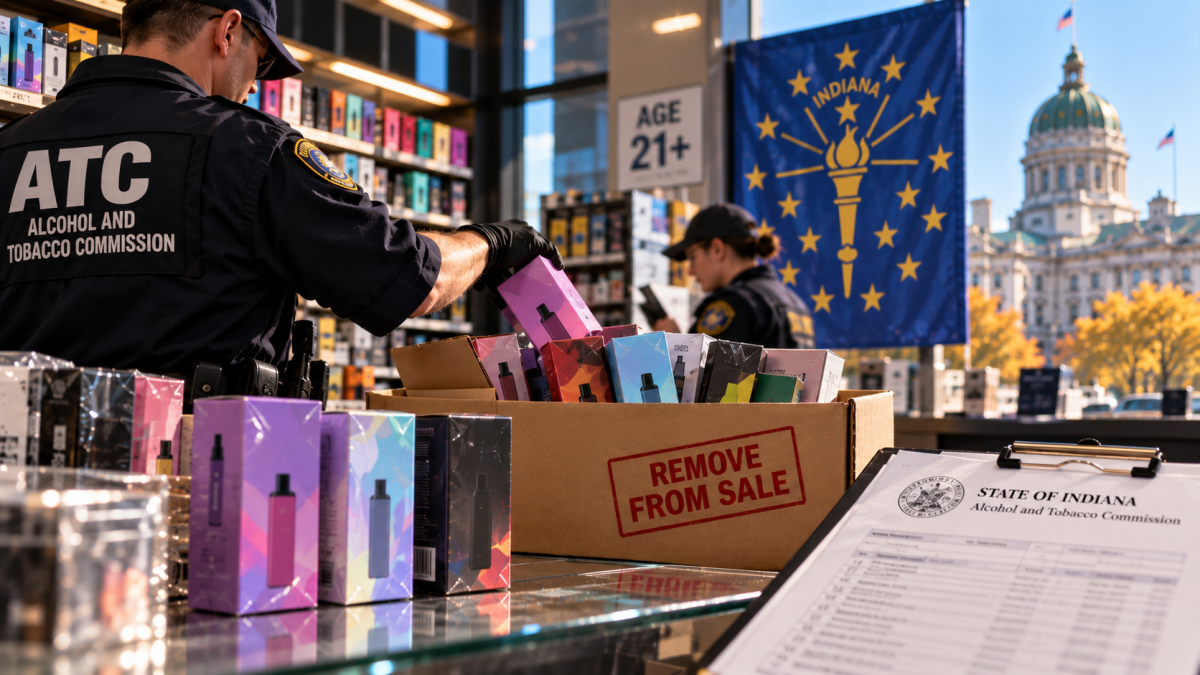
Cover Image generated by AI
Note: Information concerning the O’Hare seizures, logistics rates, cargo-loss compensation and perceived enforcement risks is based on interviews conducted by 2Firsts with Chinese vape supply-chain and cross-border logistics professionals. Sources are identified by pseudonyms because of the commercial and enforcement sensitivity of the subject. Figures that could not be independently confirmed through public records are identified as industry estimates or source accounts in the article.
Disclaimer
This article is provided solely for professional research, industry discussion, and informational purposes. Any references to brands, companies, products, technologies, or policies are made for factual reporting and analytical purposes only, and do not constitute endorsement, recommendation, promotion, or advertising by 2Firsts.
Nicotine-containing products, including but not limited to cigarettes, e-cigarettes, heated tobacco products, and nicotine pouches, carry significant health risks. Readers are responsible for complying with all applicable laws and regulations in their respective jurisdictions, including age restrictions and access limitations.
The information contained in this article should not be regarded as investment, legal, medical, regulatory, or commercial advice. While 2Firsts strives to ensure the accuracy and reliability of its content, it does not assume liability for any direct or indirect loss arising from errors, omissions, inaccuracies, or reliance on the information contained herein.
This article is not intended for individuals below the legal age for accessing tobacco or nicotine-related information in their jurisdiction.
Copyright Notice
This article is either original content produced by 2Firsts or content reproduced, translated, summarized, or adapted from third-party sources with attribution where applicable. The intellectual property rights of the original content remain with 2Firsts or the respective original rights holders.
No individual or organization may copy, reproduce, distribute, republish, modify, translate, or otherwise use this content without prior authorization. Any unauthorized use may result in legal action.
For copyright-related inquiries, corrections, or removal requests, please contact: info@2firsts.com.
AI-Assisted Translation and Editing Notice
Portions of this article may have been translated, edited, or reviewed with the assistance of artificial intelligence tools to improve efficiency and readability. Due to the limitations of AI-assisted translation and editing, discrepancies, omissions, or inaccuracies may exist when compared with the original source.
Where applicable, readers are advised to refer to the original source for the most complete and accurate information. If you identify any errors or believe that any content infringes upon your rights, please contact us at info@2firsts.com, and we will review and address the matter promptly.