Bremen Sees Active Illicit Trade in E-Cigarettes and Nicotine Pouches; Regulators Say ‘Nearly Every Inspection Finds Violations’

Oct.10.2025
Bremen Sees Active Illicit Trade in E-Cigarettes and Nicotine Pouches; Regulators Say ‘Nearly Every Inspection Finds Violations’
Bremen’s state government warns of increasingly active illicit trade in e-cigarettes, snus, and nicotine pouches. Enforcement reports “violations in nearly every inspection,” with some disposable vapes exceeding Germany’s 2 ml e-liquid cap. Since 2024, authorities have recorded 54 violations in 255 checks, concentrated around the central station district and city center.

Key Points:


Enforcement Findings: In its response to a query from the Free Democratic Party (FDP), Bremen’s state government says the illicit circulation of disposable e-cigarettes, snus, and nicotine pouches is active and rising, with “violations in nearly every inspection.”


Product Non-Compliance: Police have repeatedly seized disposable e-cigarettes that exceed Germany’s 2 ml e-liquid limit and therefore are not eligible for legal sale.


Regulatory Intensity & Frequency: Six targeted inspections were conducted at tobacco shops over the past two years; customs officers carry out multiple operations each month at newsstands and other retail outlets.


Geography & Nature of Violations: Since 2024, there have been 255 inspections with 54 violations recorded. Infractions are “clustered” at specific locations, with no evidence to date of organized crime involvement.


2Firsts, October 10, 2025 — Citing a report by Kreiszeitung on October 9, Bremen’s state government warns that illicit trade in e-cigarettes, snus, and nicotine pouches is active and on the rise. The assessment is based on the government’s formal written reply to an FDP parliamentary inquiry.


The government’s response states that enforcement inspections “almost always uncover violations.” Bremen police have seized large quantities of disposable e-cigarettes alleged to exceed Germany’s 2 ml e-liquid cap and therefore not eligible for legal sale; the circulation of non-compliant snus and nicotine pouches is also aggravating the problem. The government stresses that nicotine pouches, given their appeal to young people, pose new challenges for youth protection.


On enforcement, the state’s food surveillance, animal protection, and veterinary authorities conduct systematic, regular spot checks at points of sale for tobacco products, e-liquids, and disposable vapes, though sampling intensity is limited—only 0.5 samples per 1,000 residents. Over the past two years, there have been six targeted inspections of tobacco specialty shops; in addition, customs conducts multiple operations each month at newsstands and other retail outlets.


Bremen’s municipal administration reports that since January 1, 2024, authorities have carried out 255 inspections of businesses selling tobacco and alcohol, finding 54 violations, mainly involving sales of alcohol, tobacco, or e-cigarettes to minors; repeat offenders face higher fines. Complaints and enforcement data also show “clustered” violations in certain districts, concentrated around the Bahnhofsquartier (central station area), Bremen-Mitte (city center), as well as Woltmershausen and Gröpelingen. To date, there is no evidence of organized crime networks.


Cover image credit: Kreiszeitung.

We welcome news tips, article submissions, interview requests, or comments on this piece.

Please contact us at info@2firsts.com, or reach out to Alan Zhao, CEO of 2Firsts, on LinkedIn


Notice

1.  This article is intended solely for professional research purposes related to industry, technology, and policy. Any references to brands or products are made purely for objective description and do not constitute any form of endorsement, recommendation, or promotion by 2Firsts.

2.  The use of nicotine-containing products — including, but not limited to, cigarettes, e-cigarettes, nicotine pouchand heated tobacco products — carries significant health risks. Users are responsible for complying with all applicable laws and regulations in their respective jurisdictions.

3.  This article is not intended to serve as the basis for any investment decisions or financial advice. 2Firsts assumes no direct or indirect liability for any inaccuracies or errors in the content.

4.  Access to this article is strictly prohibited for individuals below the legal age in their jurisdiction.


Copyright


This article is either an original work created by 2Firsts or a reproduction from third-party sources with proper attribution. All copyrights and usage rights belong to 2Firsts or the original content provider. Unauthorized reproduction, distribution, or any other form of unauthorized use by any individual or organization is strictly prohibited. Violators will be held legally accountable.

For copyright-related inquiries, please contact: info@2firsts.com


AI Assistance Disclaimer


This article may have been enhanced using AI tools to improve translation and editorial efficiency. However, due to technical limitations, inaccuracies may occur. Readers are encouraged to refer to the cited sources for the most accurate information.

We welcome any corrections or feedback. Please contact us at: info@2firsts.com

U.S. Rep. Krishnamoorthi Questions FDA Over Planned PMTA Rewrite, Seeks Communications With Altria and Reynolds
U.S. Rep. Raja Krishnamoorthi on Oct. 6 questioned the FDA over its plan to reassess and potentially replace the 2021 PMTA regulatory framework, asking the agency to identify provisions it may change or eliminate, state whether current scientific evidentiary standards will be maintained, and disclose communications with Altria, Reynolds and other parties challenging the rule. Krishnamoorthi led a congressional investigation into JUUL and youth vaping in 2019 and has since remained active on e-cigarette regulation and enforcement.
Regulations
Oct.08
How Many Nicotine Pouch Factories Does Europe Need? 2Firsts Interviews AIRSCREAM on the OEM Market
At InterTabac 2026, nicotine pouch growth was visible not only in brands but across equipment, raw materials and OEM manufacturing. 2Firsts interviewed AIRSCREAM commercial head Steve Moore on how many pouch factories Europe may ultimately need and where manufacturers can differentiate, from formulation and flavour to pouch materials, production consistency and customer service. The category continues to expand, but questions remain over future capacity, consolidation and the long-term structure of the supply chain.
Sep.18
JAMA Study: U.S. Vape Directories Fail to Sustainably Curb Unlisted Sales as Product Shifts May Redistribute Brand Share 2Firsts Recommended
A study by CDC Foundation researchers found no sustained decline in e-cigarette sales across Alabama, Oklahoma and Louisiana, the first three U.S. states to implement e-cigarette directory laws. Louisiana initially saw a significant sales decline, followed by a rebound and a persistent reduction in product availability. Sales also shifted from nontobacco-flavored disposables toward prefilled cartridges, with Vuse Alto driving much of the increase in menthol cartridges. By April 2025, unlisted products still accounted for more than half of e-cigarette nicotine sales in all three states.
Sep.18
FRE and ALP Push Modern Oral to 48% of Q2 Sales as Turning Point Brands Changes CEO and Lowers Profit-Guidance Ceiling
Turning Point Brands said Executive Chairman David E. Glazek will become CEO on October 1, replacing Graham Purdy, who is stepping down for personal reasons. The company narrowed its 2026 adjusted EBITDA outlook to $70 million-$80 million from $70 million-$90 million while maintaining Modern Oral gross sales guidance of $330 million-$350 million and net sales guidance of $260 million-$270 million. In the second quarter, Modern Oral net sales rose 128% to $68.4 million and accounted for 48% of company-wide net sales. Adjusted EBITDA fell 50% year over year. TPB shares closed about 10% lower on September 21.
Market
Sep.22 by 2Firsts Perspectives
UK HMRC Launches Vape Duty Stamps on October 1, Ushering in Supply-Chain Traceability as Chinese Exporters Face New Compliance Hurdles
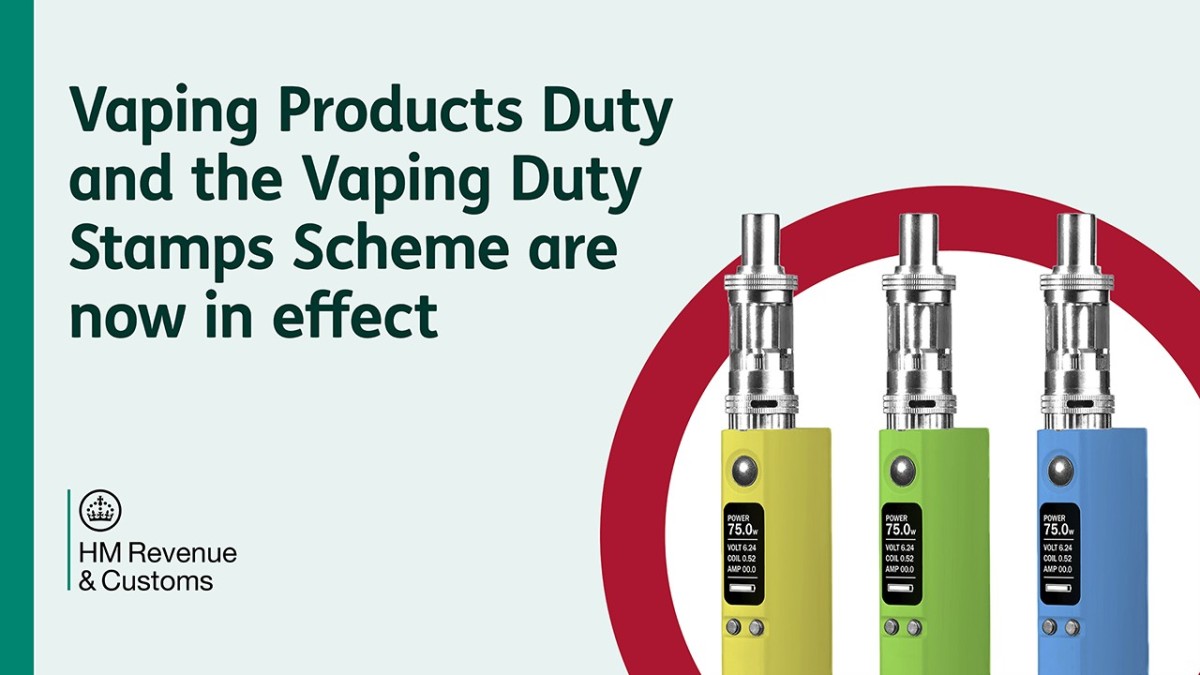
HM Revenue & Customs put the UK's Vaping Products Duty and Vaping Duty Stamps Scheme into effect on October 1. All vaping liquids manufactured in or imported into the UK are now subject to duty at £2.20 per 10ml, regardless of nicotine content. The stamp regime will introduce digital functionality designed to provide traceability throughout the supply chain, with approved manufacturers, importers and warehousekeepers required to report product movements and retailers and consumers eventually able to scan stamps to verify authenticity. China exported $177 million of vape-related products to the UK in August, up 51.4% year over year, increasing the significance of the new compliance regime for China's Shenzhen-centered vape supply chain.
Regulations
Oct.04
How Investors Are Repricing the Global Tobacco Industry as Nicotine Markets Shift
How are investors reassessing the global tobacco industry as nicotine markets evolve? In an interview with 2Firsts, Charlie Chen, Head of Research at CCB International Securities, forecasts annual growth of 30–50% for nicotine pouches, outpacing vaping and heated tobacco. He examines how regulatory enforcement, shifting market shares and new business models are influencing company valuations. The report also explores differences between multinational tobacco groups and Chinese companies, drawing on insights from the New Approaches Summit on profitability, investment strategies and industry consolidation.
Nov.11