Key Points
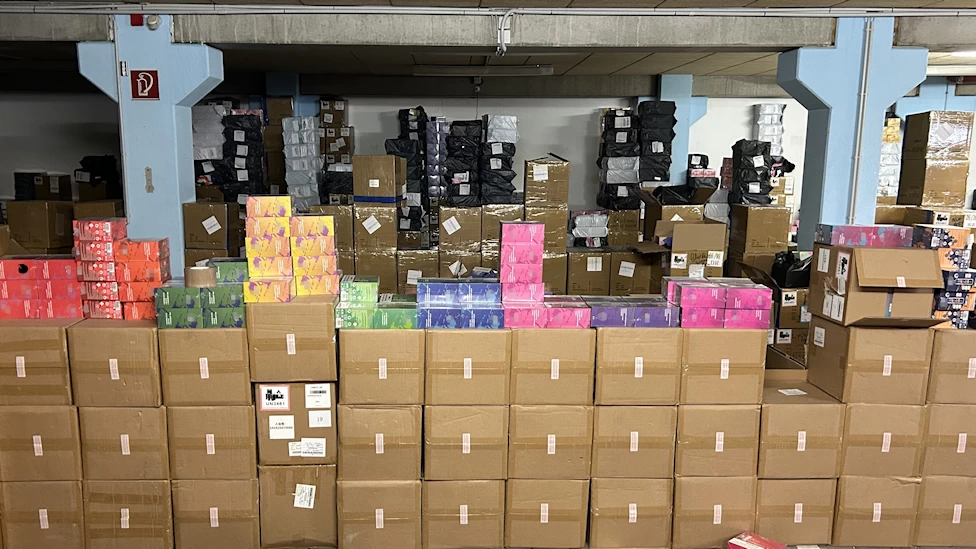
- German authorities seized hundreds of thousands of illegal disposable vapes stored across 56 European pallets.
- Investigators estimated tax losses of at least €1.8 million.
- The products were reportedly untaxed and unauthorized for sale in Germany.
- The products were allegedly transported from China into the EU by air freight.
- A suspected ringleader was arrested at Frankfurt Airport.
2Firsts
July 14, 2026
According to a joint statement released by the Darmstadt Public Prosecutor’s Office and the Frankfurt Customs Investigation Office on June 18, 2026, German authorities seized hundreds of thousands of disposable e-cigarettes during an investigation into suspected organized smuggling activities. The seizure took place on June 14, 2026, at a warehouse in Heusenstamm, Hesse, where investigators found illegal vape products occupying 56 European pallets. Authorities estimate that the seized products caused at least €1.8 million in tax losses.
Germany Seizes 56 Pallets of Illegal Vapes With €1.8 Million Tax Loss
The scale of the operation became clearer as investigators assessed the seized products. According to information cited by the German Association of E-Cigarette Trade (VDEH), the confiscated disposable vapes filled 56 European pallets and were identified as untaxed products that were not authorized for sale in Germany.
Investigators estimated that the products resulted in at least €1.8 million in tax losses. The seized vapes were also suspected of exceeding Germany’s permitted liquid capacity limits, adding another layer of regulatory concern beyond tax violations.
Under German regulations, nicotine products must meet requirements related to product authorization, liquid capacity limits, packaging standards and taxation obligations before entering the legal market. Products that fail to comply may be subject to enforcement actions by authorities.
Investigation Points to Cross-Border Supply Chain
The investigation has also drawn attention to the international supply chain behind unauthorized vape products.
According to information cited by VDEH, the seized disposable vapes were allegedly transported from China into the European Union by air freight. Authorities have not disclosed the specific manufacturers involved, while the investigation remains focused on suspected organized smuggling and illegal distribution networks.
The case highlights growing scrutiny of cross-border supply chains supplying unauthorized nicotine products to European markets.
For companies supplying the European market, compliance management, export documentation and distribution controls are becoming increasingly important.
Suspected Ringleader Arrested as Investigation Expands
Authorities conducted further searches in Dreieich and other locations, seizing around €170,000 in cash and gold and jewelry valued at approximately €150,000.
A suspected leader of the smuggling operation was arrested at Frankfurt Airport before allegedly attempting to travel to the United Arab Emirates.
German authorities said the suspects are accused of organized smuggling and illegal trade in untaxed tobacco and disposable e-cigarette products. The investigation remains ongoing.
Europe Tightens Oversight of Illegal Vape Supply Chains
The case reflects broader European efforts to strengthen oversight of unauthorized nicotine products.
Regulators are increasingly focused not only on tax losses but also on product compliance, market controls and cross-border supply chains.
Germany’s enforcement action highlights the growing scrutiny facing companies involved in the production, distribution and export of vape products into European markets.
Follow 2Firsts for the latest updates on global tobacco harm reduction, nicotine products and regulatory developments.
Cover Image source: Zollfahndungsamt Frankfurt am Main
Disclaimer
This article is provided solely for professional research, industry discussion, and informational purposes. Any references to brands, companies, products, technologies, or policies are made for factual reporting and analytical purposes only, and do not constitute endorsement, recommendation, promotion, or advertising by 2Firsts.
Nicotine-containing products, including but not limited to cigarettes, e-cigarettes, heated tobacco products, and nicotine pouches, carry significant health risks. Readers are responsible for complying with all applicable laws and regulations in their respective jurisdictions, including age restrictions and access limitations.
The information contained in this article should not be regarded as investment, legal, medical, regulatory, or commercial advice. While 2Firsts strives to ensure the accuracy and reliability of its content, it does not assume liability for any direct or indirect loss arising from errors, omissions, inaccuracies, or reliance on the information contained herein.
This article is not intended for individuals below the legal age for accessing tobacco or nicotine-related information in their jurisdiction.
Copyright Notice
This article is either original content produced by 2Firsts or content reproduced, translated, summarized, or adapted from third-party sources with attribution where applicable. The intellectual property rights of the original content remain with 2Firsts or the respective original rights holders.
No individual or organization may copy, reproduce, distribute, republish, modify, translate, or otherwise use this content without prior authorization. Any unauthorized use may result in legal action.
For copyright-related inquiries, corrections, or removal requests, please contact: info@2firsts.com.
AI-Assisted Translation and Editing Notice
Portions of this article may have been translated, edited, or reviewed with the assistance of artificial intelligence tools to improve efficiency and readability. Due to the limitations of AI-assisted translation and editing, discrepancies, omissions, or inaccuracies may exist when compared with the original source.
Where applicable, readers are advised to refer to the original source for the most complete and accurate information. If you identify any errors or believe that any content infringes upon your rights, please contact us at info@2firsts.com, and we will review and address the matter promptly.