Key Points
- Goldman Sachs' Q3 survey drew feedback from retailers and wholesalers representing approximately 40,000 U.S. retail outlets, or around 25% of the country's tobacco retail locations.
- Respondents expect nicotine pouch shelf space to expand by 11.3%; about 80% reported deep-discount cigarettes gaining share, up from 75% in Q2.
- According to NIQ data supplied by NACS to 2Firsts, convenience stores accounted for 92.9% of U.S. other tobacco product sales and 82.9% of cigarette sales in 2025.
- Goldman respondents reported relatively strong growth for ZYN and VELO; recent financial disclosures from PMI, BAT and Altria show differing growth and market share dynamics.
- Circana data showed electronic smoking device unit sales declining 13.1% and spitless tobacco unit sales rising 22.1% over 52 weeks. The FDA authorized an additional 24 VELO nicotine pouch products on October 30.
2Firsts
November 22, 2026
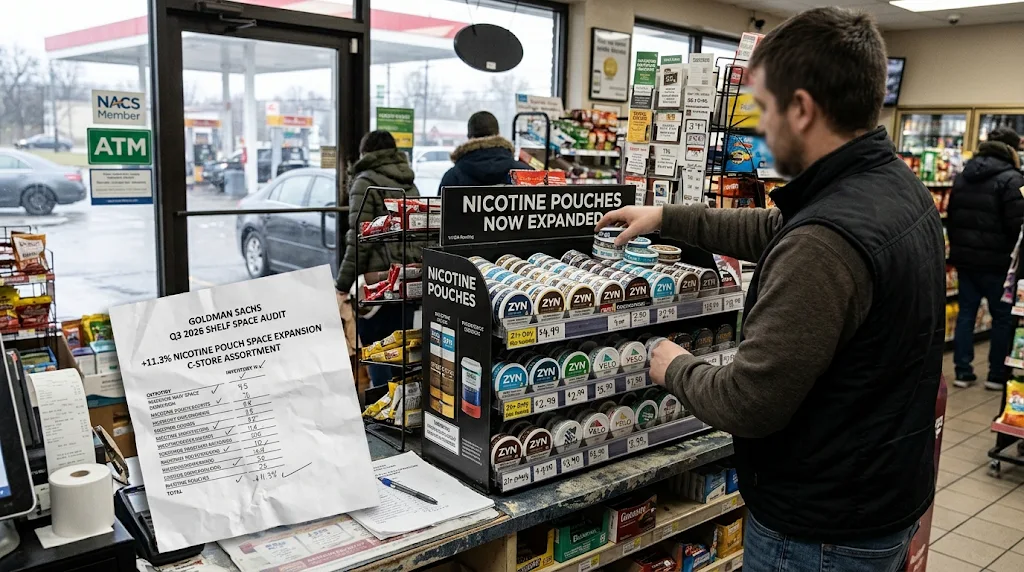
U.S. tobacco and nicotine retailers plan to allocate additional shelf space to nicotine pouches, with respondents in Goldman Sachs' third-quarter 2026 survey projecting an 11.3% increase for the category, the largest anticipated gain among major nicotine product segments.
According to a November 12 report by Convenience Store News, the latest Nicotine Nuggets survey, led by Goldman Sachs Managing Director Bonnie Herzog, gathered feedback from retailers and wholesalers representing approximately 40,000 U.S. retail locations, or roughly 25% of tobacco outlets nationwide.
Respondents reported relatively strong third-quarter growth for ZYN, owned by Philip Morris International (PMI), and VELO, owned by British American Tobacco (BAT). Growth for Altria Group's on! was more moderate.
Meanwhile, approximately 80% of respondents said deep-discount cigarettes had gained share. Convenience store operators are also reviewing tobacco and nicotine assortments in response to nicotine pouch growth, vaping regulations and changing cigarette purchasing patterns.
Goldman Survey Projects 11.3% Pouch Shelf-Space Growth as Discount Cigarettes Gain Share
Goldman Sachs' third-quarter survey found that retailers expect to add shelf space for nicotine products during 2026, with nicotine pouches receiving the most additional space, at a projected increase of 11.3%.
The figure represents respondents' expectations rather than a measured expansion already completed across U.S. stores.
About 80% of respondents said deep-discount cigarettes gained share in the third quarter, compared with approximately 75% in the second quarter.
Another 55% reported that tobacco manufacturers had less pricing power than a year earlier, down from 63% of respondents expressing the same view in Q2.
The survey found that year-on-year cigarette volume declines stabilized in the third quarter, although consumers continued to trade down from premium cigarettes to lower-priced products, while some were purchasing alternatives such as nicotine pouches and e-cigarettes.
Consumer spending conditions remained challenging. Sixty-nine percent of respondents said the financial condition of adult tobacco and nicotine consumers was stable or had improved over recent months, compared with 77% in Q2.
Respondents also reported weaker sequential convenience store traffic, although average basket sizes improved. Elevated gasoline prices and inflation continued to influence purchasing behavior among more price-sensitive consumers.
The projected expansion in nicotine pouch shelf space comes alongside changing cigarette purchasing patterns and retailers' expectations for alternative nicotine categories.
Convenience Stores Account for 92.9% of U.S. OTP Sales as Regional Chains Reallocate Backbars
Convenience stores remain a central distribution channel for tobacco and nicotine products in the United States.
According to NielsenIQ (NIQ) data provided to 2Firsts by the National Association of Convenience Stores (NACS), the convenience channel accounted for 92.9% of U.S. other tobacco product (OTP) sales and 82.9% of cigarette sales in 2025.
NACS defines OTP broadly to include traditional smokeless tobacco, cigars, vaping products, nicotine pouches and other categories. Nicotine pouches fall within its smokeless tobacco alternatives subcategory.
In an interview published by 2Firsts in October 2026, NACS Managing Director of Research Chris Rapanick said nicotine shoppers tend to visit convenience stores frequently and that merchandising space for alternative nicotine products has expanded.
NACS' CSX Convenience Benchmarking Database put gross margin at 14.86% for cigarettes and 29.85% for OTP. The latter figure covers several product categories and is not specific to nicotine pouches.
Some regional convenience store chains have already adjusted their backbar space and product assortments.
Gas N Wash, which operates 38 stores in Illinois, said vape sales were declining while nicotine pouches had become a growth category. The chain has been allocating additional space to pouches and upgrading older fixtures at selected stores.
Aman Sahi, the company's director of retail strategies, said retailers need to monitor unit sales rather than relying solely on revenue, which may be supported by price increases or manufacturer funding even when volumes decline.
InConvenience Inc., which operates 29 stores across Iowa, Missouri, Arkansas and Texas, faces different vaping regulations across its markets.
Category Manager Stephanie Hutton told CStore Decisions that customers continued to seek flavored disposable vapes, but the company had to comply with applicable regulations. It therefore increased its focus on FDA-authorized vape products, including selected Vuse and NJOY products.
InConvenience has also been adjusting nicotine pouch brands, flavors and strengths in response to customer demand. Hutton said the introduction of a small selection of higher-strength nicotine pouches had been followed by approximately 1% sales growth over the preceding month.
The chain also plans to work with tobacco suppliers to reset backbar displays and has been providing staff with product education materials.
California-based convenience chain Rotten Robbie, which operates approximately 40 stores, reorganized its backbar into two-foot category sections to accommodate changes in supplier contracts and product assortments.
Reilly Musser, the chain's vice president of marketing and merchandising, said the revised layout had made store resets and contract-related merchandising adjustments more efficient.
The operators illustrate different aspects of retail inventory management: allocating more space to growing categories, managing compliance across state lines and improving the execution of supplier agreements.
ZYN, VELO and on! Compete for Retail Space as Tobacco Groups Report Different Results
Goldman Sachs' survey found that U.S. modern oral nicotine volumes continued to grow during the third quarter, with comparatively strong performance from ZYN and VELO and more moderate growth for on!.
Recent financial disclosures from the three major tobacco groups provide further context.
PMI reported third-quarter 2026 U.S. ZYN shipments of 3.2 billion pouches, up 4.2% year on year.
The company said it was expanding its ZYN portfolio through ULTRA, additional flavors and nicotine strength variants including 1.5 mg and 8 mg products.
PMI also plans to transition most of its U.S. flagship ZYN range from 15 to 20 pouches per can while increasing distribution and commercial investment. According to Nielsen data cited by PMI, ZYN gained more than one percentage point of category share between June and September.
BAT reported that revenue from its U.S. modern oral business rose 209% in the first half of 2026, equivalent to 220% growth at constant exchange rates, while volumes increased 188%.
The company attributed the growth to VELO Plus and Grizzly Modern Oral. Its U.S. modern oral volume share reached 29.8%, an increase of 11.6 percentage points from year-end 2025.
Altria reported third-quarter on! shipments of 47.8 million cans, up 13.3% year on year.
However, on!'s share of the U.S. nicotine pouch retail category was 13.5%, down 1.3 percentage points from a year earlier and 0.9 percentage points sequentially.
| Company and brand | Reported operating indicators | Period and scope |
|---|---|---|
| PMI / ZYN | U.S. shipments of 3.2 billion pouches, up 4.2%; company-reported category share gain of more than one percentage point between June and September | Q3 2026; ZYN |
| BAT / VELO Plus and Grizzly Modern Oral | U.S. modern oral revenue up 220% at constant rates, volumes up 188%; category volume share of 29.8% | H1 2026; modern oral portfolio |
| Altria / on! | Shipments of 47.8 million cans, up 13.3%; nicotine pouch retail category share of 13.5% | Q3 2026; on! |
The companies use different units, category definitions, reporting periods and share measurement methodologies. These figures are not directly comparable brand volume or market share rankings.
Competition also extends to product formats and assortment decisions.
PMI is expanding ZYN strength options and package configurations. BAT has been broadening its VELO portfolio and U.S. modern oral distribution, while Altria faces declining on! retail share despite shipment growth.
Retailers' decisions on shelf placement, product variants and supplier promotions will influence the brands' distribution through convenience stores.
Circana: Vape Device Units Decline 13.1% as Spitless Tobacco Rises 22.1%
Separate retail data from market research firm Circana show diverging performance across U.S. convenience store tobacco and nicotine categories.
According to Circana Total U.S. Convenience figures published in the October 2026 edition of CStore Decisions, electronic smoking device sales totaled $6.22 billion during the 52 weeks ended August 9, down 5.1% year on year.
Unit sales totaled 303 million, a decline of 13.1%.
Over the same period, the spitless tobacco category generated $7.53 billion in sales, up 24.7%, with unit sales of 1.16 billion, an increase of 22.1%.
| Product category | 52-week dollar sales | Dollar sales change | Unit sales change |
|---|---|---|---|
| Cigarettes | $50.8 billion | 0.0% | -5.0% |
| Electronic smoking devices | $6.22 billion | -5.1% | -13.1% |
| Spitless tobacco | $7.53 billion | +24.7% | +22.1% |
| Total smokeless tobacco | $13.6 billion | +11.6% | +8.2% |
Source: Circana Total U.S. Convenience data for the 52 weeks ended August 9, 2026. Spitless tobacco is Circana's retail classification, which includes products such as nicotine pouches but does not correspond precisely to all modern nicotine pouch sales. Some categories are nested and should not be added together.
Circana measures convenience store sales performance, while Goldman Sachs' survey reflects retailer and wholesaler assessments and expectations.
FDA Adds 24 VELO Authorizations as Retailers Expand Their Compliance Options
The U.S. Food and Drug Administration announced on October 30, 2026, that it had authorized the marketing of 24 VELO nicotine pouch products manufactured by BAT subsidiary Modoral Brands.
The authorizations cover the VELO Mini Pouch and VELO Mini Pouch 2 ranges. Each includes four product names offered in three packaging configurations, with all products labeled as containing 4 mg of nicotine.
The FDA said the decision brought the cumulative number of nicotine pouch products authorized for marketing in the United States to 67 as of that date.
With selected ZYN, on! and VELO products now holding FDA marketing authorization, retailers have a broader range of authorized nicotine pouch SKUs to consider.
Federal marketing authorization does not guarantee retail distribution or override applicable state and local sales requirements.
E-cigarette retailers must also comply with FDA marketing authorization requirements, state vapor product directories and local restrictions where applicable.
Feedback from multi-state operators such as InConvenience shows how assortment decisions are influenced by different state rules, customer demand and available backbar space.
Goldman Sachs' survey projects an 11.3% increase in nicotine pouch shelf space, while retailers including Gas N Wash and InConvenience have already reported specific merchandising adjustments.
The scale of the eventual expansion and the allocation of additional space among brands will depend on retailers' purchasing decisions, product eligibility and subsequent consumer sales.
Follow 2Firsts for developments in global tobacco and nicotine markets, retail distribution and industry competition.
Cover Image generated by AI