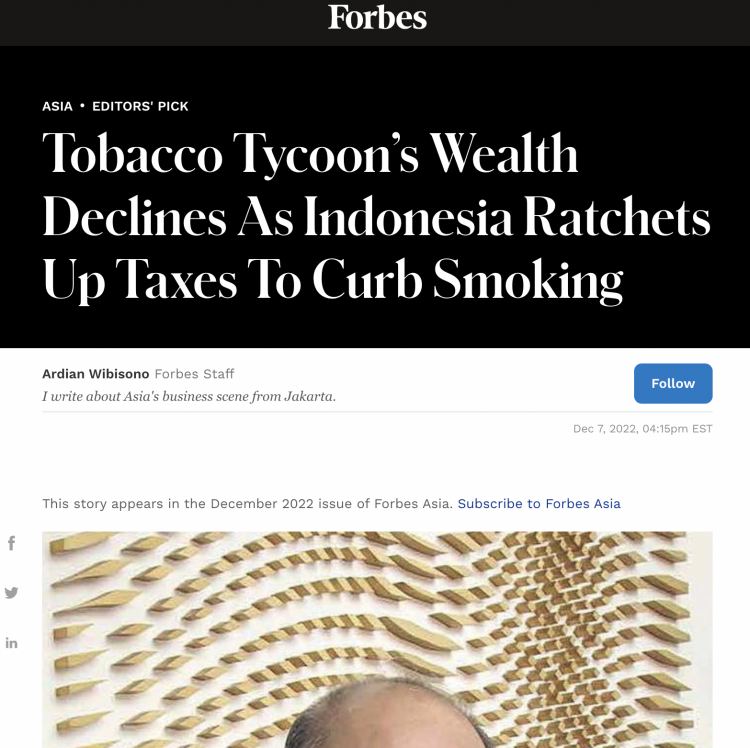
Susilo Wonowidjojo's wealth has further declined this year as the stock of his family's cigarette manufacturer Gudang Garam continues its three-year slump amid the Indonesian government's anti-smoking campaign. His net worth dropped by 27% to $3.5 billion, placing him at 14th on Indonesia's richest 50 list, down seven spots from last year.
Despite a slight improvement in sales during the first nine months of 2022, net profit has decreased by 64% year-on-year to 15 trillion Indonesian rupiahs (96 million US dollars), primarily due to the government's increase in tobacco consumption tax in January (following a 27% drop in revenue in 2021). Taxes make up over 85% of the company's total sales costs, resulting in a profit margin of 1.6%, down from 4.4% last year. Additionally, in November, Finance Minister Sri Mulyani Indrawati announced additional tax increases in 2023 and 2024. The company has stated its plans to raise prices.
In recent years, Indonesia has strengthened its measures to combat smoking, especially among young people. Approximately one quarter of the country's 276 million population smoke cigarettes. Overseas sales for Gudang Garam have also declined, dropping nearly 15% year-on-year in 2021 to 1.8 billion cigarettes. The company diversified its operations in 2019 with the construction of toll roads and is currently building the Dhoho airport in Kediri, East Java at a cost of 600 million dollars, which is expected to open in October of next year.
Gudang Garam was founded in 1958 by Susilo's father, Surya Wonowidjojo. Since 2009, Susilo has served as the CEO of the Kediri-based company, with his sister Juni Setiawati serving as the executive commissioner. In June, Susilo's son Indra was appointed as the Vice President Director.
2FIRSTS will continue to report on this issue, with further updates available on the "2FIRSTS APP". Scan the QR code below to download the app.
Disclaimer
This article is provided solely for professional research, industry discussion, and informational purposes. Any references to brands, companies, products, technologies, or policies are made for factual reporting and analytical purposes only, and do not constitute endorsement, recommendation, promotion, or advertising by 2Firsts.
Nicotine-containing products, including but not limited to cigarettes, e-cigarettes, heated tobacco products, and nicotine pouches, carry significant health risks. Readers are responsible for complying with all applicable laws and regulations in their respective jurisdictions, including age restrictions and access limitations.
The information contained in this article should not be regarded as investment, legal, medical, regulatory, or commercial advice. While 2Firsts strives to ensure the accuracy and reliability of its content, it does not assume liability for any direct or indirect loss arising from errors, omissions, inaccuracies, or reliance on the information contained herein.
This article is not intended for individuals below the legal age for accessing tobacco or nicotine-related information in their jurisdiction.
Copyright Notice
This article is either original content produced by 2Firsts or content reproduced, translated, summarized, or adapted from third-party sources with attribution where applicable. The intellectual property rights of the original content remain with 2Firsts or the respective original rights holders.
No individual or organization may copy, reproduce, distribute, republish, modify, translate, or otherwise use this content without prior authorization. Any unauthorized use may result in legal action.
For copyright-related inquiries, corrections, or removal requests, please contact: info@2firsts.com.
AI-Assisted Translation and Editing Notice
Portions of this article may have been translated, edited, or reviewed with the assistance of artificial intelligence tools to improve efficiency and readability. Due to the limitations of AI-assisted translation and editing, discrepancies, omissions, or inaccuracies may exist when compared with the original source.
Where applicable, readers are advised to refer to the original source for the most complete and accurate information. If you identify any errors or believe that any content infringes upon your rights, please contact us at info@2firsts.com, and we will review and address the matter promptly.