Key Points
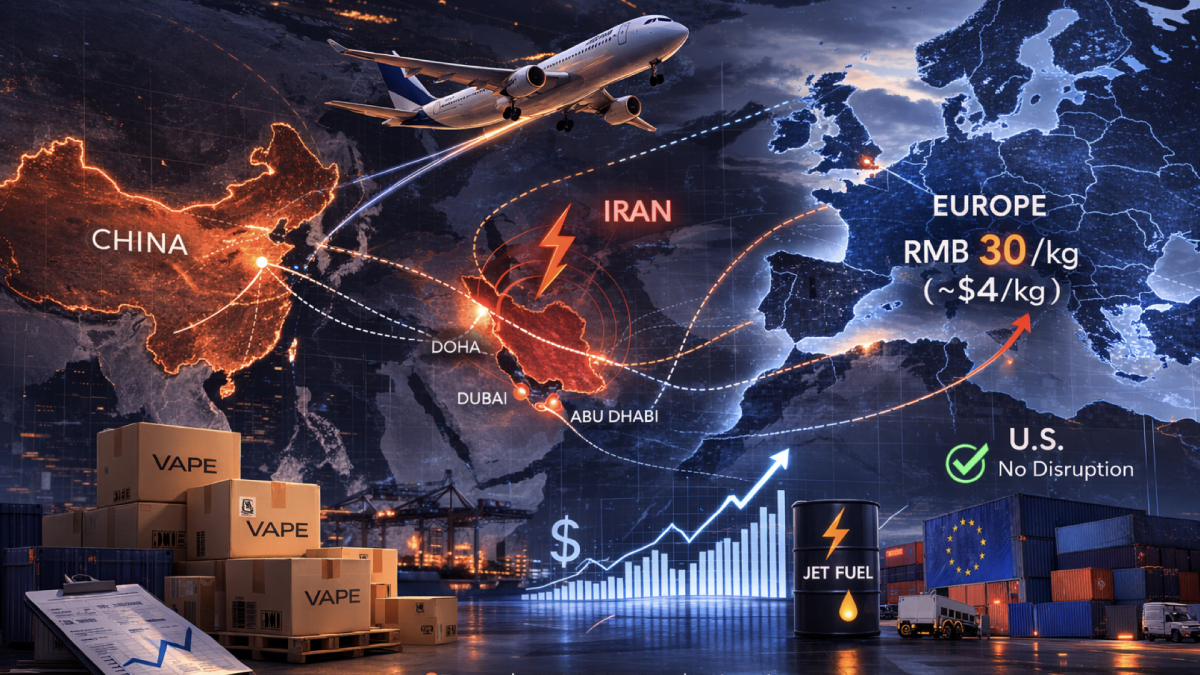
- 30%–40% of China-Europe vape air cargo relies on Middle East transit hubs.
- Europe-bound freight rates remain around RMB 30 per kg (about $4 per kg) instead of falling seasonally.
- U.S.-bound shipments have not seen material disruption so far.
- Direct flights operated by Chinese carriers remain relatively stable.
- Rising oil prices could transmit cost pressure across global routes.
- Sea freight remains commercially impractical due to extended transit times.
2Firsts, March 02, 2026, Shenzhen
As military hostilities escalate across the Middle East — including U.S.-Israel operations and Iranian retaliatory strikes — disruptions at key aviation hubs are rippling through global air cargo networks. For Chinese vape exporters, this regional volatility has effectively severed the "Silk Road of the Skies," preventing the usual post-Lunar New Year decline in freight rates and creating a stark divide between European and American supply chains.
According to logistics specialist Mr. L, roughly 30% to 40% of air cargo capacity for vape shipments from China to Europe depends on transit hubs in Doha, Dubai and Abu Dhabi.
As tensions surrounding Iran intensify, airlines including Qatar Airways (QR), Emirates (EK) and Etihad Airways (EY) face operational uncertainties that could affect transit stability and scheduling reliability.
By contrast, shipments from China to the United States, which rely less on Middle East stopovers, have not experienced material disruption so far, according to industry sources.
Direct charter services operated by Chinese carriers that avoid Middle Eastern transit points have also remained comparatively stable, Mr. L said.
Seasonal Decline in Europe Fails to Appear
In most years, freight rates on China-Europe routes drop sharply after the Lunar New Year, often falling into single-digit renminbi per kilogram.
This year, however, Europe-bound rates have held at about RMB 30 per kilogram (roughly $4 per kilogram), largely unchanged from pre-holiday levels.
“The absence of seasonal decline effectively amounts to a price increase,” Mr. L said.
Another logistics professional, Mr. J, noted that shipment volumes were subdued during the first week after the holiday but have begun recovering in the second week.
Future rate movements on Europe routes will depend on cargo volume support, he said:
- If exporters resume normal shipment volumes at around RMB 30 per kg, rates may hold.
- If volumes remain soft, downward price adjustments could follow.
Fuel Risk Could Broaden Impact
Mr. J also warned that continued instability involving Iran could lift global oil prices over the next one to two months.
Higher jet fuel costs would raise airlines’ operating expenses and could be passed on through fuel surcharges. In that scenario, even routes not transiting the Middle East—including U.S.-bound shipments—could face indirect cost pressure.
“At this stage, the disruption is concentrated on Europe-bound routes, but fuel-driven cost transmission could widen the impact,” he said.
Limited Alternatives
Vape products typically depend on air transport due to leakage risks and product stability concerns.
Meanwhile, disruptions in the Red Sea have reduced the reliability of the Suez Canal corridor. Rerouting vessels around the Cape of Good Hope could extend Europe-bound transit times to roughly 70 days.
Under such conditions, sea freight remains commercially impractical for most exporters, reinforcing reliance on air cargo despite rising volatility.
(Cover image generated by AI)
For the latest developments in the global vape industry, follow 2Firsts.
Disclaimer
This article is provided solely for professional research, industry discussion, and informational purposes. Any references to brands, companies, products, technologies, or policies are made for factual reporting and analytical purposes only, and do not constitute endorsement, recommendation, promotion, or advertising by 2Firsts.
Nicotine-containing products, including but not limited to cigarettes, e-cigarettes, heated tobacco products, and nicotine pouches, carry significant health risks. Readers are responsible for complying with all applicable laws and regulations in their respective jurisdictions, including age restrictions and access limitations.
The information contained in this article should not be regarded as investment, legal, medical, regulatory, or commercial advice. While 2Firsts strives to ensure the accuracy and reliability of its content, it does not assume liability for any direct or indirect loss arising from errors, omissions, inaccuracies, or reliance on the information contained herein.
This article is not intended for individuals below the legal age for accessing tobacco or nicotine-related information in their jurisdiction.
Copyright Notice
This article is either original content produced by 2Firsts or content reproduced, translated, summarized, or adapted from third-party sources with attribution where applicable. The intellectual property rights of the original content remain with 2Firsts or the respective original rights holders.
No individual or organization may copy, reproduce, distribute, republish, modify, translate, or otherwise use this content without prior authorization. Any unauthorized use may result in legal action.
For copyright-related inquiries, corrections, or removal requests, please contact: info@2firsts.com.
AI-Assisted Translation and Editing Notice
Portions of this article may have been translated, edited, or reviewed with the assistance of artificial intelligence tools to improve efficiency and readability. Due to the limitations of AI-assisted translation and editing, discrepancies, omissions, or inaccuracies may exist when compared with the original source.
Where applicable, readers are advised to refer to the original source for the most complete and accurate information. If you identify any errors or believe that any content infringes upon your rights, please contact us at info@2firsts.com, and we will review and address the matter promptly.