Key Points
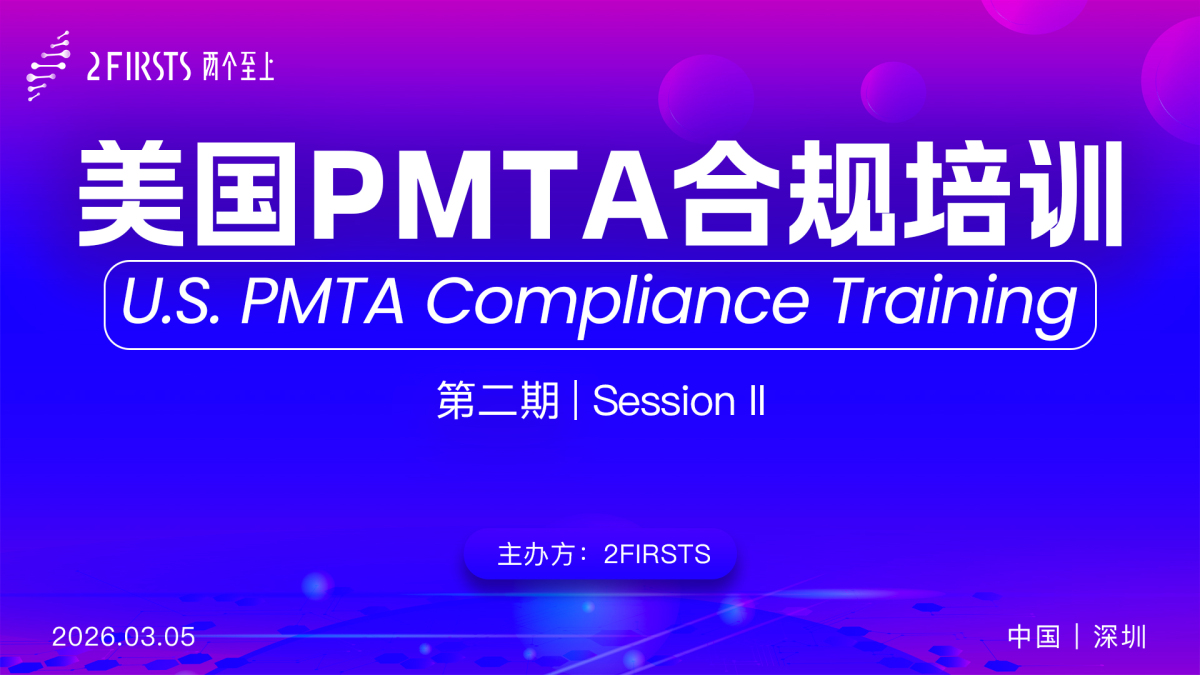
1. Training Event: 2Firsts held its second U.S. PMTA compliance training in Shenzhen, attracting nearly 20 professionals from vape manufacturing, e-liquid and supply-chain companies.
2. Program Content: The course provided a structured overview of the U.S. regulatory framework and PMTA pathway, followed by an exam through which qualified participants received certification.
3. Program Strengths: The training draws on four core advantages—industry intelligence, regulatory expertise, project experience and global resources—to support companies navigating the PMTA process.
4. Next Steps: 2Firsts said registration for the third PMTA training session will open soon, alongside customized in-house corporate training programs.
2Firsts
Shenzhen, March 9, 2026
On March 5, 2026, 2Firsts held its second U.S. PMTA (Pre-Market Tobacco Product Application) compliance training session in Shenzhen. The program was led by 2Firsts compliance experts Echo Guo and Kurt Yang and focused on the U.S. regulatory framework for electronic cigarettes, the PMTA application process, and corporate compliance strategies.
Nearly 20 industry professionals attended the program, including representatives from e-cigarette brands, manufacturers, e-liquid companies and related supply-chain businesses. Representatives from several leading industry companies were also present.
The training followed the inaugural session held in July 2025. China remains the world’s largest manufacturing base for vaping products, and interest among Chinese companies in the U.S. regulatory framework continues to grow. The United States is widely regarded as one of the most tightly regulated markets for next-generation nicotine products, and PMTA has become a critical compliance gateway for companies seeking to enter or expand in the U.S. market.

Growing Regulatory Complexity Drives Demand for Structured Learning
PMTA is a core regulatory pathway established under the U.S. Tobacco Control Act. It requires manufacturers to submit extensive scientific evidence, product information, behavioral research and public health analysis before products can be marketed in the United States.
Applicants must demonstrate that their products meet the standard of “Appropriate for the Protection of Public Health” (APPH).
Because PMTA involves scientific evaluation, regulatory policy considerations and behavioral impact assessments, the framework has long been viewed as one of the most technically demanding regulatory systems in the global nicotine industry.
Industry observers note that knowledge related to PMTA has historically been concentrated among a relatively small group of specialized institutions and large companies. Structured learning opportunities for the broader industry have been limited, leaving many companies to rely on fragmented information when attempting to understand the regulatory process.
Questions raised by participants during the training reflected how industry priorities are evolving. In earlier stages, companies often focused on basic issues such as the cost and timeline of PMTA applications. Participants in the latest session raised more complex compliance questions, including:
● Differences between federal and state-level regulations in the United States
● Age-verification technologies and youth protection measures
● The role of supply-chain partners within the PMTA framework
● Long-term regulatory strategies for operating in the U.S. market
Some companies also raised broader strategic considerations, including whether operational infrastructure in the United States may influence regulatory strategy or market positioning. These discussions suggest that many companies are moving beyond introductory learning and entering a deeper stage of regulatory and market strategy planning.
Training Combines Regulatory Framework, Case Studies and Compliance Tools
The training program focused on the structural components of the PMTA regulatory framework. Key modules included:
● The U.S. regulatory system for next-generation tobacco products and the PMTA framework
● State-level regulatory developments affecting vaping products
● Structural analysis of successful PMTA cases
● The role of Tobacco Product Master Files (TPMF) and related compliance documentation used in PMTA submissions
● Age-verification mechanisms and youth protection compliance tools
Through regulatory interpretation and case analysis, the course aimed to help participating companies build a comprehensive understanding of the PMTA system and the practical challenges companies may encounter during compliance preparation.
At the conclusion of the training, participants completed an examination. Those who passed the assessment received the “2Firsts Global Next-Generation Product Compliance Certification (U.S. Edition)”, designed to evaluate participants’ foundational understanding of the U.S. regulatory framework and PMTA system.
Diverse Participants: Corporate Teams and Individual Professionals
Participants represented a range of professional backgrounds. Some attended as part of company delegations, including compliance personnel, product managers and market strategy staff. In several cases, companies sent teams that included U.S. market leads, product managers and compliance specialists.
Other participants joined the program as individuals seeking to deepen their professional knowledge of U.S. regulatory policy. Some indicated that they hope to expand their career opportunities in areas such as compliance management, international market operations or regulatory research.
This mix of participants reflects growing demand for regulatory expertise within the industry. As global regulation of next-generation nicotine products continues to evolve, compliance capabilities are increasingly becoming an important competitive factor for companies operating internationally.
Promoting Broader Access to Regulatory Knowledge
2Firsts has long focused on global tobacco regulation and industry developments through its news coverage and professional compliance services. According to the organization, one objective of launching the PMTA training program is to broaden access to regulatory knowledge and help more companies and professionals systematically understand complex regulatory frameworks.
Because PMTA expertise has traditionally been concentrated among a limited number of institutions and large corporations, smaller companies often face barriers when attempting to understand the regulatory system. Through training programs, industry dialogue and ongoing information updates, 2Firsts aims to help companies move from fragmented information toward a more structured understanding of U.S. regulatory processes.
Four Key Strengths of the Training Program
According to 2Firsts, the PMTA training program is built on four core strengths:
Information Advantage
The program draws on 2Firsts’ ongoing global coverage of tobacco regulation and market developments to provide up-to-date policy and industry insights.
Professional Knowledge
Course content is based on long-term research and analysis of the PMTA regulatory framework and the broader FDA compliance system.
Practical Experience
The program is delivered by compliance specialists with project experience, incorporating case discussions and practical regulatory considerations.
Global Resource Network
2Firsts maintains ongoing cooperation with compliance consultancies, testing laboratories, technical solution providers and industry experts. The organization also acts as a connector between China’s manufacturing supply chain and global compliance resources.
Building a Continuous Learning Framework
During the training, participants also asked how companies can continue tracking the evolving U.S. regulatory landscape.
Organizers suggested that companies regularly monitor updates from the FDA website, regulatory announcements and developments among major industry participants. Continuous monitoring and analysis of regulatory information can help companies stay informed about policy changes.
Some participating companies also expressed interest in customized in-house training programs that could be tailored to their specific business structures and compliance needs.
Next Training Session
2Firsts announced that registration for the third PMTA compliance training session will open soon. The organization will also accept applications for customized corporate training programs.
For further information, please contact:
info@2firsts.com