New Method for Creating Cocaine-Like Compounds from Plants

Dec.05.2022
New Method for Creating Cocaine-Like Compounds from Plants
Scientists replicate coca plant's complex biochemical pathway to produce potential study drugs. Follow-up on 2FIRSTS APP.

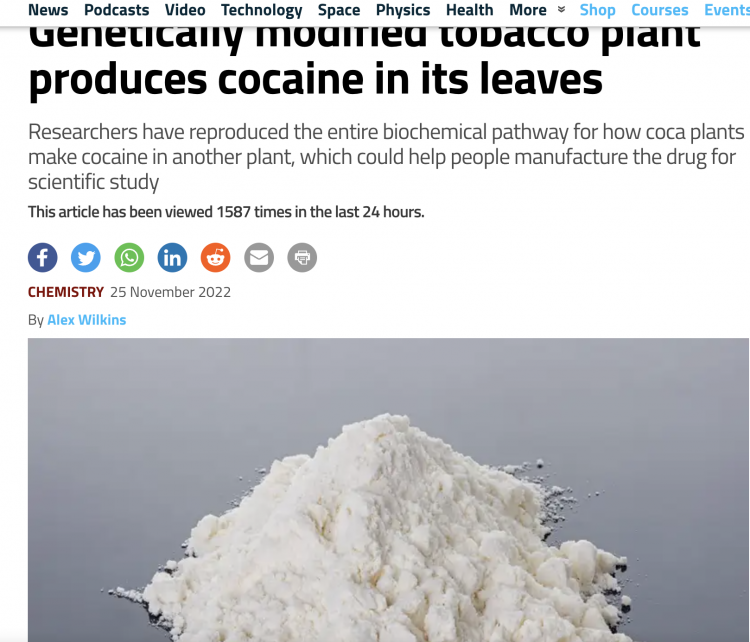
The complex biochemistry of the coca plant that produces cocaine has been extracted and replicated in a close relative of the tobacco plant. Modifying other plants or microorganisms to recreate this process may lead to a method of manufacturing a stimulant or producing chemically similar compounds with unique properties.


Researchers have replicated the entire biochemical pathway of how the coca plant produces cocaine in another plant, which could aid in the production of drugs for scientific research.


2FIRSTS will continue to cover this topic and updates will be available on the '2FIRSTSAPP'. Scan the QR code below to download the app.


Disclaimer

This article is provided solely for professional research, industry discussion, and informational purposes. Any references to brands, companies, products, technologies, or policies are made for factual reporting and analytical purposes only, and do not constitute endorsement, recommendation, promotion, or advertising by 2Firsts.

Nicotine-containing products, including but not limited to cigarettes, e-cigarettes, heated tobacco products, and nicotine pouches, carry significant health risks. Readers are responsible for complying with all applicable laws and regulations in their respective jurisdictions, including age restrictions and access limitations.

The information contained in this article should not be regarded as investment, legal, medical, regulatory, or commercial advice. While 2Firsts strives to ensure the accuracy and reliability of its content, it does not assume liability for any direct or indirect loss arising from errors, omissions, inaccuracies, or reliance on the information contained herein.

This article is not intended for individuals below the legal age for accessing tobacco or nicotine-related information in their jurisdiction.


Copyright Notice

This article is either original content produced by 2Firsts or content reproduced, translated, summarized, or adapted from third-party sources with attribution where applicable. The intellectual property rights of the original content remain with 2Firsts or the respective original rights holders.

No individual or organization may copy, reproduce, distribute, republish, modify, translate, or otherwise use this content without prior authorization. Any unauthorized use may result in legal action.

For copyright-related inquiries, corrections, or removal requests, please contact: info@2firsts.com.


AI-Assisted Translation and Editing Notice

Portions of this article may have been translated, edited, or reviewed with the assistance of artificial intelligence tools to improve efficiency and readability. Due to the limitations of AI-assisted translation and editing, discrepancies, omissions, or inaccuracies may exist when compared with the original source.

Where applicable, readers are advised to refer to the original source for the most complete and accurate information. If you identify any errors or believe that any content infringes upon your rights, please contact us at info@2firsts.com, and we will review and address the matter promptly.


JAMA Issues First U.S. Clinical Guidance on Vaping for Smoking Cessation, Urging Complete Switch From Cigarettes
JAMA has published a Special Communication offering systematic recommendations for U.S.-based clinicians on the use of nicotine e-cigarettes in adult smoking cessation. Developed by the Harm Reduction Workgroup of the Society for Research on Nicotine and Tobacco’s Treatment Research Network, the paper recommends including e-cigarettes alongside FDA-approved cessation medications in risk-benefit discussions. It cites high-certainty evidence that nicotine e-cigarettes achieve higher quit rates than nicotine replacement therapy and evidence suggesting efficacy comparable to highly effective medications such as varenicline and cytisine. For adults who choose vaping to quit, the authors recommend FDA-authorized products, sufficient nicotine delivery and a rapid, complete transition away from cigarettes rather than prolonged dual use.
Aug.13
Research | Swedish Study Finds Oral Lesions in 79% of Examined Nicotine Pouch Users, With Distinct Tissue Responses
A new Swedish study found oral mucosal lesions in 79% of examined nicotine pouch users and 89% of tobacco-derived snus users, with different tissue-response patterns between the two categories. For manufacturers and regulators, the findings shift attention toward product formulation, flavouring, pouch materials and local oral exposure, not only whether a product contains tobacco. The study found no higher prevalence of caries or periodontal disease, but it could not establish causality, long-term outcomes or differences between individual products or designs.
Special Report
Jul.27
Scottish Vape Display Rules Could Cost Businesses £61 Million, Affecting More Than 11,000 Retail Outlets
A Scottish government impact assessment estimates that proposed vape display and packaging rules could create up to £61 million ($82 million) in compliance costs for businesses, affecting more than 11,000 retail outlets. The estimated costs are mainly linked to inventory adjustments, retail storage changes and the resources required for businesses to understand and implement the new requirements. The measures form part of the UK’s broader efforts to tighten vape regulation, particularly around product displays, packaging and sales practices.
Aug.10
Product | VEEV One Plus Goes Official as PMI Strengthens Its Closed-Pod Vaping Portfolio
Philip Morris International (PMI) has officially introduced the VEEV One Plus, the next-generation device in its closed-pod vaping lineup. The product is now featured on the official VEEV website in Portugal, bringing hardware upgrades including a new dual-pod storage system, a larger battery, and an updated device design while maintaining compatibility with existing VEEV One pods.
Jul.02
Product | Summo 150K Introduces Refillable Design With Up to 150,000 Puffs, Exploring a New High-Capacity Vape Format
Summo has introduced the Summo 150K Refillable Disposable Vape, entering the ultra-high-puff vape segment with a claimed capacity of up to 150,000 puffs. The device combines a 40ml dual e-liquid system, transparent tank design, dual mesh coils and a 900mAh rechargeable battery, using a refillable structure to differentiate itself from conventional disposable vapes. The product appeared on overseas online retail channels including Vapesourcing and VapeBarTime between late June and early July 2026.
Jul.22
UK PM Andy Burnham Shifts Business Rates Policy, Supporting Hospitality While Raising Pressure on Vape Shops
UK Prime Minister Andy Burnham’s government is adjusting business rates policy to support hospitality businesses while some other sectors, including vape retailers, face higher operating cost pressures. According to Streamline Feed, AJ Bell and other reports, the policy shift reflects a redistribution of business rate burdens as the government seeks to support sectors facing economic pressure. For UK vape shops, the change comes amid a broader regulatory environment shaped by the disposable vape ban, the upcoming Vaping Products Duty and increased compliance requirements.
News
Jul.24